Introduction to Artificial Intelligence
Introduction to Artificial Intelligence
What is Artificial Intelligence?
Artificial intelligence is about making machines smart. The goal is to create computer systems that can perform tasks that normally require human intelligence. This includes things like learning from experience, solving problems, understanding language, and recognizing objects in an image.
Artificial Intelligence
noun
The theory and development of computer systems able to perform tasks that normally require human intelligence, such as visual perception, speech recognition, decision-making, and translation between languages.
Think of it like teaching a computer. At first, it knows nothing. You provide it with information and rules, and it starts to recognize patterns. The more data it gets, the better it becomes at its task. It's not about creating a robot with human emotions, but about building tools that can reason and adapt.
AI enables machines to learn from data, identify patterns, and make decisions with minimal human intervention.
The Early Dreams of AI
The idea of intelligent machines isn't new. For centuries, myths and stories have featured artificial beings with minds of their own. But the scientific journey began in the mid-20th century, alongside the invention of the first electronic computers.
A key figure was Alan Turing, a British mathematician who imagined machines that could think. In 1950, he proposed a simple test to see if a machine could exhibit intelligent behavior indistinguishable from that of a human. It's called the Turing Test, and it's still a famous benchmark in AI.
The field officially got its name in the summer of 1956. A group of researchers, including John McCarthy, Marvin Minsky, and Claude Shannon, gathered for a workshop at Dartmouth College. They wanted to explore the idea that "every aspect of learning or any other feature of intelligence can in principle be so precisely described that a machine can be made to simulate it."
1956: Dartmouth Conference: Official birth of AI as a field of study, coining the term “Artificial Intelligence.”
This event marked the formal beginning of AI research. It sparked a wave of optimism and funding, leading to the creation of the first AI programs.
Waves of Progress and Setbacks
The history of AI isn't a straight line of progress. It's more like a series of waves, with periods of great excitement followed by times of disappointment and reduced funding, often called "AI winters."
The first wave, from the 1950s to the 1970s, focused on solving logic puzzles and proving mathematical theorems. Early programs could play checkers and translate simple sentences. But researchers soon hit a wall. The computers of the time weren't powerful enough, and the problems they were trying to solve were more complex than they realized.
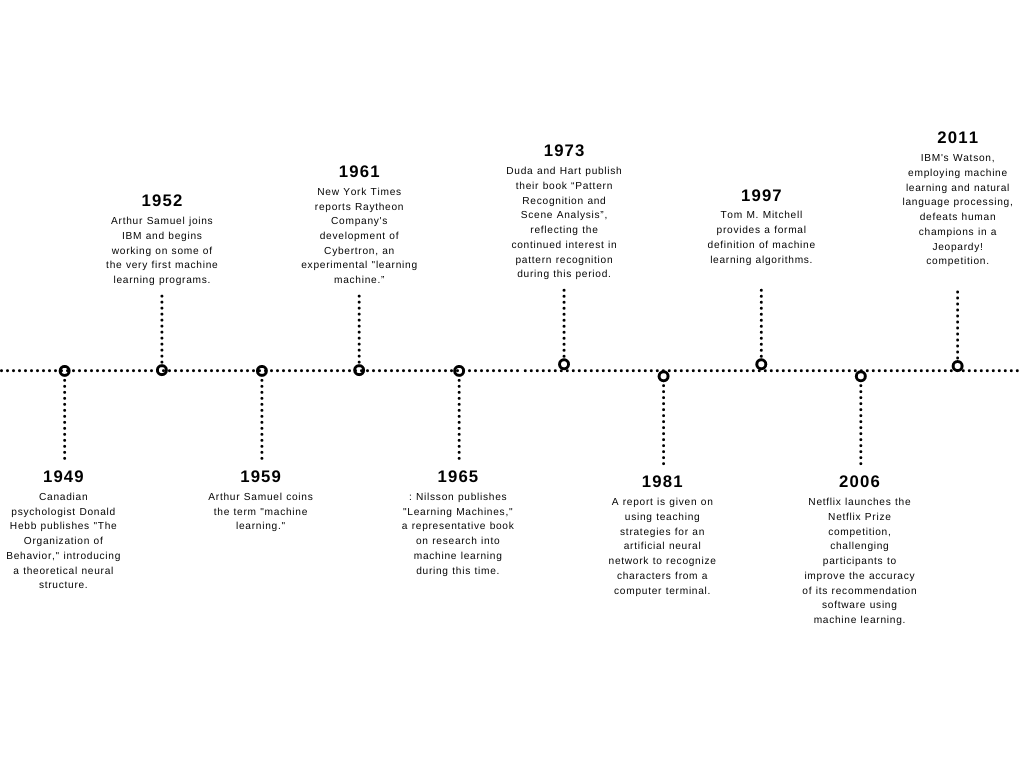
The 1980s brought a second wave with the rise of "expert systems." These were programs designed to mimic the decision-making ability of a human expert in a specific field, like medicine or finance. They were commercially successful for a time but were expensive to build and difficult to maintain. When the hype outpaced reality, another AI winter began.
Then came the modern era, starting in the late 1990s and exploding in the 2010s. Two key factors changed everything: the availability of massive amounts of data (the internet) and the development of much more powerful computers.
This combination of big data and powerful hardware allowed a subfield of AI called machine learning to flourish, leading to the breakthroughs we see today.
Instead of programming explicit rules, developers could now create systems that learned patterns directly from data. This led to dramatic improvements in areas like computer vision and natural language processing. The evolution from simple rule-based systems to complex learning models marks the biggest shift in AI's history.
Now let's check your understanding of these foundational ideas.
What is the primary goal of Artificial Intelligence?
The term "Artificial Intelligence" was officially coined at a summer workshop held at which institution?
Understanding where AI came from helps us see where it might be going. From its philosophical roots to its modern-day applications, the journey of AI is a story of human curiosity and technological innovation.