Introduction to Artificial Intelligence
Introduction to AI
What Is Artificial Intelligence?
Artificial intelligence is the science of making machines smart. The goal is to create systems that can perform tasks that typically require human intelligence, like learning, reasoning, and problem-solving. Instead of being programmed for every single possibility, an AI is designed to adapt and think on its own.
Artificial Intelligence
noun
A field of computer science dedicated to creating systems capable of performing tasks that normally require human intelligence. This includes learning, reasoning, problem-solving, perception, and language understanding.
At its core, AI aims to replicate or simulate human intelligence in machines. The objectives are broad, covering everything from understanding a spoken sentence to driving a car. These goals break down into specific abilities like:
- Reasoning and Problem-Solving: Looking at a problem and figuring out a logical solution.
- Knowledge Representation: Storing what it knows or learns in a way that's useful.
- Learning: Improving its performance over time by analyzing data and experience.
- Perception: Understanding the world through senses like sight (vision) and sound (speech).
A Quick Trip Through Time
The idea of intelligent machines has been around for centuries, but the formal field of AI research began in the mid-20th century. It's been a journey of exciting breakthroughs and periods of slower progress, often called "AI winters."
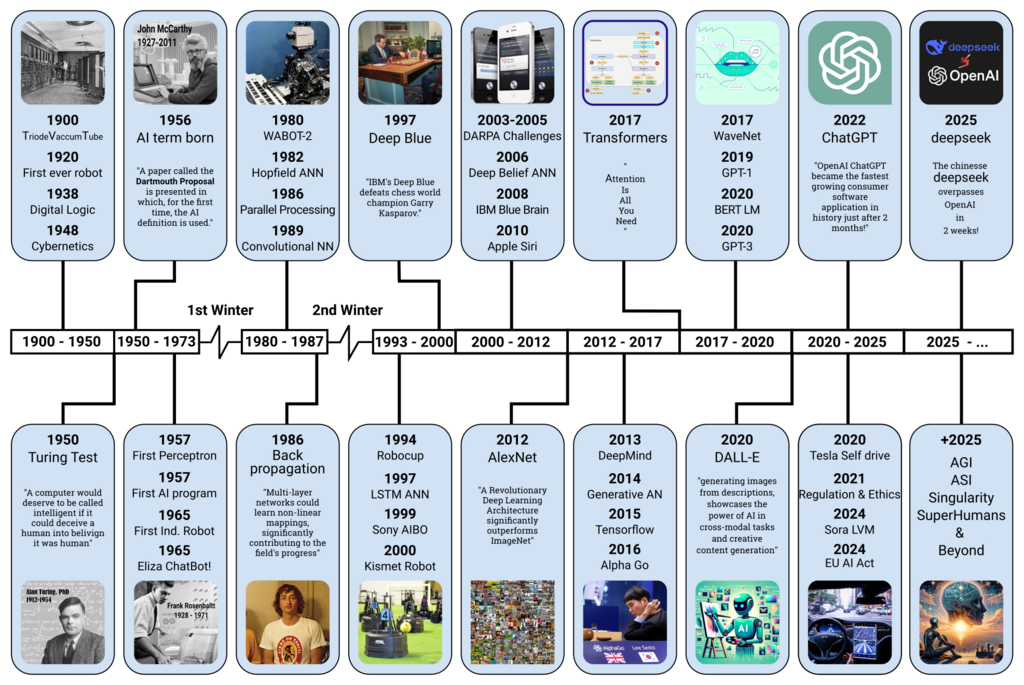
The term "artificial intelligence" itself was coined in 1956 at a workshop at Dartmouth College. This event brought together the founding fathers of the field and set the agenda for AI research for years to come. Since then, we've seen a few pivotal moments.
| Year | Milestone |
|---|---|
| 1950 | Alan Turing proposes the "Turing Test" to determine if a machine can exhibit intelligent behavior indistinguishable from a human. |
| 1956 | The Dartmouth Workshop is held, officially establishing AI as a research discipline. |
| 1997 | IBM's Deep Blue chess computer defeats world champion Garry Kasparov, a major symbolic victory for AI. |
| 2010s | The rise of "deep learning" and powerful computers leads to rapid advances in image and speech recognition. |
| 2022 | The release of ChatGPT brings generative AI into the mainstream, showing its power to create human-like text. |
The Branches of AI
AI isn't just one thing; it's a broad field with many specialized areas. Think of it like medicine, which has cardiologists, dermatologists, and neurologists. In AI, these specializations are called subfields.
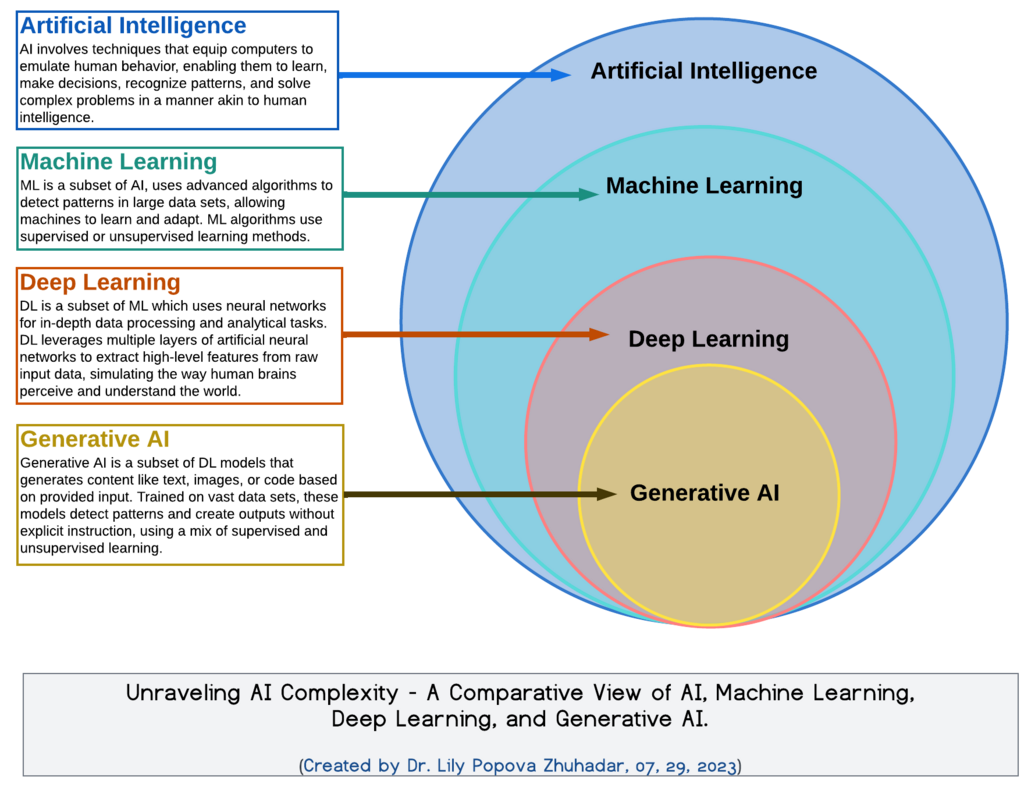
Let's look at a few of the most important ones.
Machine Learning (ML) is the most common type of AI today. It’s the science of getting computers to learn and improve from experience without being explicitly programmed. Instead of writing rules by hand, developers feed the system huge amounts of data and let it learn the patterns itself.
Natural Language Processing (NLP) focuses on the interaction between computers and human language. The goal is to enable machines to read, understand, interpret, and generate human languages. Every time you use a voice assistant or a translation app, you're using NLP.
Computer Vision is the subfield that works to give computers the power of sight. It involves training machines to interpret and understand the visual world. Using digital images from cameras and videos, computer vision systems can identify and classify objects, and then react to what they "see."
These subfields often overlap. For example, a self-driving car uses computer vision to see pedestrians and machine learning to predict their behavior. Together, these branches are pushing the boundaries of what machines can do.
What is the primary goal of Artificial Intelligence?
Which AI subfield is most directly responsible for allowing a machine to understand and interpret human language?