Introduction to Artificial Intelligence
Introduction to Artificial Intelligence
What Is Artificial Intelligence?
Artificial intelligence, or AI, is about creating machines that can think, learn, and solve problems like humans do. The main goal is to build systems that can perform tasks that would normally require human intelligence. This includes things like recognizing speech, making decisions, and understanding language.
Artificial Intelligence
noun
The theory and development of computer systems able to perform tasks that normally require human intelligence, such as visual perception, speech recognition, decision-making, and translation between languages.
Think about how you learn. You see examples, you practice, and you get better over time. AI systems do something similar. They are designed to perceive their environment, reason about what they perceive, and take actions to achieve specific goals. From playing a complex game of chess to helping doctors diagnose diseases, the objectives of AI are broad and increasingly integrated into our daily lives.
A Brief History of AI
The idea of intelligent machines has been around for centuries, but the modern field of AI research began in the mid-20th century. A key moment was the Dartmouth Workshop in 1956, where the term "artificial intelligence" was first coined. This gathering brought together pioneers who were optimistic about creating thinking machines in just a few years.
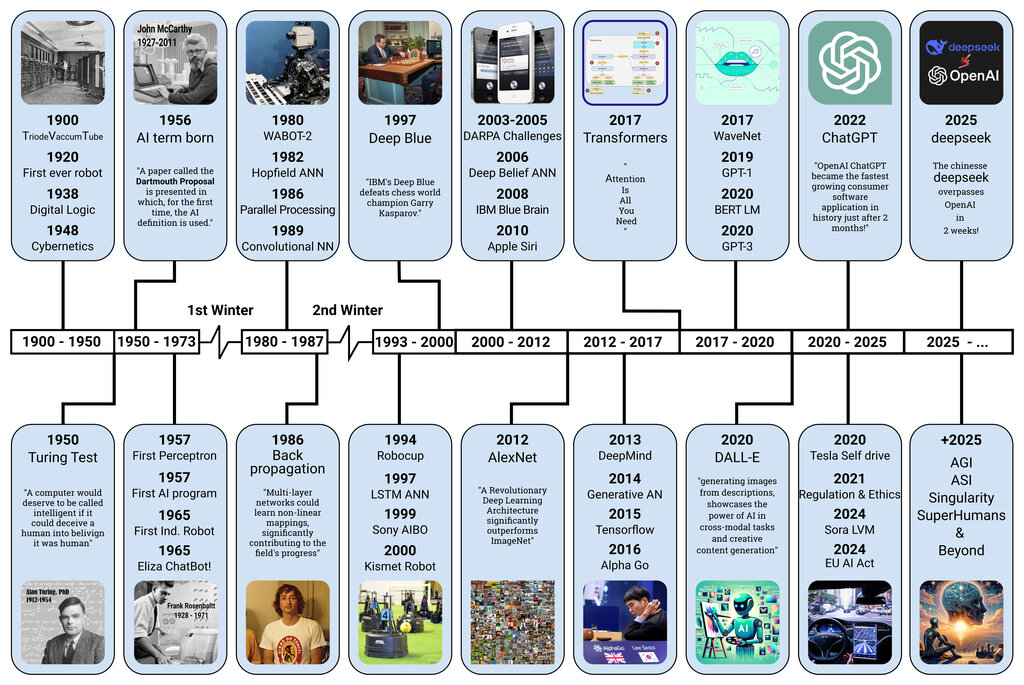
The journey wasn't a straight line. The field experienced periods of great excitement and funding, followed by "AI winters" where progress slowed and interest faded. However, recent advances in computing power and the availability of vast amounts of data have fueled a massive resurgence. This has led to the powerful AI technologies we see today.
Two Main Types of AI
When we talk about AI, it's helpful to break it down into two main categories: narrow AI and general AI. Understanding the difference is key to seeing where AI is today and where it might go in the future.
Almost all AI in existence today is considered Narrow AI.
Artificial Narrow Intelligence (ANI), sometimes called Weak AI, is designed to perform a single, specific task. It operates within a pre-defined range and cannot perform tasks beyond what it was programmed to do. Think of a chatbot that answers customer service questions or the AI that recommends movies on a streaming service. It's incredibly good at its one job, but it can't suddenly decide to write a symphony.
Artificial General Intelligence (AGI), or Strong AI, is different. This is the type of AI often seen in science fiction. AGI would possess the ability to understand, learn, and apply its intelligence to solve any problem, much like a human being. It would have consciousness and self-awareness. It's important to remember that AGI is still a theoretical concept and does not exist yet.
| Feature | Narrow AI (ANI) | General AI (AGI) |
|---|---|---|
| Scope | Performs a specific task | Can handle any intellectual task a human can |
| Examples | Virtual assistants, self-driving cars, image recognition | Fictional characters like HAL 9000 or Data |
| Current Status | Widely used today | Theoretical / In research |
AI in Action
You probably interact with narrow AI every day without even realizing it. It's the engine behind many of the technologies we now take for granted.
From optimizing supply chains in retail to helping doctors analyze medical scans in healthcare, AI's applications are transforming industries. As technology continues to evolve, AI is becoming an even more integral part of the modern world, driving innovation and efficiency.
What is the primary goal of artificial intelligence?
The type of AI that can perform a wide variety of tasks and solve new problems with human-like intelligence is known as Artificial General Intelligence (AGI).
This introduction provides a foundation for understanding what AI is. We've covered its basic definition, history, and the key types you'll encounter. With these concepts in mind, you're ready to explore the specific technologies that make AI possible.