Introduction to Artificial Intelligence
Introduction to Artificial Intelligence
What Is Artificial Intelligence?
Artificial Intelligence, or AI, is the science of making machines that can think and learn like humans. It’s a broad field in computer science focused on creating systems that can perform tasks that normally require human intelligence. This includes things like recognizing speech, solving problems, making decisions, and understanding language.
Think of it this way: when you write a traditional computer program, you give it a very specific set of instructions to follow. To calculate a tip, you tell it to take the bill amount, multiply it by a certain percentage, and show the result. But with AI, you don't give it explicit step-by-step instructions. Instead, you might show it thousands of examples of restaurant bills and the tips that were left. From this data, the AI system learns to figure out the task on its own.
The core idea of AI is to build machines that can learn from experience, adapt to new inputs, and perform human-like tasks.
This ability to learn from data is what makes AI so powerful. It allows machines to tackle complex problems that are difficult to code by hand, from identifying diseases in medical scans to powering the recommendation engine that suggests your next favorite movie.
A Brief History of AI
The dream of creating intelligent machines has been around for centuries, but the modern field of AI has a more recent origin. The journey began with pioneers who believed that human thought could be broken down and simulated by a machine.
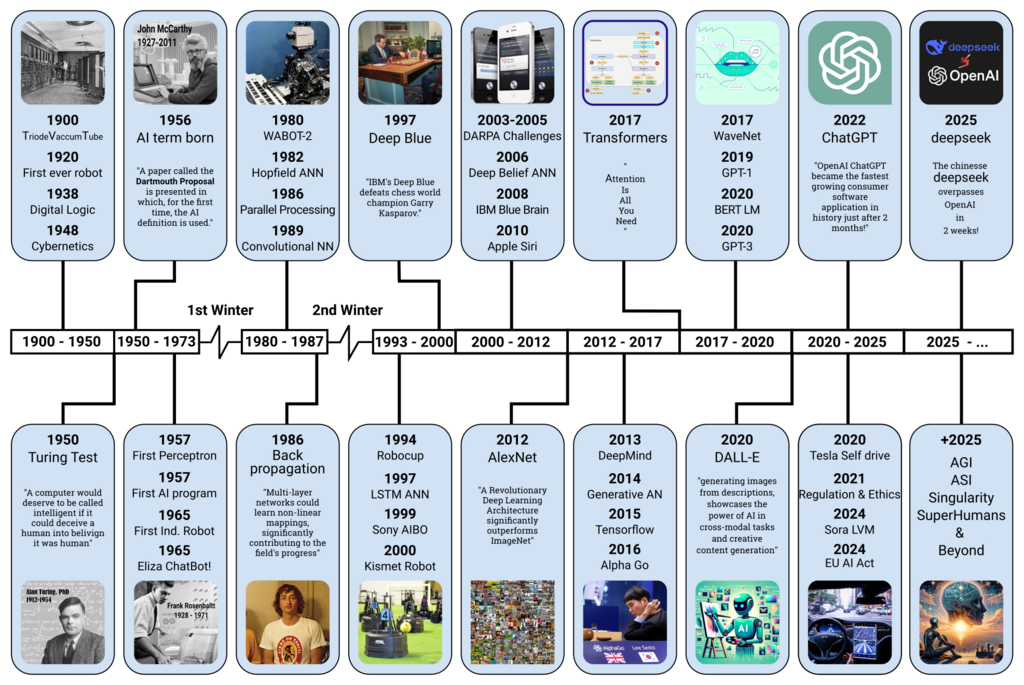
Understanding the history of artificial intelligence is crucial for grasping its current capabilities and future potential.
The term “Artificial Intelligence” was officially coined in 1956 at the Dartmouth Workshop. This event brought together a small group of researchers who laid the groundwork for the decades of innovation that would follow. The early years were filled with excitement and bold predictions. Scientists developed programs that could solve algebra problems, prove theorems in geometry, and speak basic English.
However, progress was slower than expected. The limited computing power and data of the time created major hurdles. This led to periods known as "AI winters," when funding dried up and public interest faded. Researchers realized that creating true intelligence was far more complex than they had imagined.
Things began to change with the rise of machine learning. Instead of trying to program intelligence with complex rules, researchers focused on creating systems that could learn patterns from data. This shift, combined with the explosion of the internet and massive increases in computing power, fueled the AI boom we see today.
Why AI Matters Today
AI is no longer just a concept from science fiction; it's a technology that is reshaping our world. Its impact is felt across nearly every industry, changing how we live, work, and interact with each other.
Here are a few examples of AI's significance in modern society:
- Healthcare: AI algorithms help doctors diagnose diseases like cancer earlier and more accurately by analyzing medical images. They can also personalize treatment plans based on a patient's genetic makeup.
- Transportation: Self-driving cars use AI to navigate roads, while logistics companies use it to optimize delivery routes, saving fuel and time.
- Entertainment: The recommendations you get on streaming services are powered by AI that learns your preferences. In video games, AI creates realistic and challenging non-player characters.
- Finance: AI systems detect fraudulent transactions in real-time and help manage investment portfolios by analyzing market trends.
- Customer Service: Chatbots and virtual assistants handle customer inquiries around the clock, providing instant support and freeing up human agents for more complex issues.
The ability of AI to analyze vast amounts of data and identify patterns that are invisible to humans is its greatest strength. It's a powerful tool that helps us solve some of our biggest challenges and unlock new opportunities for innovation and growth.
What is the fundamental difference between an AI system and a traditional computer program?
The term "Artificial Intelligence" was officially coined at which event?
This foundation gives you a starting point for understanding the more complex and specialized areas of AI we'll explore next.