Introduction to Artificial Intelligence
Introduction to AI
What Is Artificial Intelligence?
At its core, Artificial Intelligence (AI) is about building machines that can think, learn, and solve problems like humans do. It’s the science of making computers perform tasks that traditionally require human intelligence. This includes everything from understanding language and recognizing faces to making decisions and learning from experience.
Artificial Intelligence
noun
The theory and development of computer systems able to perform tasks that normally require human intelligence, such as visual perception, speech recognition, decision-making, and translation between languages.
Think about how you learn a new skill. You observe, you practice, and you adjust based on what works and what doesn't. AI systems operate on a similar principle, but they use data and algorithms instead of firsthand experience. The ultimate goal is to create systems that can operate autonomously and adapt to new situations without being explicitly programmed for every possible scenario.
AI isn't a single technology. It's a broad field of computer science with many different approaches and applications.
A Quick Trip Through Time
The idea of intelligent machines has been around for centuries, but the formal study of AI began in the mid-20th century. A key moment was the Dartmouth Workshop in 1956, where the term "Artificial Intelligence" was first coined. Early researchers were incredibly optimistic, believing that a machine with human-like intelligence was just a few decades away.
This initial excitement led to significant advancements in areas like problem-solving and game playing. However, progress stalled in the 1970s and 80s, a period known as the "AI winter." The computers of the time weren't powerful enough, and the data needed to train complex systems was scarce. Funding dried up, and AI research moved out of the spotlight.
The field saw a resurgence in the 1990s and 2000s, driven by faster computers, the explosion of the internet, and the availability of massive datasets. This new era was marked by the rise of machine learning, a subfield of AI that focuses on creating systems that learn from data. A major milestone was in 1997, when IBM's Deep Blue chess computer defeated the reigning world champion, Garry Kasparov.
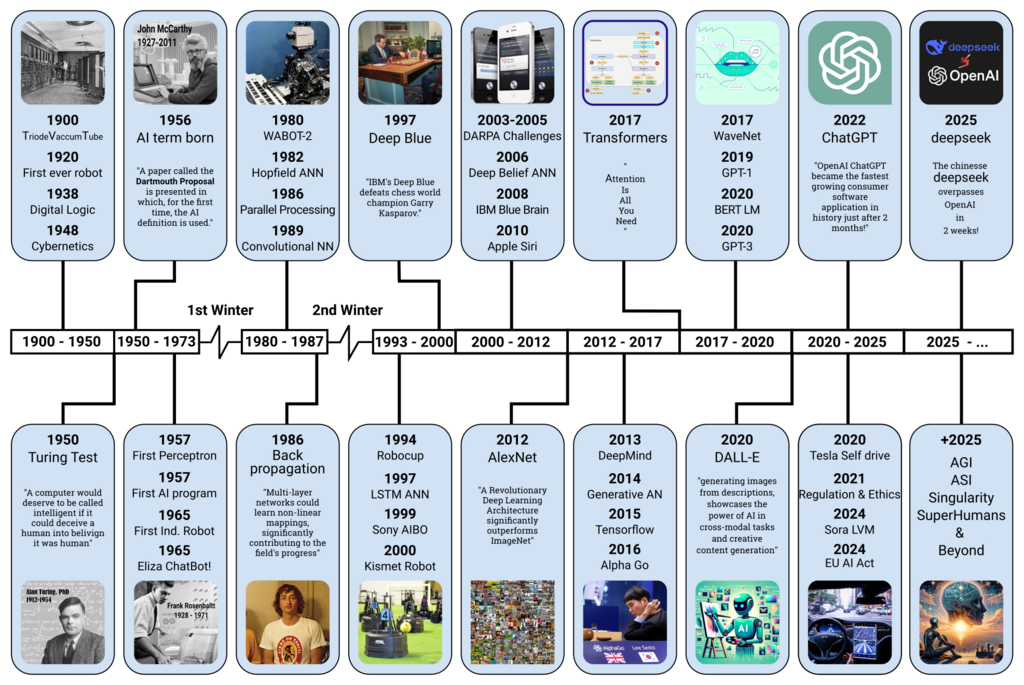
Today, we are in a golden age of AI, with breakthroughs happening at a rapid pace. Modern approaches, especially deep learning, have led to systems that can outperform humans in specific tasks like image recognition and natural language processing.
Core Goals and Principles
So, what are AI researchers actually trying to achieve? The goals of AI can be broken down into a few core capabilities that mimic human intelligence:
-
Reasoning and Problem-Solving: This is the ability to use logic to make deductions and find solutions to problems. It can be as simple as winning a game of tic-tac-toe or as complex as planning logistics for a global shipping company.
-
Knowledge Representation: An AI needs a way to store information about the world. This involves representing objects, properties, categories, and the relationships between them in a way a computer can use.
-
Learning: This is perhaps the most crucial goal. Instead of being programmed with every rule, an AI system learns from data. It identifies patterns and makes adjustments to improve its performance over time.
-
Perception: AI systems need to perceive the world around them. This involves processing sensory data, like images (computer vision), sound (speech recognition), and text (natural language processing).
AI in the Real World
AI is no longer just a concept from science fiction; it's a part of our daily lives. From the recommendation engines that suggest what to watch next on streaming services to the virtual assistants on our phones, AI is working behind the scenes.
In healthcare, AI helps doctors diagnose diseases earlier and more accurately by analyzing medical images. In finance, it detects fraudulent transactions and powers automated trading systems. Automakers use AI to develop self-driving cars that can perceive their environment and navigate safely. AI is also transforming scientific research, helping to analyze massive datasets to discover new drugs and understand climate change.
This is just the beginning. As the technology continues to evolve, AI will undoubtedly find its way into even more aspects of our world, solving complex problems and creating new possibilities.
What is the core objective of Artificial Intelligence?
The term "Artificial Intelligence" was first coined at which key historical event?
This introduction has covered the basic landscape of AI, from its definition and history to its core goals. In the next sections, we'll dive deeper into the different types of AI and the specific techniques that make them work.