Introduction to Artificial Intelligence
Introduction to AI
What Is Artificial Intelligence?
At its heart, artificial intelligence is the science of making machines smart. It’s about creating computer systems that can perform tasks that normally require human intelligence. This includes things like learning from experience, recognizing objects, understanding language, and making decisions.
Think of it this way: a standard computer program follows explicit instructions given by a programmer. An AI system, on the other hand, can often figure out the instructions on its own by analyzing vast amounts of data.
Artificial Intelligence
noun
A field of computer science dedicated to creating systems capable of performing tasks that typically require human intelligence, such as visual perception, speech recognition, decision-making, and translation between languages.
A Quick Trip Through Time
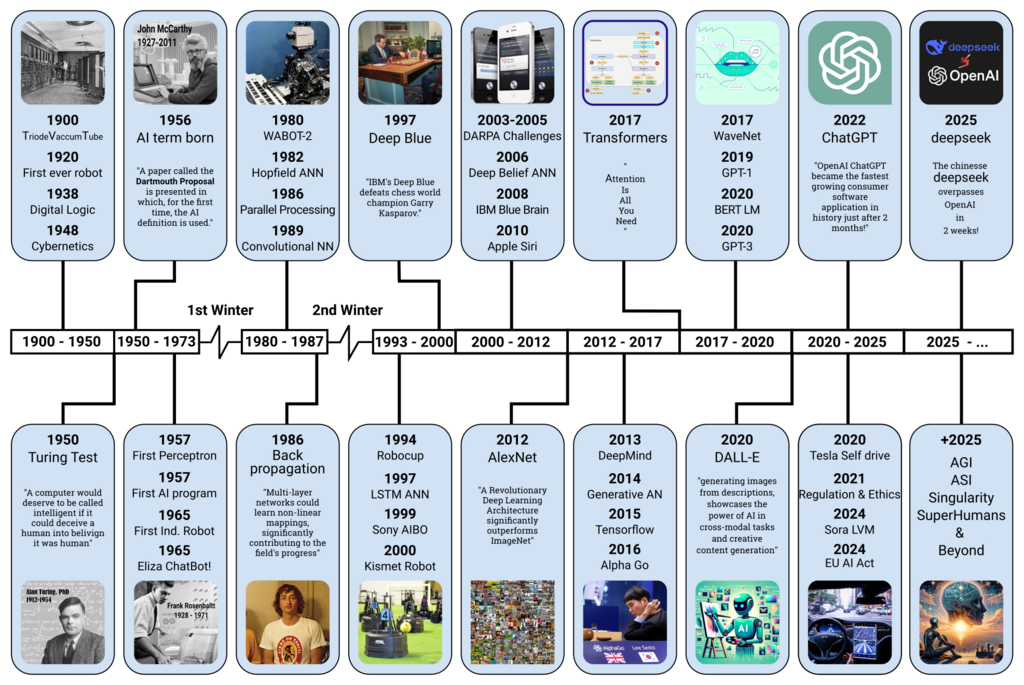
The idea of intelligent machines has been around for centuries, but the actual field of AI is relatively young. One of the earliest conceptual cornerstones was laid by British mathematician Alan Turing in 1950. He proposed a test, now called the Turing Test, to see if a machine could exhibit intelligent behavior indistinguishable from that of a human.
The term "artificial intelligence" itself was coined in 1956 at a workshop at Dartmouth College. A group of scientists gathered to explore the idea that every aspect of learning or any other feature of intelligence could, in principle, be so precisely described that a machine could be made to simulate it. This event is widely considered the birth of AI as a formal field of research.
The years following the Dartmouth workshop were filled with optimism. Researchers developed programs that could solve algebra problems and prove theorems in geometry. But the initial excitement soon met with reality. The complexity of creating true intelligence was far greater than anticipated, leading to a period of reduced funding and interest known as the first "AI winter" in the mid-1970s.
Decades of quiet, steady progress followed. Then, in 1997, a major milestone captured the world's attention: IBM's Deep Blue supercomputer defeated world chess champion Garry Kasparov. It was a clear demonstration that a machine could master a complex, strategic game once thought to be the exclusive domain of human intellect.
The Evolution of Ideas
The way we build AI has changed dramatically over time. Early approaches, often called "Symbolic AI" or "Good Old-Fashioned AI," tried to create intelligence by programming a set of rules for the computer to follow. For example, to identify a cat, you might write rules like "if it has fur, whiskers, and pointy ears, it might be a cat." This worked for well-defined, logical problems but struggled with the messy, unpredictable nature of the real world.
A major shift came with the rise of machine learning. Instead of hand-crafting rules, this approach involves showing the computer countless examples. To teach it what a cat is, you'd show it thousands of cat pictures. The system then learns the patterns and features of a cat on its own. This method proved far more flexible and powerful.
More recently, a subset of machine learning called deep learning has become dominant. Inspired by the structure of the human brain, deep learning uses complex, multi-layered "neural networks." These networks are exceptionally good at finding intricate patterns in massive datasets, powering today's most advanced AI systems, from voice assistants to image generators.
This evolution from rule-based systems to data-driven learning models is the core story of AI's technical development. It's a journey from telling a machine exactly what to do, to giving it the tools to learn for itself.