Introduction to Artificial Intelligence
Introduction to AI
What Is Artificial Intelligence?
Artificial intelligence is the science of making machines that can think and act like humans. The goal is to create systems that can perform tasks that normally require human intelligence, such as learning, reasoning, problem-solving, and understanding language.
Artificial intelligence (AI) is commonly defined as “a system’s ability to interpret external data correctly, to learn from such data, and to use those learnings to achieve specific goals and tasks through flexible adaptation.”
Think of it like teaching a computer to ride a bike. You wouldn't give it a long list of instructions on how to balance, pedal, and steer. Instead, you'd let it try, fall, and learn from its mistakes until it gets it right. AI works in a similar way, but for much more complex tasks.
A Quick History
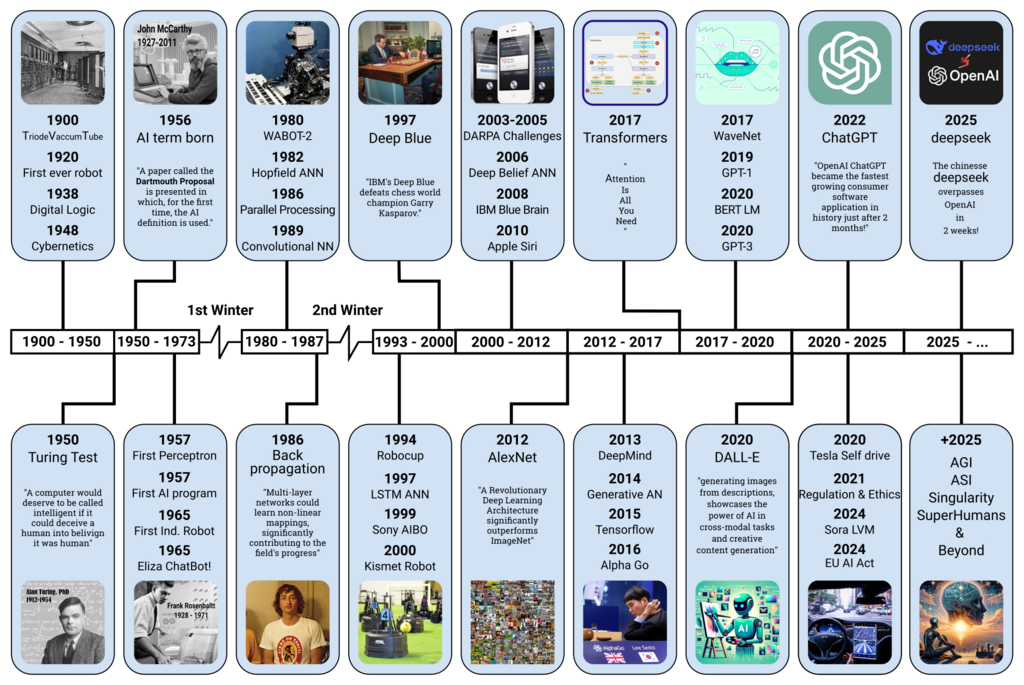
The idea of intelligent machines has been around for centuries, but the modern field of AI officially began in the summer of 1956 at a workshop at Dartmouth College. There, a group of scientists coined the term "artificial intelligence" and kicked off decades of research.
The journey wasn't a straight line. It has seen periods of great excitement and funding, known as "AI summers," followed by times of disappointment and budget cuts, called "AI winters." Early systems were based on complex sets of rules, but progress was slow. The real breakthroughs came with more powerful computers and vast amounts of data, allowing machines to learn for themselves.
Two Kinds of AI
When people talk about AI, they are usually referring to one of two types: Narrow AI or General AI.
Narrow AI
noun
Also known as Weak AI, this is intelligence that is focused on a single, specific task. This is the only type of AI we have successfully created so far.
Every AI you interact with today is a form of Narrow AI. Spam filters in your email, self-driving cars, and facial recognition software are all designed to do one thing very well. They can be incredibly powerful at their specific job, but they can't operate outside of it. A chess-playing AI can't write a poem, and a spam filter can't diagnose a medical condition.
General AI
noun
Also known as Strong AI or Artificial General Intelligence (AGI), this is a theoretical form of AI that would have a human-like ability to understand, learn, and apply its intelligence to solve any problem.
An AGI wouldn't just perform one task; it could switch contexts and learn new skills on its own, much like a person. It could write a symphony, discover a scientific breakthrough, and have a meaningful conversation. Creating AGI is the ultimate goal for many AI researchers, but it remains a distant and incredibly complex challenge.
AI in the Wild
Artificial intelligence is no longer just a concept in a lab. It's an active part of our daily lives and a powerful tool across many industries. Here are just a few examples of how AI is being used today.
| Industry | Application | What it does |
|---|---|---|
| Healthcare | Medical Imaging Analysis | Helps doctors detect diseases like cancer in X-rays and MRIs more accurately. |
| Finance | Fraud Detection | Analyzes transaction patterns in real-time to identify and prevent fraudulent activity. |
| Transportation | Self-Driving Cars | Uses sensors and cameras to navigate roads, identify obstacles, and make driving decisions. |
| Entertainment | Recommendation Engines | Suggests movies, music, and products based on your past behavior and preferences. |
| Customer Service | Chatbots | Answers common customer questions and resolves issues without human intervention. |
Ethical Questions
As AI becomes more powerful and widespread, it raises important ethical questions that we need to address as a society. Building responsible AI means thinking carefully about its potential impact.
One of the biggest concerns is bias. An AI system learns from the data it's given. If that data reflects existing societal biases, the AI will learn and even amplify those biases. For example, if a hiring AI is trained on historical data where men were hired more often for technical roles, it might unfairly penalize female candidates.
Privacy is another major issue. Many AI systems, like personalized advertising and facial recognition, rely on collecting huge amounts of personal data. This raises questions about who owns that data, how it's used, and how we can protect individuals from being monitored or exploited.
Finally, there's the question of accountability. If a self-driving car causes an accident, who is at fault? The owner, the manufacturer, or the programmer who wrote the code? As AI systems make more autonomous decisions, we need clear rules for who is responsible when things go wrong.

Navigating these challenges is essential to ensure that artificial intelligence is developed and used in a way that benefits everyone.
What is the primary goal of artificial intelligence?
The term "artificial intelligence" was officially coined during a 1956 summer workshop at which institution?