Introduction to Artificial Intelligence
Introduction to Artificial Intelligence
What Is Artificial Intelligence?
Artificial intelligence is the science of making machines that can think and act like humans. It's a broad field with a simple goal: to create systems that can perform tasks that normally require human intelligence. This includes things like learning from experience, solving problems, understanding language, and recognizing objects in a scene.
Artificial Intelligence
noun
A field of computer science dedicated to creating systems capable of performing tasks that typically require human intelligence, such as learning, reasoning, and perception.
Early on, AI pioneers had four main approaches in mind:
- Thinking Humanly: Trying to make machines think like people, which involves understanding the inner workings of the human mind.
- Acting Humanly: Focusing on creating machines that can perform actions we'd consider intelligent if a human did them. This is the idea behind the famous Turing Test.
- Thinking Rationally: Using logic to build intelligent systems. The goal is to create programs that reason in a provably correct way.
- Acting Rationally: Designing agents that act to achieve the best possible outcome. This is the most common approach today, as it's more general and goal-oriented.
In short, AI is about building rational agents—systems that perceive their environment and take actions to maximize their chances of success.
A Journey Through Time
The dream of intelligent machines is ancient, but the scientific field of AI is relatively new. Its history is a fascinating story of bold ideas, frustrating setbacks, and incredible breakthroughs.
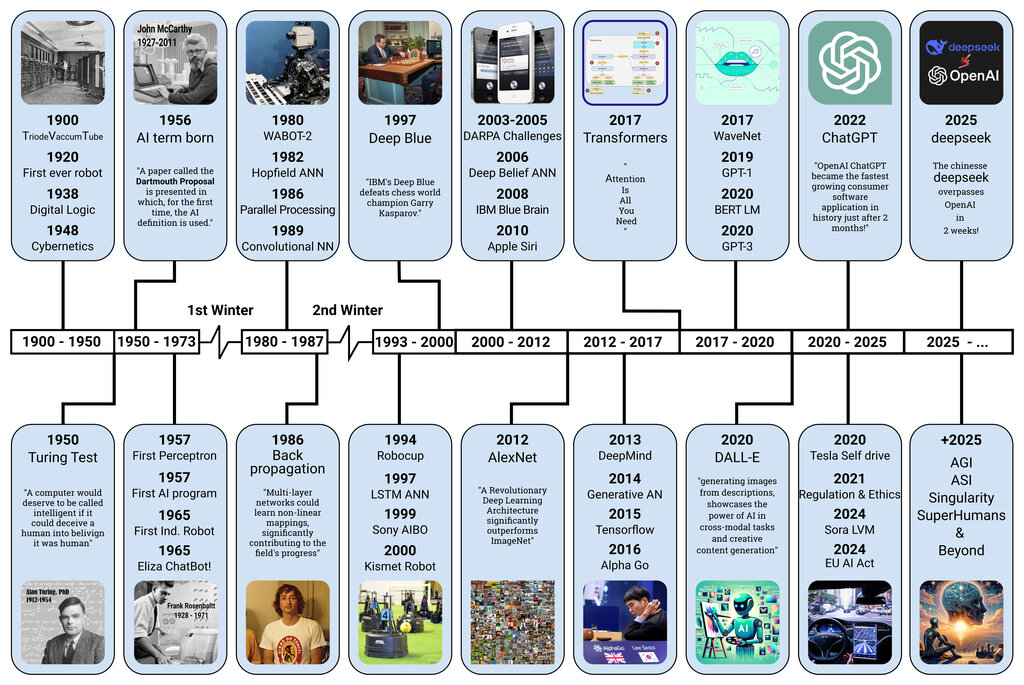
It all started with foundational work in the 1940s and 50s. Computer scientist Alan Turing was a key figure. In 1950, he proposed the "Turing Test" to determine if a machine could exhibit intelligent behavior indistinguishable from that of a human. This question laid the philosophical groundwork for the entire field.
The term "artificial intelligence" itself was coined in 1956 at a workshop at Dartmouth College. Computer scientist John McCarthy organized the event, bringing together a small group of researchers to brainstorm how to make machines think. This conference is widely considered the birth of AI as an academic discipline.
The initial years were filled with optimism. Early programs could solve algebra problems and prove theorems in logic. One famous early example was ELIZA, a program that could simulate a conversation with a psychotherapist. While simple, it showed the potential for machines to interact using natural language.
However, the initial excitement outpaced the technology. By the mid-1970s, researchers hit a wall. The complexity of the problems was far greater than anticipated, and computers weren't powerful enough. Funding dried up, leading to a period known as the "AI winter."
Progress didn't stop, but it slowed and shifted focus. In the 1980s, "expert systems" became popular. These were programs designed to mimic the decision-making ability of a human expert in a specific domain, like diagnosing medical conditions. This was a more practical, rule-based approach to AI.
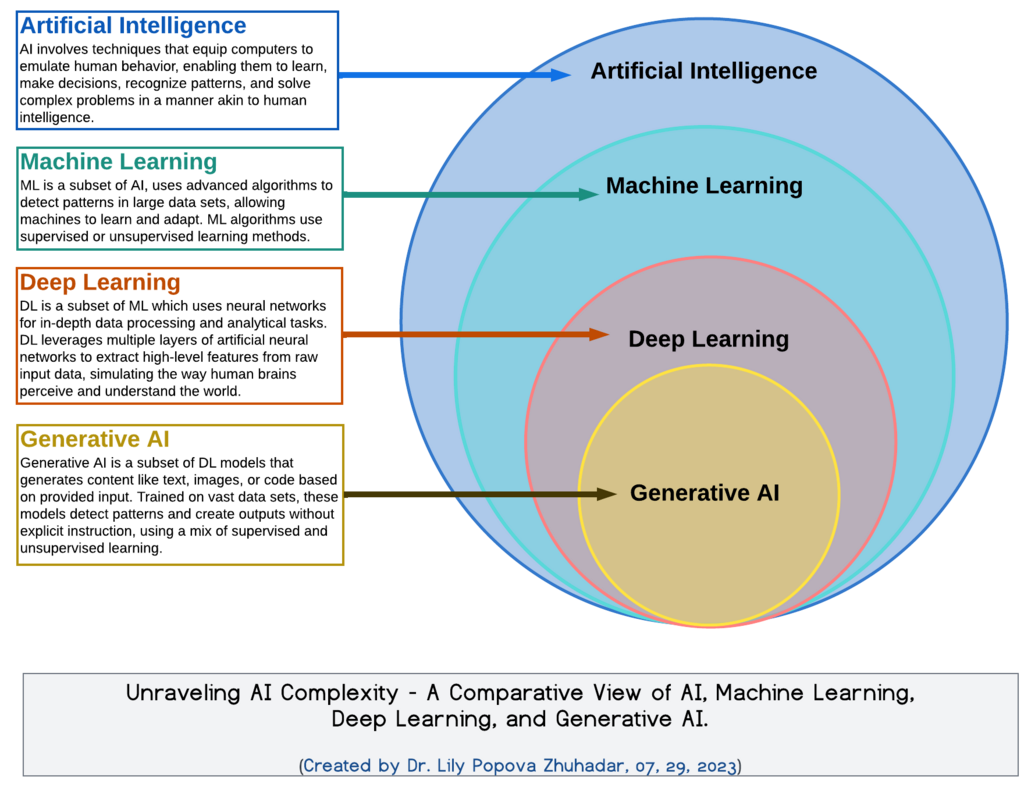
Then came a major shift. Instead of programming rules by hand, researchers focused on making machines that could learn from data. This is the core idea of machine learning. The resurgence of an old idea from the 1950s—the neural network—combined with more data and faster computers, paved the way for the modern AI revolution.
The Modern AI Explosion
The 2010s marked a turning point. Three factors came together perfectly:
- Big Data: The internet and connected devices created massive datasets to train AI models.
- Powerful Hardware: Graphics Processing Units (GPUs), originally for gaming, turned out to be perfect for the parallel computations needed for complex neural networks.
- Better Algorithms: Refinements in machine learning techniques, particularly deep learning, allowed for breakthroughs that were previously impossible.
This convergence led to astonishing achievements. In 2016, Google's AlphaGo defeated the world's top Go player, a feat many thought was decades away. AI models began to achieve human-level performance in image recognition, speech-to-text, and language translation.
This history—from Turing's abstract questions to today's powerful deep learning models—shows a clear evolution. The field moved from hand-crafted rules to systems that learn patterns from data, leading to the flexible and powerful AI we see today.
Now, let's test your knowledge of AI's foundational concepts and history.
Which of the four main approaches to AI is most common today and focuses on designing agents that achieve the best possible outcome?
The Turing Test is designed to evaluate a machine's ability to do what?
From its philosophical beginnings to its modern breakthroughs, AI has come a long way. Understanding this journey is the first step in appreciating its power and potential.