Introduction to Artificial Intelligence
Introduction to Artificial Intelligence
What is Artificial Intelligence?
Artificial intelligence is about making computers smart. It’s a field of computer science dedicated to creating systems that can perform tasks that usually require human intelligence. This includes things like learning from experience, solving problems, understanding language, and recognizing objects in an image.
Artificial Intelligence
noun
A branch of computer science focused on building machines capable of performing tasks that typically require human intelligence.
Think of it this way: when you learn to ride a bike, you don't follow a rigid set of instructions. You try, you fall, you adjust, and eventually, you figure it out. AI aims to give computers a similar ability to learn and adapt, but with data instead of scraped knees. It's not about creating lifelike robots, but about building useful tools that can reason and act.
AI is a broad field of study, not just one single technology. It encompasses a wide range of methods and goals.
The Scope of AI
The applications of AI are incredibly diverse. It works behind the scenes in many tools you use every day. Your email's spam filter uses AI to learn which messages are junk. Streaming services use it to guess what movie you'll want to watch next. Even your bank uses AI to detect fraudulent transactions.
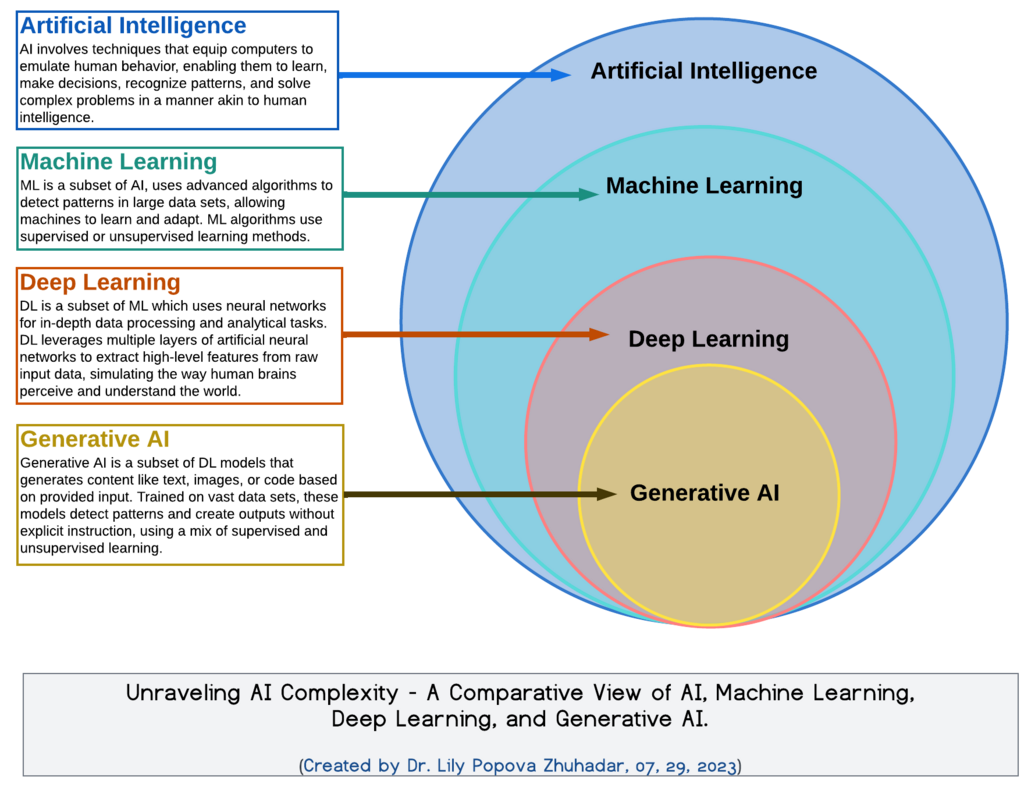
As the diagram shows, AI is an umbrella term. It covers many different subfields, each with its own specific techniques. Some systems are designed for one particular task, like playing chess, while others are built to handle a wider range of problems, like understanding and responding to human speech. The goal is always to use data to make a system more capable and helpful.
How AI Systems Work
At its core, a typical AI system follows a simple pattern: it takes in data, processes it using an algorithm, and produces an output. This process allows it to make predictions, classify information, or decide on an action.
The key ingredient is data. An AI system learns by analyzing vast amounts of information. For example, to build an AI that can identify cats in photos, you would show it millions of pictures, some with cats and some without. The algorithm then learns the patterns, features, and pixels that usually signify "cat." The output is its best guess—a prediction—when it sees a new photo.
AI in Everyday Life
You don't need to work in a tech lab to see AI in action. It's woven into the fabric of modern life, often in ways that are so seamless we don't even notice. From personal convenience to large-scale operations, AI is already here.
| Everyday Task | How AI Helps |
|---|---|
| Getting Driving Directions | Predicts traffic patterns to find the fastest route. |
| Unlocking Your Phone | Recognizes your face or fingerprint. |
| Shopping Online | Recommends products based on your browsing history. |
| Writing an Email | Suggests corrections and autocompletes sentences. |
These small interactions add up. AI is a powerful tool that helps us navigate our world more efficiently, stay connected, and access information. It's the silent partner in many of the apps and services we rely on.
Now that you have a basic understanding of what AI is, let's test your knowledge.
What is the primary goal of Artificial Intelligence?
A typical AI system takes in data, processes it using an algorithm, and produces a(n) ______.
Understanding these foundational ideas is the first step. AI is a tool, and like any tool, its power comes from how we choose to use it.