Introduction to Artificial Intelligence Essentials
Introduction to AI
What Is Artificial Intelligence?
At its core, artificial intelligence is about creating machines that can think, learn, and solve problems like a human. It's a broad field in computer science focused on building smart systems capable of performing tasks that typically require human intelligence.
Artificial Intelligence
noun
The theory and development of computer systems able to perform tasks that normally require human intelligence, such as visual perception, speech recognition, decision-making, and translation between languages.
Think about how you recognize a friend's face in a crowd, understand a spoken sentence, or decide the best route to take to work. These tasks feel effortless, but they involve complex processing. The goal of AI is to enable computers to do these kinds of things. It's not about creating conscious robots from science fiction, but about making tools that can perceive, reason, learn, and adapt.
A Brief History
The dream of intelligent machines is ancient, but the scientific field of AI is relatively new. It officially began in the summer of 1956 at a workshop at Dartmouth College, where the term "artificial intelligence" was coined. Early researchers were optimistic, believing that a machine as intelligent as a human being was just a few decades away.
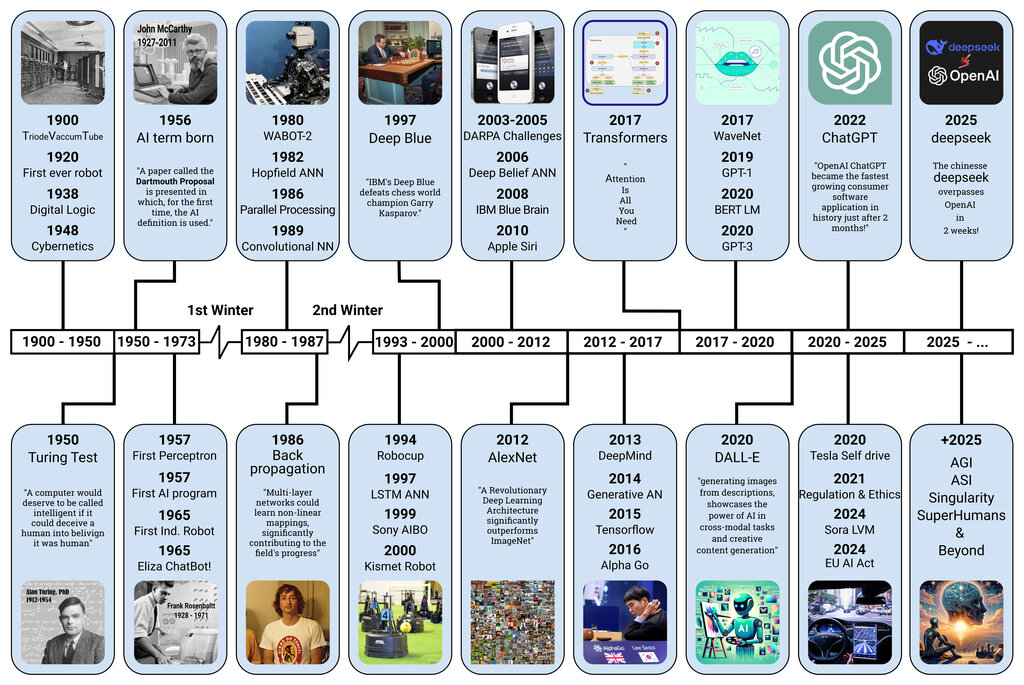
Progress was slower than expected. The initial excitement led to periods of reduced funding and interest, known as "AI winters." However, breakthroughs continued. The development of more powerful computers and the availability of massive amounts of data in the 21st century sparked a resurgence. Computing power and new algorithms allowed AI to finally start delivering on some of its early promises, leading to the rapid advancements we see today.
The Branches of AI
AI isn't a single technology; it's a collection of different subfields, each focusing on a specific aspect of intelligence. Let's look at three of the most important branches.
Machine Learning (ML) is the science of getting computers to learn and act like humans do, by feeding them data and letting them improve on their own without being explicitly programmed. Instead of writing step-by-step instructions, developers create algorithms that allow the computer to learn from examples.
Imagine teaching a child to recognize a cat. You don't list rules like "if it has pointy ears, whiskers, and a tail, it's a cat." Instead, you show them pictures of cats. Eventually, they learn to identify cats on their own. Machine learning works in a similar way, analyzing vast datasets to find patterns and make predictions.
Neural Networks are a type of machine learning model inspired by the structure of the human brain. They are made up of interconnected nodes, or "neurons," that process information in layers. When a neural network is trained on data, the connections between its neurons are adjusted, allowing it to "learn" to recognize complex patterns.
Neural networks are the powerhouse behind many recent AI breakthroughs, especially in an area called Deep Learning, which uses very large neural networks with many layers.
Finally, there's a branch focused on communication.
Natural Language Processing (NLP) is the branch of AI that gives computers the ability to understand, interpret, and generate human language, both spoken and written. It's the technology behind voice assistants, translation apps, and spam filters.
The goal of NLP is to bridge the gap between human communication and computer understanding. It's an incredibly complex task, as human language is filled with ambiguity, context, and nuance.
These core branches are the building blocks of the AI systems we interact with every day. Understanding them is the first step to seeing how AI is shaping our world.
Ready to check your understanding? Let's try a few questions.
What is the primary goal of artificial intelligence?
The term "artificial intelligence" was officially coined at a workshop held at which institution in 1956?
This foundation gives you a map to the world of AI. From here, you can begin to explore how these ideas are put into practice.