Introduction to Artificial Intelligence
Introduction to AI
What Is AI?
Artificial intelligence is the science of making machines that can think, learn, and solve problems like humans do. The main goal is to create systems, or “agents,” that can perceive their environment, understand what they're seeing, and take actions to achieve specific goals. It's not just about crunching numbers; it's about reasoning, understanding language, and even recognizing objects in an image.
Artificial Intelligence
noun
A field of computer science dedicated to creating systems capable of performing tasks that typically require human intelligence.
Two Kinds of AI
When people talk about AI, they're usually talking about one of two types: Narrow AI or General AI. Understanding the difference is key.
Artificial Narrow Intelligence (ANI), or Weak AI, is what we have today. This kind of AI is designed to perform a single, specific task. Think of the AI that recommends movies on a streaming service, a chatbot that answers customer questions, or a program that plays chess. It might seem incredibly smart, but it's operating within a very limited, pre-defined set of rules and data. It can't suddenly decide to learn French or write a poem unless it was specifically built for that purpose.
Narrow AI is a specialist. It’s a grandmaster at chess but can’t even make a cup of tea.
Artificial General Intelligence (AGI), or Strong AI, is the stuff of science fiction—for now. AGI refers to a machine with the ability to understand, learn, and apply its intelligence to solve any problem, just like a human being. An AGI system could switch seamlessly between translating languages, composing music, and conducting scientific research. It would possess consciousness, self-awareness, and the ability to think abstractly. We haven't built anything close to AGI yet.
The Story of AI
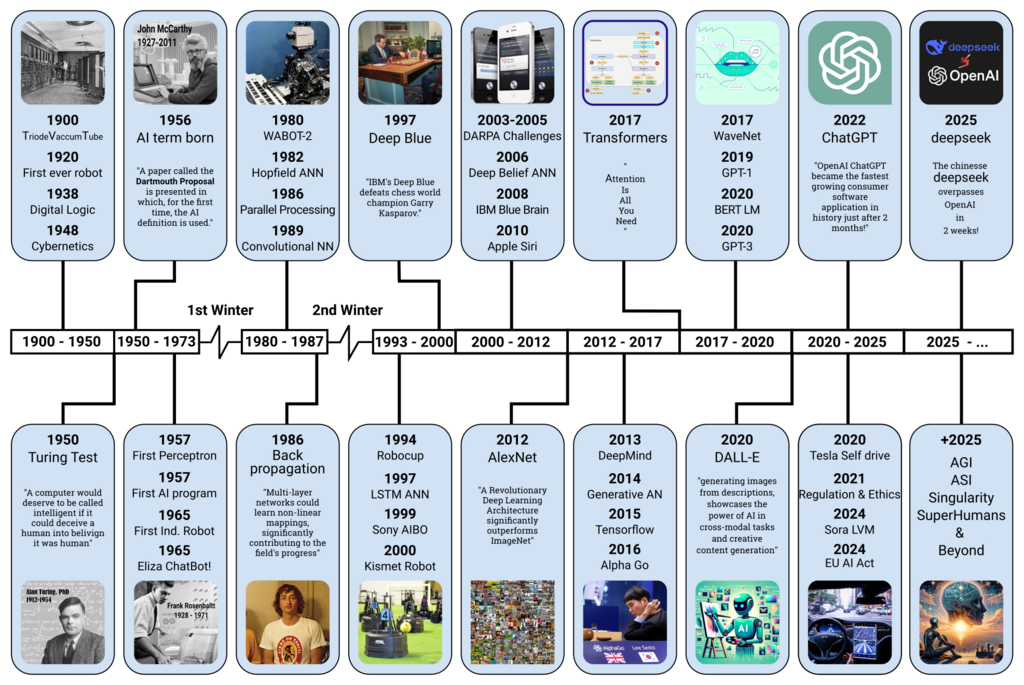
The dream of creating intelligent machines is ancient, but the formal field of AI began in the mid-20th century. A key figure was the British mathematician Alan Turing. In 1950, he posed a simple but profound question: "Can machines think?"
To answer this, he proposed an experiment called the Turing Test. Imagine a human judge having two separate text conversations, one with another human and one with a machine. If the judge can't reliably tell which is which, the machine is said to have passed the test. It was a foundational idea for measuring machine intelligence.
The Turing Test wasn't about whether a machine really thinks, but whether it can imitate human thinking so well that we can't tell the difference.
The field got its name a few years later. In the summer of 1956, a group of researchers gathered at Dartmouth College for a workshop. Their goal was to explore the idea that "every aspect of learning or any other feature of intelligence can in principle be so precisely described that a machine can be made to simulate it." It was here that computer scientist John McCarthy coined the term "artificial intelligence," and the discipline was officially born.
High Hopes and Hard Times
The years following the Dartmouth Workshop were filled with incredible optimism. Pioneers of the field made bold predictions, suggesting that machines with human-level intelligence were just a few decades away. This excitement attracted significant government funding, and researchers made early progress in areas like game playing and logical reasoning.
But the initial hype outpaced reality. The challenges of creating true intelligence were far greater than anyone had anticipated. Computers at the time were slow and had very little memory. Creating systems that could understand the nuances of language or navigate the messy, unpredictable real world proved incredibly difficult.
By the mid-1970s, funding started to dry up as progress stalled. This period, and a similar one in the late 1980s, became known as AI winters. The grand promises hadn't materialized, and the field fell out of favor for a time.
So what changed? Why are we in an AI boom now? A few key factors came together. First, the internet created massive amounts of data—text, images, and videos—that could be used to train AI systems. Second, computing power exploded. Processors became exponentially faster and cheaper, particularly specialized chips called GPUs. Finally, researchers developed smarter algorithms, especially in an area called machine learning.
This combination of big data, powerful computers, and better algorithms sparked the modern AI resurgence, leading to the breakthroughs we see today.
Ready to check your understanding? Let's see what you've learned about the foundations of AI.
What is the primary goal of artificial intelligence?
The type of AI we have today, such as a movie recommendation engine or a chess-playing program, is known as:
Understanding AI's history—its ambitious beginnings, its periods of struggle, and its recent explosion—provides a vital context for where the technology is today and where it might be headed.