Introduction to Artificial Intelligence
Introduction to Artificial Intelligence
What Is Artificial Intelligence?
At its core, Artificial Intelligence is about creating systems that can perform tasks that typically require human intelligence. This isn't about building robots that look and act exactly like us. It's about teaching machines to recognize patterns, learn from data, and make decisions.
a system’s ability to interpret external data correctly, to learn from such data, and to use those learnings to achieve specific goals and tasks through flexible adaptation.
Think about how a child learns to identify a dog. You don't give them a set of rules like "if it has four legs, fur, and a tail, it's a dog." Instead, you show them many different dogs. Over time, their brain learns to recognize the general pattern of "dog-ness."
AI, particularly the branch called machine learning, works in a similar way. Engineers feed a system vast amounts of data—pictures, text, or numbers—and the system learns to identify patterns and make predictions on its own. The goal is to simulate a kind of intelligence, allowing a machine to solve problems and adapt.
A Brief History of AI
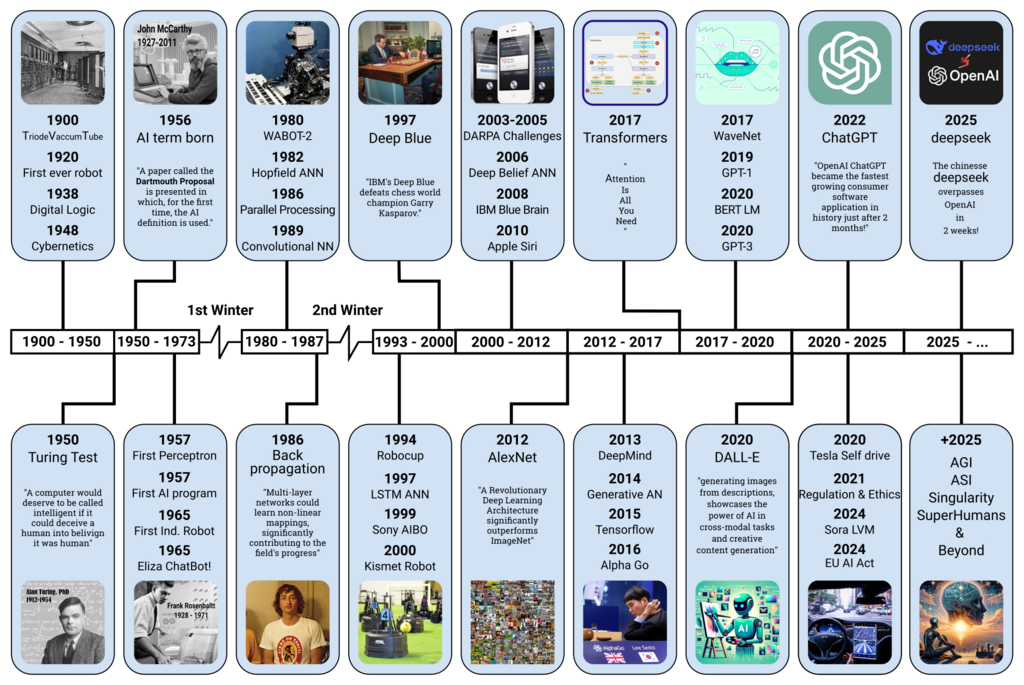
The dream of intelligent machines is ancient, but the actual scientific field of AI is relatively young. It officially began in the summer of 1956 at a workshop at Dartmouth College, where the term "Artificial Intelligence" was coined. This event sparked a wave of optimism. Researchers believed that a machine as intelligent as a human being was just a few decades away.
Early research focused on problem-solving and symbolic reasoning. The initial belief was that if you could write down enough logical rules for a computer, you could create intelligence.
But the real world is messy and complex. Early AI systems were brittle and couldn't handle uncertainty. This led to a period in the 1970s known as the "AI winter," when funding dried up and progress stalled. The initial promises had been too grand.
The field was revived in the 1980s with the rise of machine learning. Instead of programming rules by hand, researchers developed algorithms that allowed computers to learn from data. This was a major shift. The recent explosion in AI is thanks to two key ingredients: massive amounts of data from the internet and powerful computer hardware that can process it all.
Two Kinds of AI
When people talk about AI, they are often mixing up two very different concepts: the AI we have today and the AI we see in movies. It's crucial to understand the distinction between Artificial Narrow Intelligence (ANI) and Artificial General Intelligence (AGI).
Artificial Narrow Intelligence
noun
AI that is specialized for a particular task. It operates within a limited context and is a master of its specific domain.
Every AI application you use today is a form of ANI. Your phone's voice assistant, the recommendation engine on a streaming service, and the software that guides a self-driving car are all narrow AI. They can perform their specific tasks incredibly well, often better than humans. However, you can't ask your spam filter for a weather forecast or expect a chess-playing AI to write a poem. They are specialists.
Artificial General Intelligence
noun
A hypothetical form of AI that possesses the ability to understand, learn, and apply its intelligence to solve any problem that a human can.
AGI is the stuff of science fiction—for now. It refers to a machine with the flexible, creative, and common-sense reasoning of a human. An AGI could switch between tasks, learn entirely new skills without being retrained, and understand context and nuance. While researchers are actively working toward it, AGI does not yet exist. The path from today's narrow AI to a hypothetical general AI is long and filled with immense scientific challenges.
| Feature | Narrow AI (ANI) | General AI (AGI) |
|---|---|---|
| Scope | Specific, limited tasks | Any intellectual task a human can do |
| Learning | Learns from data for one domain | Can transfer knowledge across domains |
| Current State | Exists and is widely used | Hypothetical; does not exist yet |
| Example | Image recognition, language translation | A truly self-aware, problem-solving consciousness |
Knowing these basics provides a solid foundation. It helps separate the reality of AI today from the speculation about its future, allowing for a clearer understanding of how this technology works and where it might be headed.