Introduction to Artificial Intelligence
Introduction to Artificial Intelligence
What is Artificial Intelligence?
Artificial intelligence, or AI, is about creating computer systems that can perform tasks that usually require human intelligence. Think about things like understanding language, recognizing images, making decisions, and solving problems. Instead of programming a computer with a rigid set of instructions for every single scenario, AI allows a system to learn and adapt on its own.
AI is the science of making machines smart, especially smart computer programs.
It's the difference between a simple calculator, which only follows pre-programmed rules, and a system that can learn to identify a cat in a photo by analyzing thousands of cat pictures. The calculator is just executing commands; the AI is developing an understanding based on data.
The Two Main Flavors of AI
AI isn't a single thing. It's a broad field with different levels of intelligence. The two main categories you'll hear about are Narrow AI and General AI.
Narrow AI, also known as Weak AI, is what we have today. It’s designed to perform a specific, narrow task. Your smartphone's voice assistant, a spam filter for your email, or a navigation app that finds the fastest route are all examples of Narrow AI. They are incredibly good at their one job, but they can't operate outside of it. You can't ask your spam filter for a weather forecast.
General AI, or Strong AI, is the kind of intelligence you see in science fiction movies. This is a hypothetical type of AI that would possess the ability to understand, learn, and apply its intelligence to solve any problem, much like a human being. It would have consciousness, self-awareness, and the ability to think abstractly. We are still very far from creating true General AI.
| Feature | Narrow AI (ANI) | General AI (AGI) |
|---|---|---|
| Scope | Performs a single, specific task | Can handle any intellectual task |
| Example | Spam filtering, voice assistants | Fictional robots like C-3PO |
| Status | Exists today | Theoretical / In development |
| Awareness | No consciousness or self-awareness | Possesses consciousness |
How Does AI Actually Learn?
So, how do we make a machine intelligent? The most common approach is through Machine Learning (ML). Instead of being explicitly programmed, a machine learning model is trained on a massive amount of data. It learns to recognize patterns within that data and then uses those patterns to make predictions or decisions.
Machine Learning
noun
A subfield of AI that gives computers the ability to learn without being explicitly programmed.
Imagine teaching a child what a dog is. You don't list a bunch of rules like "if it has four legs, fur, and a tail, it's a dog." Instead, you show them many different dogs. Eventually, the child's brain figures out the common patterns. Machine learning works in a similar way, but with data instead of real-world examples.
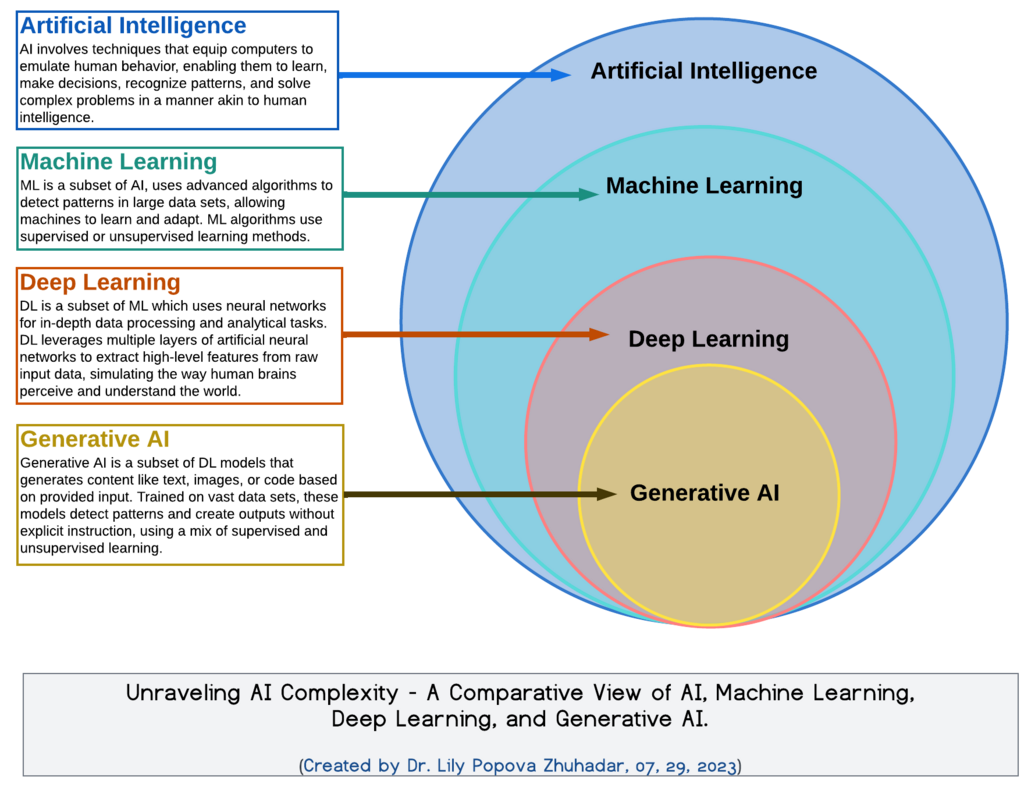
A specialized type of machine learning is Deep Learning. It takes the learning process a step further by using a structure inspired by the human brain. This structure is called a Neural Network.
Deep learning is particularly powerful for complex tasks like recognizing speech or identifying objects in images with high accuracy.
The Brains of the Operation
A neural network is made up of interconnected nodes, or "neurons," organized in layers. When you feed data into the network, it travels through these layers. Each neuron processes the information it receives and passes it on to the next layer. As the data moves through the network, the system learns to identify more and more complex features.
For example, when identifying a face, the first layer might recognize simple edges and colors. The next layer might combine those to identify shapes like eyes and noses. Subsequent layers would combine those features to recognize a complete face. This layered approach is what gives deep learning its name and its power.
Now that you've got the basics down, let's test your knowledge.
What is the fundamental difference between an Artificial Intelligence system and a traditional, rule-based computer program (like a simple calculator)?
Which of the following describes 'General AI' (also known as Strong AI)?
Understanding these core concepts—AI, narrow vs. general, machine learning, deep learning, and neural networks—provides the foundation for exploring the incredible world of artificial intelligence.