Introduction to Artificial Intelligence
Introduction to Artificial Intelligence
What Is Artificial Intelligence?
Artificial intelligence is all about building machines that can think and learn like humans. It's a broad field in computer science focused on creating systems that can perform tasks that typically require human intelligence. This includes things like understanding language, recognizing images, making decisions, and solving problems.
Artificial Intelligence
noun
The theory and development of computer systems able to perform tasks that normally require human intelligence, such as visual perception, speech recognition, decision-making, and translation between languages.
The goal isn't just to make a machine follow a set of pre-programmed rules. It's to enable it to process information, identify patterns, and adapt its behavior based on new data, much like a person does. Think of it as teaching a computer to be smart, rather than just obedient.
The Journey of AI
The dream of creating intelligent machines isn't new. It has roots in ancient myths and centuries of philosophical thought. But the scientific pursuit of AI began in the mid-20th century, alongside the development of the first electronic computers.
The field was officially born in the summer of 1956 at a workshop at Dartmouth College. It was here that the term "artificial intelligence" was coined, kicking off decades of research.
The early years were filled with excitement and bold predictions. Researchers developed programs that could solve algebra problems and prove mathematical theorems. But the initial excitement soon met with reality. The complexity of creating true intelligence was far greater than anticipated, and progress slowed. This led to periods known as "AI winters," when funding dried up and public interest waned.
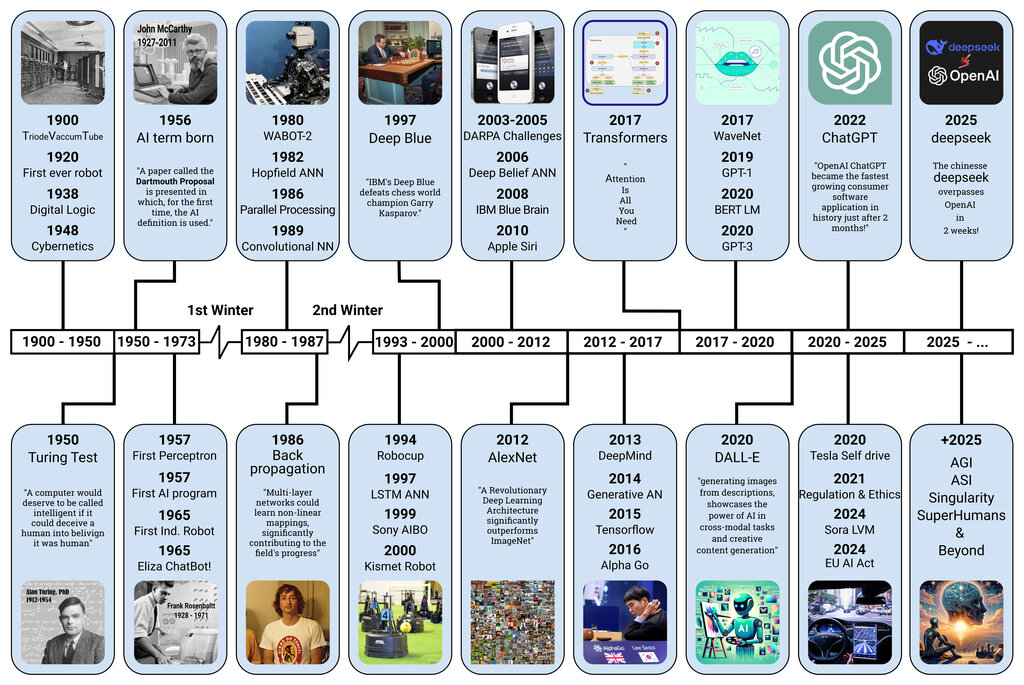
Despite these challenges, progress continued. The 1980s saw the rise of "expert systems," AI programs designed to mimic the decision-making ability of a human expert in a specific domain. Then, in 1997, a major milestone captured the world's attention: IBM's Deep Blue supercomputer defeated world chess champion Garry Kasparov. It was a clear demonstration that a machine could master a complex, strategic game once thought to be the exclusive domain of human intellect.
Why AI Grew So Fast
The 21st century has seen an explosion in AI capabilities. This rapid acceleration isn't due to a single breakthrough, but rather the convergence of three key factors.
- Big Data: The internet and connected devices created an unimaginable amount of data. This data is the lifeblood of modern AI, providing the raw material for machine learning algorithms to learn from.
- Powerful Computing: The development of more powerful processors, especially graphics processing units (GPUs), made it possible to run complex AI models that require massive amounts of calculation.
- Smarter Algorithms: Researchers developed more sophisticated algorithms and neural network architectures, allowing AI to learn more efficiently and tackle more complex problems, like understanding human speech and recognizing objects in photos.
Together, these forces have transformed AI from a niche academic field into a technology that is reshaping industries and our daily lives.
What is the fundamental goal of Artificial Intelligence?
In the history of AI, what does the term "AI winter" refer to?
Understanding AI's past helps us make sense of its present capabilities and provides a foundation for exploring where this powerful technology is headed next.