Introduction to Artificial Intelligence
Introduction to Artificial Intelligence
What Is Artificial Intelligence?
Artificial Intelligence, or AI, is about creating computer systems that can perform tasks that usually require human intelligence. This includes things like learning from experience, solving problems, understanding language, and recognizing objects and sounds.
Think of it this way: when you learn to ride a bike, you don't just follow a strict set of instructions. You try, you fall, you adjust, and eventually, your brain figures out how to balance and pedal. AI tries to get computers to learn in a similar way, moving beyond simple calculations to make smart decisions on their own.
At its core, AI is the science of making machines smart.
A Quick Trip Through Time
The idea of intelligent machines has been around for centuries, but the official starting point for AI as a field was a workshop at Dartmouth College in the summer of 1956. A group of scientists gathered to explore the idea that "every aspect of learning or any other feature of intelligence can in principle be so precisely described that a machine can be made to simulate it." It was here that the term "artificial intelligence" was first used.
The history of artificial intelligence reveals a fascinating journey from philosophical thought experiments to technologies that are now reshaping our world.
Early AI research was full of optimism. Researchers created programs that could solve algebra problems and play checkers. These early systems worked by following a set of carefully programmed rules, an approach known as symbolic AI or "Good Old-Fashioned AI."
However, progress stalled. The real world turned out to be much messier and more complex than these rule-based systems could handle. This led to periods known as "AI winters," when funding dried up and interest waned because the technology couldn't live up to its initial hype.
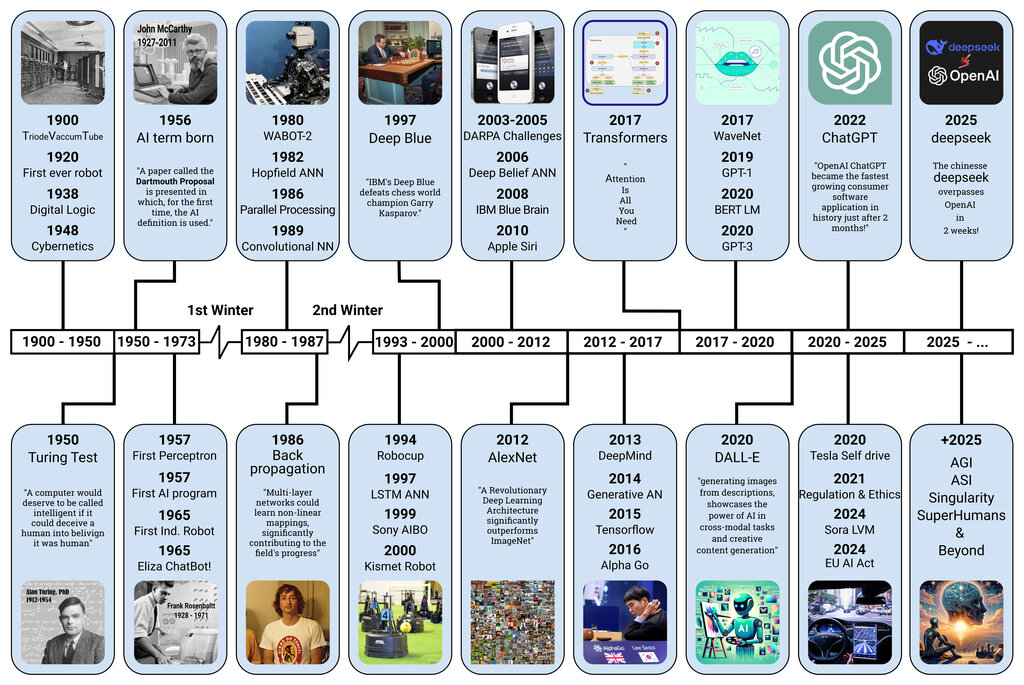
The field was reborn with a new approach: machine learning. Instead of programming explicit rules, developers began creating systems that could learn patterns directly from large amounts of data. This shift laid the groundwork for the AI boom we see today.
Major Breakthroughs
A few key moments pushed AI from the laboratory into the public eye. One of the most famous was in 1997, when IBM's chess computer, Deep Blue, defeated world champion Garry Kasparov. It was a major milestone, showing that a machine could beat the best human player in a game of complex strategy.
The next leap forward came with the rise of deep learning, a subfield of machine learning inspired by the structure of the human brain. Thanks to massive datasets and more powerful computers, deep learning models achieved incredible results in areas like image and speech recognition.
Another landmark event was in 2016, when Google DeepMind's AlphaGo beat Lee Sedol, one of the world's best Go players. Many thought this was a decade away, as Go is far more intuitive and complex than chess. AlphaGo's victory demonstrated a new level of machine creativity and intuition.
Why Now?
So, what caused the recent explosion in AI capabilities? Three main factors came together to create the perfect storm.
| Factor | Description |
|---|---|
| Big Data | The internet and connected devices generate enormous amounts of data every day. This data is the fuel for modern AI systems, giving them vast examples to learn from. |
| Better Algorithms | Researchers have made significant progress in developing more sophisticated and efficient machine learning algorithms. |
| Powerful Computers | The development of specialized hardware, like Graphics Processing Units (GPUs), has made it possible to train large, complex AI models much faster and more cheaply than before. |
These three ingredients—data, algorithms, and computing power—have created a virtuous cycle. More data leads to better models, which encourages the development of more powerful hardware, which in turn allows us to process even more data. This cycle is driving the rapid pace of innovation we're experiencing.
Time to check your understanding of these foundational ideas.
What is the primary goal of Artificial Intelligence?
The term "artificial intelligence" was first used during a summer workshop in 1956. Where was this workshop held?
With this foundation, you're ready to explore the different types of AI and how they're changing the world around us.