Introduction to Artificial Intelligence
Introduction to Artificial Intelligence
What Is AI Anyway?
Artificial Intelligence is about making computers do things that usually require human intelligence. This includes tasks like learning, reasoning, problem-solving, understanding language, and perceiving the world around them. Think of it less as creating a conscious robot and more as building a very specialized, powerful tool. A calculator is great at arithmetic, but it can't figure out the best route to the grocery store. AI aims to tackle those more complex, nuanced problems.
Artificial Intelligence
noun
A field of computer science dedicated to creating systems that can perform tasks that typically require human intelligence.
At its core, AI is the science of making machines smart.
From Myth to Machine
The dream of creating intelligent, non-human beings is ancient, appearing in myths and stories for centuries. But the scientific journey of AI is much more recent. It began in earnest in the mid-20th century, when pioneers first believed that human thought could be broken down into logical steps and replicated by a machine.
A pivotal moment was the summer of 1956 at Dartmouth College. A group of scientists gathered for a workshop with a bold proposal: to explore the idea that "every aspect of learning or any other feature of intelligence can in principle be so precisely described that a machine can be made to simulate it." It was here that the term "artificial intelligence" was officially coined.
The meeting kick-started serious research on AI and laid the groundwork for many of the breakthroughs that came in the following decades.
The years that followed were filled with excitement and optimism. Researchers developed programs that could solve algebra problems and prove theorems in geometry. But progress was slower than expected. The computers of the day were simply not powerful enough, and the problems of creating true intelligence were far more difficult than first imagined. This led to periods known as "AI winters," when funding dried up and public interest waned.
But the dream never died. As computer processing power grew exponentially and vast amounts of data became available with the rise of the internet, AI experienced a powerful resurgence. The slow, chilly winters gave way to a new spring of innovation.
Major Leaps Forward
AI's history is marked by key breakthroughs that pushed the boundaries of what machines could do. These weren't just academic exercises; they were powerful demonstrations that captured the world's imagination and paved the way for the technology we use today.
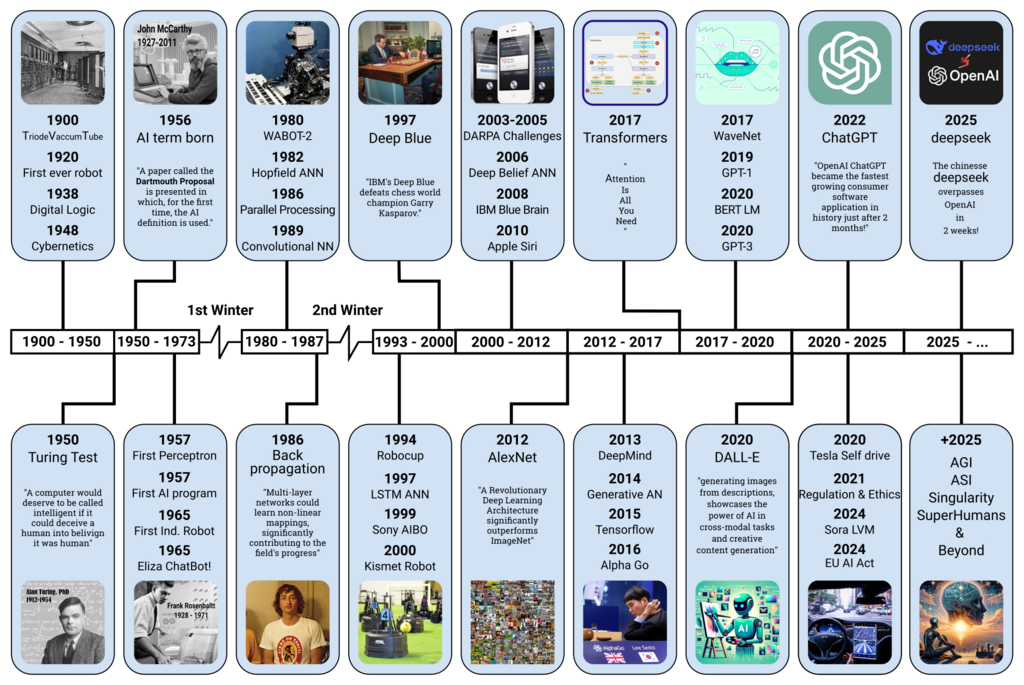
Here are some of the most significant milestones:
| Year | Milestone | Significance |
|---|---|---|
| 1950 | Alan Turing proposes the Turing Test | A test of a machine's ability to exhibit intelligent behavior indistinguishable from that of a human. |
| 1956 | Dartmouth Workshop | The term "artificial intelligence" is coined, and the field is formally established. |
| 1966 | ELIZA | An early natural language processing program that simulated a psychotherapist, showing the potential for human-computer conversation. |
| 1997 | Deep Blue defeats Garry Kasparov | IBM's chess computer beats the world champion, a major symbolic victory for AI in a game of complex strategy. |
| 2012 | AlexNet wins image recognition contest | A neural network that dramatically improved image recognition accuracy, kickstarting the deep learning revolution. |
| 2016 | AlphaGo defeats Lee Sedol | Google DeepMind's program beats a world champion Go player, a feat once thought to be decades away due to the game's immense complexity. |
The victory of Deep Blue was a watershed moment. Chess was seen as a pinnacle of human intellect, requiring strategy, foresight, and creativity. When a machine won, it fundamentally changed the public conversation about machine intelligence.
Nearly twenty years later, AlphaGo's victory was arguably even more profound. Go is exponentially more complex than chess, relying heavily on intuition. AlphaGo didn't just calculate; it made creative, surprising moves that professionals described as beautiful. This demonstrated a new level of AI capability, moving from pure calculation to something that resembled intuition.
What is the fundamental goal of artificial intelligence, as described in the text?
Where was the term 'artificial intelligence' officially coined?
This journey from abstract ideas to powerful, real-world systems shows a consistent pattern: human ingenuity pushing the boundaries of what's possible.