Introduction to Artificial Intelligence
Introduction to AI
What Is Artificial Intelligence?
Artificial Intelligence, or AI, is the science of making machines that can think or act intelligently. The goal is to create systems that can perform tasks that typically require human intelligence, like understanding language, recognizing patterns, solving problems, and making decisions.
At its heart, AI is about simulating human intelligence in machines so they can learn, reason, and perceive.
Think of it this way: when you ask your phone for the weather, an AI system processes your speech, finds the information, and speaks the answer back to you. It's not magic; it's a set of complex rules and patterns that a machine has learned to follow.
A Brief History
The idea of intelligent machines has been around for centuries, but the modern field of AI officially began in 1956 at a workshop at Dartmouth College. It was there that the term "Artificial Intelligence" was coined.
The journey of AI has seen periods of great excitement and funding, known as "AI summers," followed by periods of disillusionment and reduced investment, called "AI winters." Early AI focused on rule-based systems, where programmers tried to write down every possible rule for a given task. This worked for simple games like checkers but failed for more complex problems.
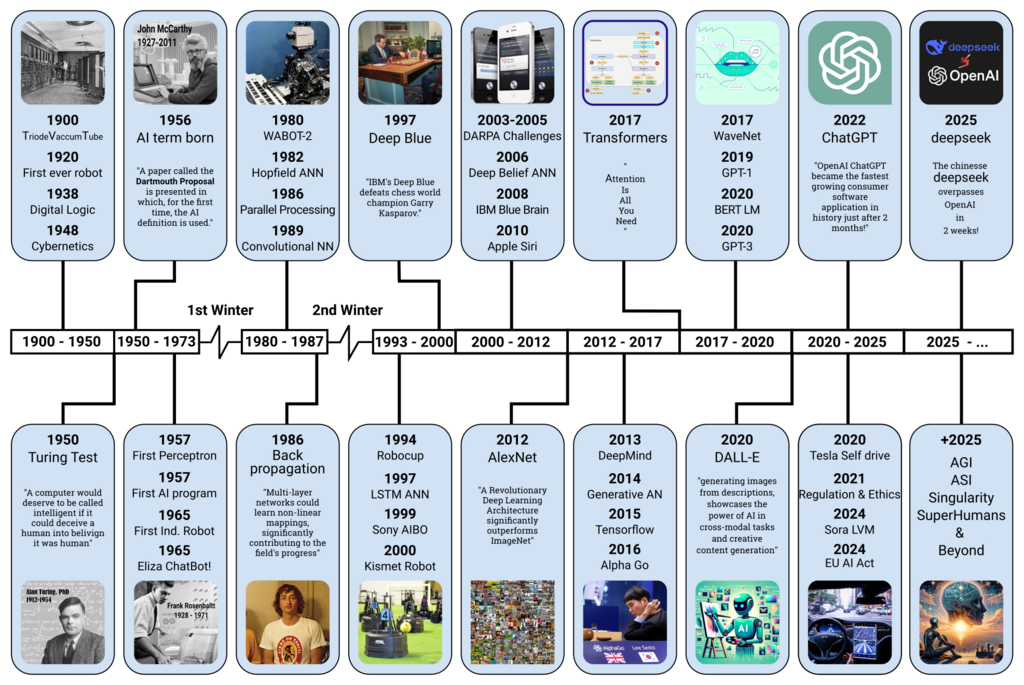
Over time, the focus shifted from writing rules to letting machines learn from data. This shift, combined with massive increases in computing power and the availability of huge datasets, has fueled the AI boom we see today.
Two Types of AI
When people talk about AI, they're usually referring to one of two main types: Narrow AI and General AI. Understanding the difference is key, because one is all around us, and the other is still the stuff of science fiction.
Artificial Narrow Intelligence (ANI)
noun
AI that is designed and trained for one particular task. It operates within a limited, pre-defined range and cannot perform beyond its specific domain.
Also known as Weak AI, this is the only type of AI we have successfully created so far. It's everywhere. The recommendation engine that suggests movies on Netflix, the virtual assistant that answers your questions, and the software that recognizes faces in photos are all examples of Narrow AI. They are incredibly powerful at their specific jobs, but they can't step outside of them. A chess-playing AI can't write a poem or diagnose a disease.
Artificial General Intelligence (AGI)
noun
A theoretical form of AI where a machine would have an intelligence equal to humans. It would have a self-aware consciousness and the ability to solve problems, learn, and plan for the future.
Also called Strong AI, this is the type of AI you see in movies, like the android Data from Star Trek or HAL 9000 from 2001: A Space Odyssey. An AGI would be able to understand and learn any intellectual task that a human being can. It could switch from translating languages to composing music to solving complex physics problems without being reprogrammed. Currently, AGI remains a theoretical concept and a long-term goal for many researchers.
| Feature | Narrow AI (ANI) | General AI (AGI) |
|---|---|---|
| Scope | Performs a single task or a narrow range of tasks | Can perform any intellectual task a human can |
| Capability | Specialized intelligence | Generalized, human-like intelligence |
| Learning | Learns from data for its specific task | Can learn and adapt across different domains |
| Current Status | Widely used and implemented today | Theoretical, does not yet exist |
Core Principles and Applications
So, how do AI systems actually work? While the technical details can get very complex, the core principle is about recognizing patterns and making predictions based on data. An AI system is fed vast amounts of information—pictures, text, numbers—and it learns to identify relationships within that data.
For example, an AI designed to identify cats in photos is shown millions of pictures, some with cats and some without. Over time, it learns the common features of a cat (whiskers, pointy ears, feline eyes) and can then spot a cat in a new picture it has never seen before.
This fundamental ability allows AI to be applied in countless ways across many industries.
- Healthcare: AI helps doctors analyze medical images like X-rays and MRIs to detect diseases like cancer earlier and more accurately.
- Finance: Banks use AI to detect fraudulent transactions in real-time and to assess credit risk for loans.
- Transportation: AI is the brain behind self-driving cars, navigating roads and avoiding obstacles. It also optimizes traffic flow in cities.
- Entertainment: Streaming services use AI to recommend songs, movies, and shows based on your viewing habits.
- Retail: AI powers personalized shopping experiences and helps manage inventory by predicting demand for products.
What is the primary goal of Artificial Intelligence?
The recommendation engine on a streaming service that suggests movies based on your viewing history is an example of which type of AI?
This is just a glimpse into the world of AI. It's a field that's constantly evolving, built on these foundational ideas of mimicking intelligence, learning from data, and performing specific, useful tasks.