Introduction to Artificial Intelligence
Introduction to Artificial Intelligence
What Is Artificial Intelligence?
Artificial intelligence is about making computers smart. It’s a field of computer science focused on creating systems that can perform tasks that normally require human intelligence. This includes things like learning from experience, solving problems, understanding language, and recognizing objects in an image.
At its core, AI is about a system's ability to take in data, learn from it, and use that knowledge to accomplish specific goals.
Artificial Intelligence
noun
A branch of computer science dealing with the simulation of intelligent behavior in computers.
The dream of creating intelligent machines isn't new. It goes back to ancient myths about artificial beings. But the scientific journey began much more recently. The key idea was simple: if human thinking is a form of computation, then a computer should be able to simulate it.
The Birth of a Field
The 1950s marked the official beginning of AI as an academic field. A key moment was a 1956 workshop at Dartmouth College. It was here that a group of scientists gathered to brainstorm how machines could learn and reason. Computer scientist John McCarthy coined the term "artificial intelligence" for this new field of study.
Early AI research was full of optimism. Researchers developed programs that could solve algebra word problems, prove theorems in logic, and play checkers. These early systems worked by following carefully programmed rules and logical steps, an approach later called "symbolic AI."
Milestones and Winters
Progress wasn't always a straight line. The field experienced periods known as "AI winters," when funding and interest dwindled. Early successes led to bold predictions that were hard to live up to. Computers were not yet powerful enough, and researchers underestimated the immense difficulty of tasks that humans find easy, like understanding a simple story.
But breakthroughs kept the dream alive. In the 1980s, "expert systems" became popular. These were AI programs designed to mimic the decision making ability of a human expert in a narrow field, like diagnosing diseases.
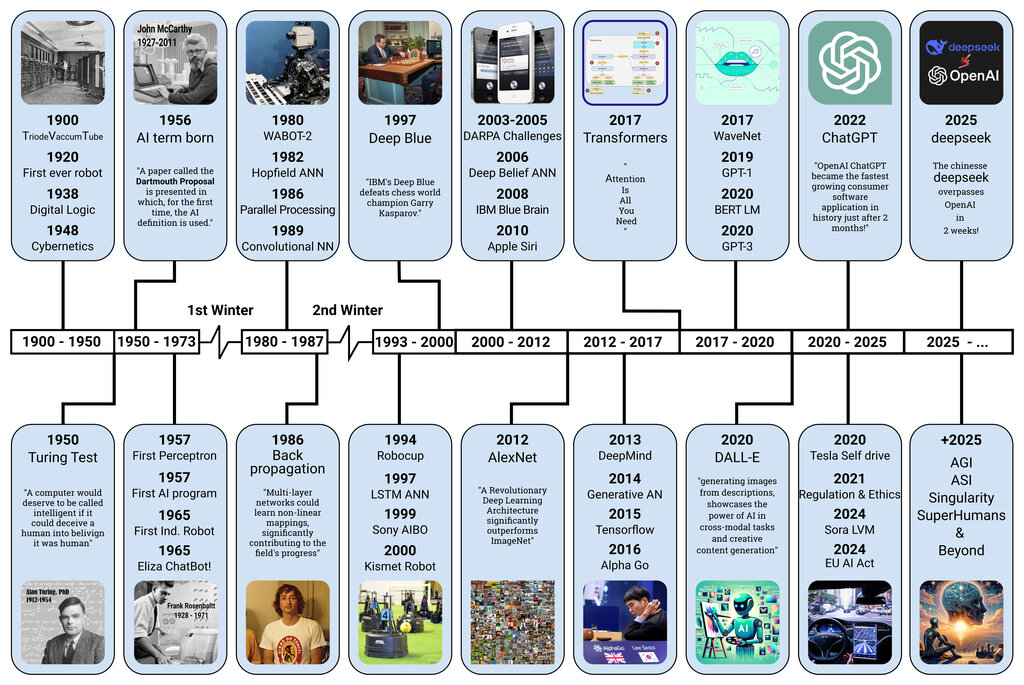
A major milestone came in 1997 when IBM's chess computer, Deep Blue, defeated world champion Garry Kasparov. This was a huge public moment for AI. It showed that a machine could master a complex, strategic game once thought to be the exclusive domain of human intellect.
In the following decades, progress accelerated thanks to two key factors: the availability of massive amounts of data and huge increases in computing power. These ingredients fueled the rise of machine learning, a subfield of AI that allows computers to learn from data without being explicitly programmed.
From chess champions to today's language models, each step built on the last, turning science fiction into practical reality.
This historical journey, with its cycles of excitement and disappointment, laid the foundation for the powerful AI tools we see today.
What is the primary goal of the field of artificial intelligence?
The term "artificial intelligence" was coined at a workshop in 1956. Where was this influential workshop held?