Introduction to Artificial Intelligence
Introduction to Artificial Intelligence
What Is Artificial Intelligence?
At its core, artificial intelligence is the science of making machines that can think or act like humans. The goal is to create systems that can perform tasks that typically require human intelligence, such as learning, reasoning, problem-solving, and understanding language.
Think of it this way: we're trying to build a machine that can learn from experience, adjust to new inputs, and perform human-like tasks.
Artificial Intelligence
noun
A field of computer science dedicated to creating systems capable of performing tasks that normally require human intelligence.
This doesn't mean creating robots that look and act exactly like us. AI can be something as simple as the software that suggests your next song or as complex as a system that helps doctors diagnose diseases.
A Quick Trip Through Time
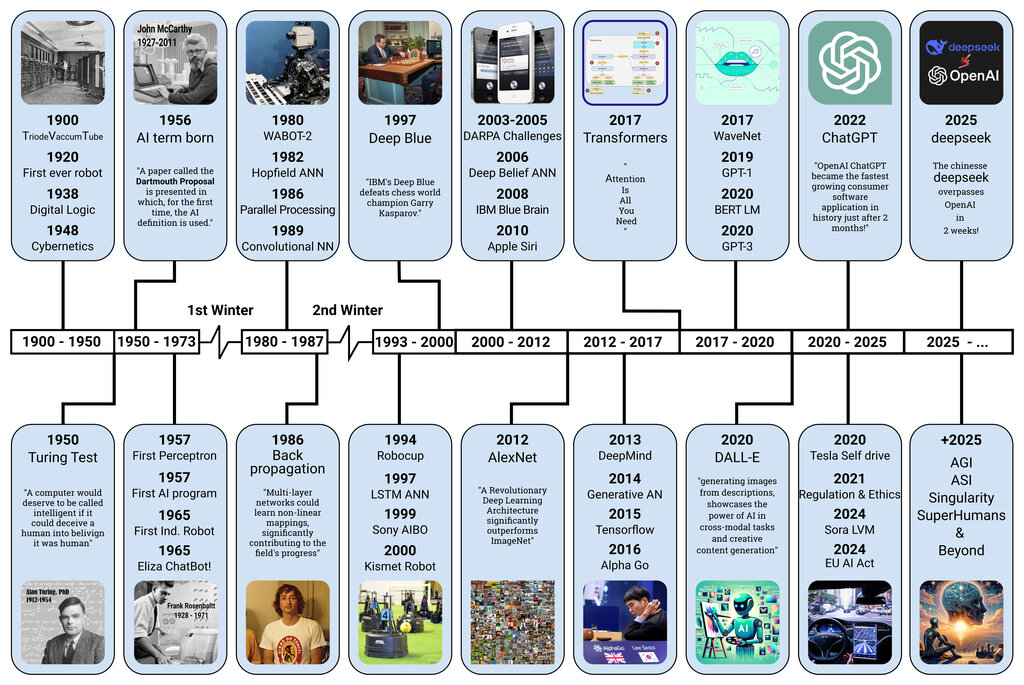
The idea of intelligent machines has been around for centuries, but the modern field of AI began to take shape in the 1950s. The term "artificial intelligence" was first coined at a workshop at Dartmouth College in 1956. This event brought together the founding fathers of the field and kicked off decades of research.
The journey wasn't a straight line. Early excitement led to bold predictions, but progress was slow. Limited computing power and data led to periods known as "AI winters," when funding and interest dried up. But in the last couple of decades, things have changed dramatically. The rise of the internet created massive amounts of data, and faster computers provided the power to process it. These two ingredients fueled the rapid advancements we see today.
Two Kinds of AI
When people talk about AI, they are usually referring to one of two broad categories: Narrow AI or General AI. Understanding the difference is key to understanding where the technology is today and where it might be headed.
Think of it as the difference between a specialist and a generalist. One is an expert in a single area, while the other can handle almost anything you throw at it.
Artificial Narrow Intelligence (ANI), often called Weak AI, is the only type of AI we have successfully created so far. It's designed and trained for one specific task. Your virtual assistant, the AI that recommends movies, and language translation apps are all examples of Narrow AI. They can be incredibly good at their single job, sometimes even better than humans, but they can't operate outside of it.
Artificial General Intelligence (AGI), or Strong AI, is the kind of AI you see in movies. This is a machine with the ability to understand, learn, and apply its intelligence to solve any problem, much like a human being. AGI doesn't exist yet. Creating a machine with the flexible, common-sense reasoning of a human is one of the biggest challenges in computer science.
| Feature | Narrow AI (ANI) | General AI (AGI) |
|---|---|---|
| Scope | Performs a single, specific task | Can handle any intellectual task |
| Learning | Trained on a specific dataset | Learns and adapts on its own |
| Examples | Siri, Alexa, Spam filters | Fictional characters like HAL 9000 |
| Status | Exists today | Theoretical / In development |
Now that you have a grasp of the basics, let's test your knowledge.
What is the core goal of artificial intelligence?
The term 'artificial intelligence' was first coined at a 1956 workshop held at which institution?
Understanding these core concepts is the first step in exploring the fascinating world of artificial intelligence.