Introduction to Artificial Intelligence
Introduction to AI
What Is AI Anyway?
Artificial Intelligence, or AI, is about creating machines that can think, learn, and solve problems like humans do. It's a broad field in computer science focused on building smart systems that can perform tasks that typically require human intelligence. This could be anything from understanding language to recognizing patterns or making decisions.
Artificial Intelligence
noun
A field of computer science dedicated to creating systems capable of performing tasks that normally require human intelligence, such as visual perception, speech recognition, decision-making, and translation between languages.
Think of it less as creating a conscious robot and more as giving software the ability to reason and learn from data. Instead of being explicitly programmed for every single step, an AI system can adapt and improve its performance over time.
Three Flavors of AI
AI isn't a single, monolithic thing. Experts usually classify it into three main types based on its capabilities. Understanding these categories helps clarify what AI can do today and what it might do tomorrow.
Artificial Narrow Intelligence (ANI): This is the only type of AI we have successfully created so far. ANI is designed to perform a single specific task, like playing chess, recognizing faces in photos, or filtering spam from your email. It can be incredibly powerful at its one job but can't operate outside of that narrow domain. Your smartphone's voice assistant is a classic example of narrow AI.
Next are the two types that are still in the realm of science fiction and active research.
Artificial General Intelligence (AGI): This is the AI you often see in movies. AGI would have the ability to understand, learn, and apply knowledge across a wide range of tasks at a level comparable to a human. It wouldn't just be good at one thing; it could switch contexts, reason abstractly, and solve new problems it wasn't specifically trained for.
Artificial Superintelligence (ASI): This is the next hypothetical step. An ASI would be an intellect that is much smarter than the best human brains in virtually every field, including scientific creativity, general wisdom, and social skills. It's a concept that raises profound questions about the future of humanity.
A Brief History of AI
The dream of creating intelligent machines is ancient, but the scientific pursuit of AI began in the 1950s. The field was officially born at a 1956 workshop at Dartmouth College, where the term "artificial intelligence" was coined.
The early years were filled with excitement and optimism. Researchers developed programs that could solve algebra problems, prove logical theorems, and speak simple English. But the initial hype outpaced reality. The complexity of creating true intelligence was far greater than anticipated, leading to periods of reduced funding and interest known as "AI winters."
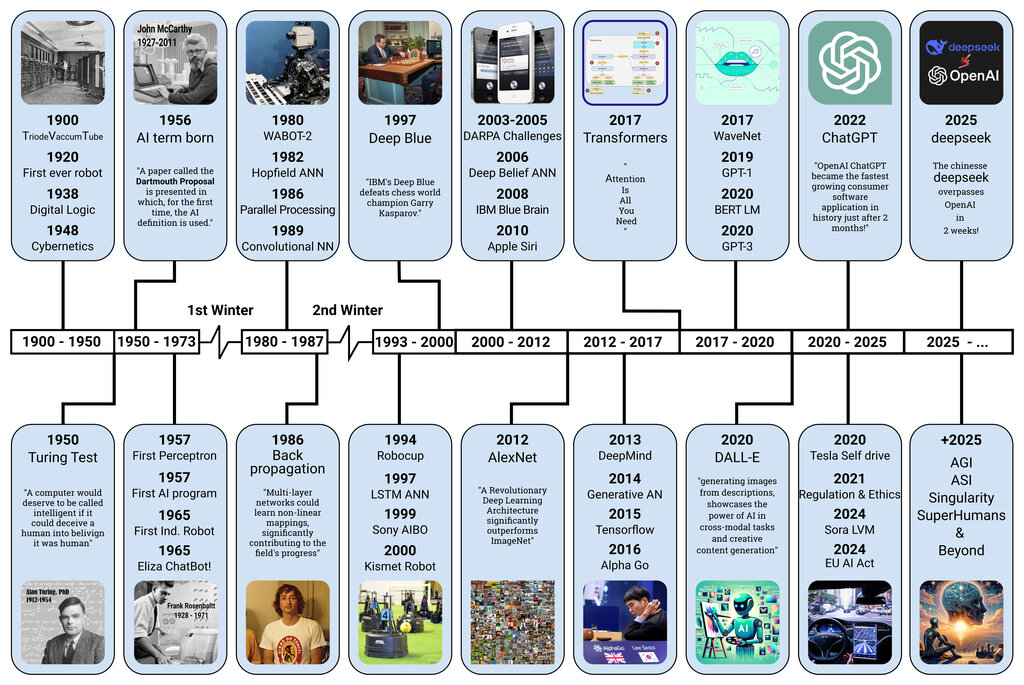
Things began to change in the 1990s and 2000s. A combination of faster computers, larger datasets, and smarter algorithms reignited the field. In 1997, IBM's Deep Blue chess computer famously defeated world champion Garry Kasparov, a major milestone that captured public attention.
More recently, the rise of "deep learning," a technique inspired by the structure of the human brain, has powered a new wave of breakthroughs. This has led to the advanced AI we interact with today, from powerful search engines and recommendation systems to the generative models that can create text and images.
What is the primary goal of Artificial Intelligence as a field of computer science?
The term "artificial intelligence" was officially coined at a workshop in 1956.
This foundation gives us a starting point for understanding where AI is today and where it might be headed. We've defined what it is, explored its different types, and taken a quick tour of its history.