Introduction to Artificial Intelligence
Introduction to Artificial Intelligence
What Is Artificial Intelligence?
Artificial intelligence, or AI, is the science of making machines that can think and learn. The goal is to build systems that can perform tasks that normally require human intelligence, like recognizing faces, understanding speech, or making decisions.
This introduction to this special issue discusses artificial intelligence (AI), commonly defined as “a system’s ability to interpret external data correctly, to learn from such data, and to use those learnings to achieve specific goals and tasks through flexible adaptation.”
Think of it like this: you can give a computer a set of rigid rules to follow, like a calculator. That's automation, but it's not intelligence. Intelligence is about flexibility and adaptation. An AI system learns from experience, just like we do. It looks at vast amounts of information, finds patterns, and uses those patterns to make predictions or take action in new situations.
A Field with Many Layers
AI isn't a single technology. It's a broad field of study with many different branches and techniques. You'll often hear terms like machine learning and deep learning used alongside AI. They are all related, but they aren't the same thing.
- Artificial Intelligence is the overall concept of creating intelligent machines.
- Machine Learning (ML) is a subset of AI. It's a specific approach that involves training a system on data to learn without being explicitly programmed.
- Deep Learning (DL) is a subset of machine learning that uses complex, multi-layered structures called neural networks, which are loosely inspired by the human brain.
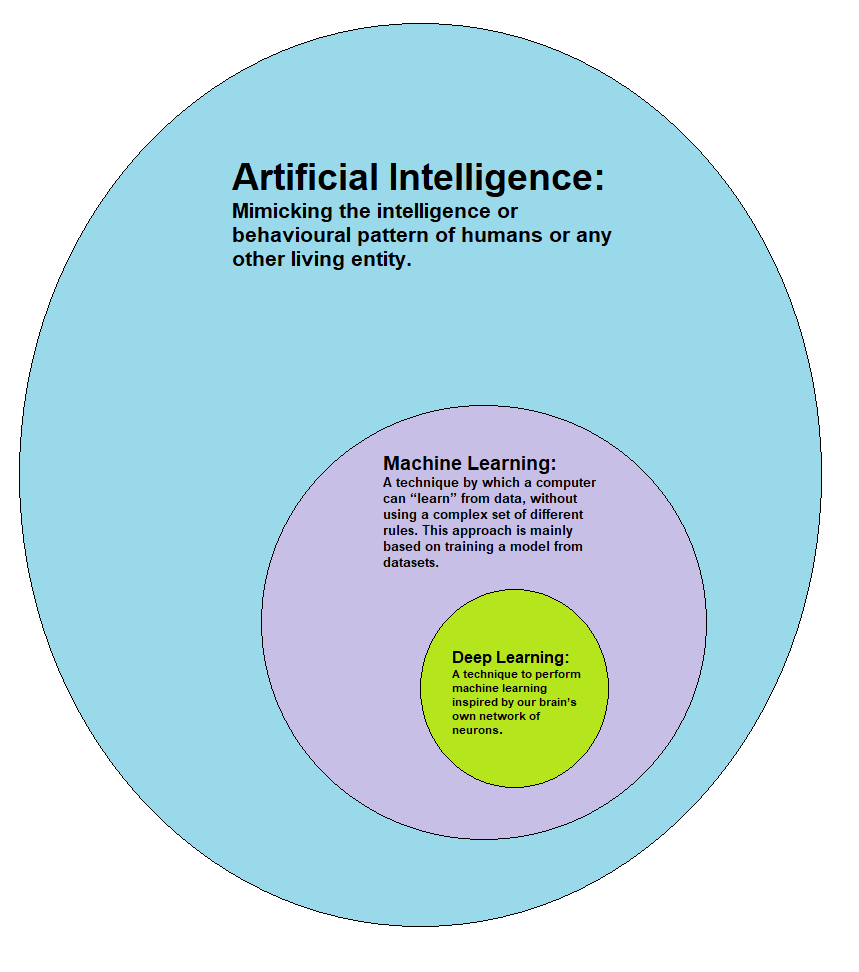
This layered relationship is important. Most of the AI we interact with today, from voice assistants to streaming recommendations, is powered by machine learning and deep learning techniques. Understanding this hierarchy helps clarify what people mean when they talk about "AI".
Core Principles
At its core, a typical AI system follows a simple loop: it takes in data, processes it to find patterns or make predictions, and then produces an output. The key is the "processing" step, where the learning happens. The system adjusts its internal logic based on the data it sees, getting better and more accurate over time.
For example, to train an AI to recognize cats, you would show it thousands of pictures, some with cats and some without. The system analyzes the images and learns the visual patterns associated with "cat." After enough training, it can accurately identify a cat in a new picture it has never seen before.
AI in the Real World
The significance of AI comes from its wide range of applications. It's no longer a futuristic concept; it's a practical tool being used today across nearly every industry to solve complex problems and create new possibilities.
| Sector | AI Application Example |
|---|---|
| Healthcare | Analyzing medical images like X-rays and MRIs to detect diseases earlier and more accurately than the human eye. |
| Finance | Detecting fraudulent credit card transactions in real-time by identifying unusual spending patterns. |
| Transportation | Powering self-driving cars, which use sensors and AI to perceive their environment and navigate safely. |
| Entertainment | Recommending movies, music, and shows based on your viewing history and preferences. |
| Customer Service | Using chatbots to answer common questions and resolve issues, freeing up human agents for more complex problems. |
These examples are just the beginning. As technology advances, AI is becoming more integrated into the tools we use every day, often in ways we don't even notice. It's a foundational technology that is reshaping our world.
What is the primary goal of artificial intelligence?
Which statement best describes the relationship between Artificial Intelligence (AI), Machine Learning (ML), and Deep Learning (DL)?
From making daily life more convenient to solving some of humanity's biggest challenges, AI is a powerful force with vast potential.