Introduction to Artificial Intelligence
Introduction to Artificial Intelligence
What Is Artificial Intelligence?
At its core, artificial intelligence is about creating machines that can think, learn, and solve problems like humans do. Think of it like teaching a computer to do more than just follow instructions. Instead of just calculating numbers, it can recognize a face in a photo, translate a sentence, or even drive a car.
A system’s ability to interpret external data correctly, to learn from such data, and to use those learnings to achieve specific goals and tasks through flexible adaptation.
This might sound complex, but you interact with AI every day. When your phone suggests a faster route to work or a streaming service recommends a movie you might like, that's AI in action. It's a broad field in computer science focused on building smart machines capable of tasks that typically require human intelligence.
A Brief History of AI
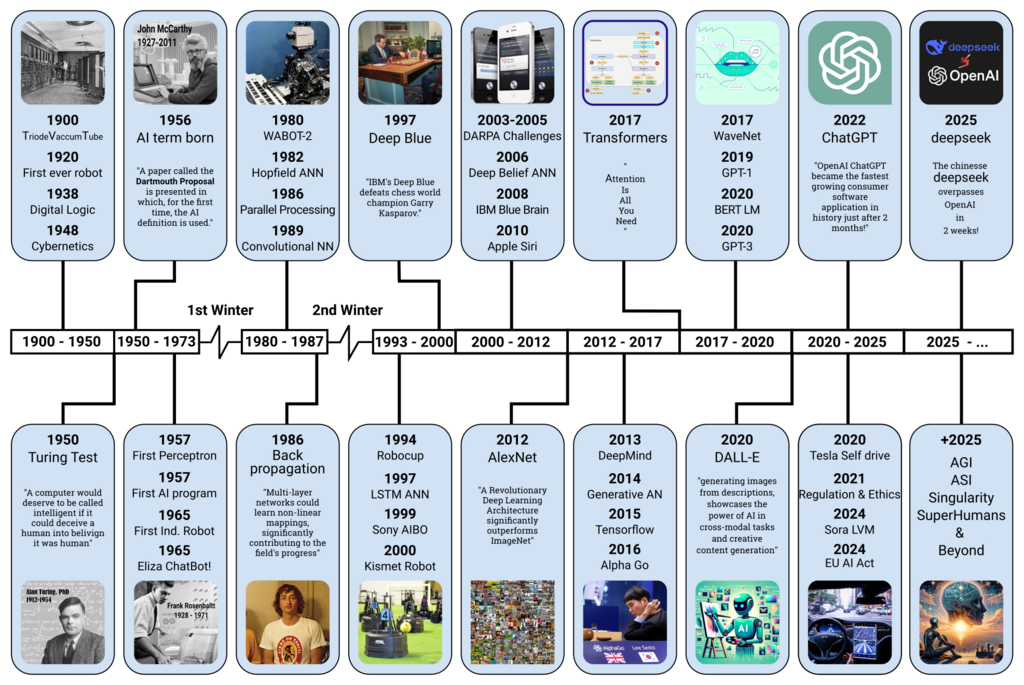
The dream of creating intelligent machines has been around for centuries, but the modern field of AI officially began in the summer of 1956. A group of scientists gathered at Dartmouth College for a workshop where they coined the term "artificial intelligence."
Early AI research was full of optimism. Researchers developed programs that could solve algebra problems, prove theorems in logic, and speak simple English. However, progress slowed in the 1970s and 80s due to limitations in computing power and data. This period is sometimes called the "AI winter."
Things picked up again in the 1990s and 2000s with the rise of the internet and more powerful computers. Suddenly, there was a massive amount of data to train AI systems on, leading to breakthroughs that power the technology we use today.
Types of AI
Not all AI is created equal. The AI we have today is very different from the intelligent robots we see in movies. We can broadly categorize AI into two main types: Narrow AI and General AI.
Artificial Narrow Intelligence
noun
Also known as Weak AI, this type of artificial intelligence is designed and trained for a particular task. It operates within a limited context and is a master of its specific domain.
Artificial Narrow Intelligence (ANI) is all around us. Your smart assistant, the recommendation algorithm on a shopping website, and the software that recognizes your face to unlock your phone are all examples of ANI. They are incredibly good at what they do, but they can't operate outside of their specific programming. You can't ask your spam filter for a weather forecast, for instance.
Narrow AI is a specialist. It excels at one specific job.
Artificial General Intelligence
noun
Also known as Strong AI, this is a theoretical form of AI where a machine would have an intellect comparable to a human's. It would have a self-aware consciousness and the ability to solve problems, learn, and plan for the future.
Artificial General Intelligence (AGI) is the kind of adaptable, flexible intelligence that we humans possess. An AGI system could learn to do anything a human can, from washing dishes to composing a symphony. Currently, AGI is still the stuff of science fiction and a long-term goal for many researchers. Building a machine with the common sense and broad understanding of the world that humans have is an incredibly complex challenge.
General AI is a generalist. It could theoretically perform any intellectual task a human can.
Understanding this distinction is key. The AI revolution we're currently experiencing is driven entirely by advances in Narrow AI.
What is the primary goal of artificial intelligence?
The period in the 1970s and 80s when progress in AI research slowed due to technical limitations is often referred to as the...
This foundation gives you a starting point for understanding the world of AI. It's a field built on decades of research, now focused on specialized systems that are becoming more integrated into our lives.