Introduction to Artificial Intelligence
Introduction to AI
What Is Artificial Intelligence?
Artificial intelligence, or AI, is a field of computer science focused on creating systems that can perform tasks that typically require human intelligence. This includes things like learning from experience, solving problems, understanding language, and recognizing patterns.
Think of it less as creating a robot that looks and acts exactly like a person, and more as trying to build the underlying processes of thought. The goal is to create machines that can reason, learn, and adapt on their own.
artificial intelligence
noun
The theory and development of computer systems able to perform tasks that normally require human intelligence, such as visual perception, speech recognition, decision-making, and translation between languages.
At its core, AI is about developing algorithms, which are sets of rules or instructions, that allow computers to process information and make decisions. These algorithms are designed to improve over time, just like a person gets better at a new skill with practice.
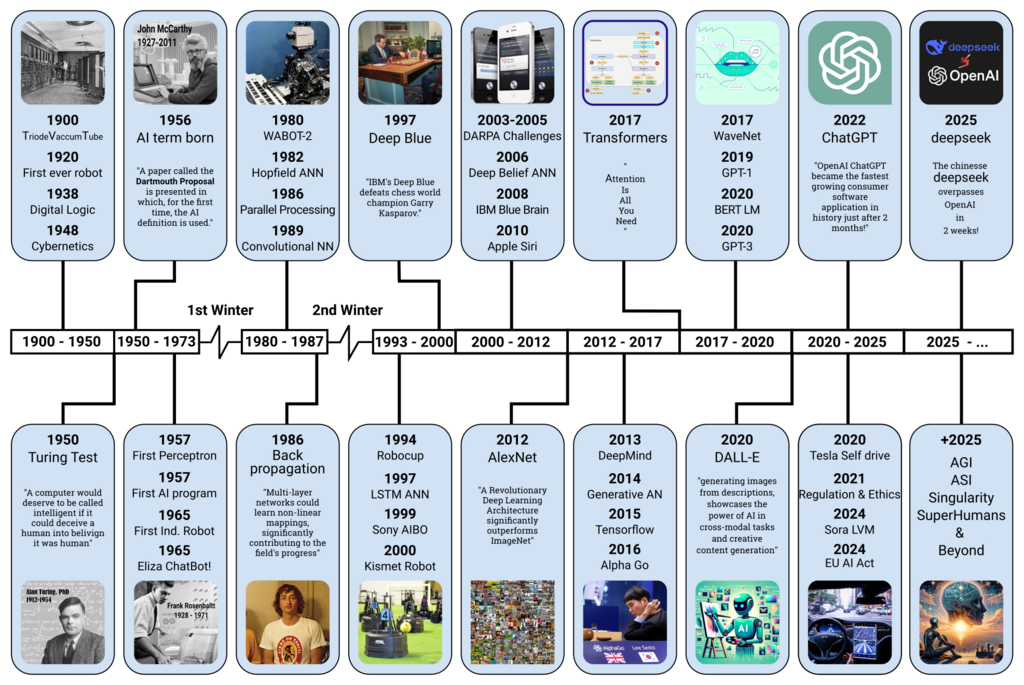
A Brief History of AI
The idea of artificial minds isn't new. Philosophers have wondered about it for centuries, and stories of automated beings date back to ancient myths. But the scientific pursuit of AI began in the mid-20th century, alongside the development of the first electronic computers.
A pivotal moment came in 1956 at the Dartmouth Workshop. It was here that a group of scientists officially coined the term "artificial intelligence" and laid out the field's ambitious goals. Early researchers were incredibly optimistic, believing that a machine with human-like intelligence was just a few decades away.
Early AI focused on symbolic reasoning, where knowledge was represented by symbols and rules. A program might have rules like, "If it has feathers and can fly, then it is a bird." This approach worked well for clearly defined problems, like playing chess.
However, progress slowed in the 1970s and 80s. The real world turned out to be much messier and more complex than a chessboard. Computers weren't powerful enough, and the systems couldn't handle ambiguity. This led to periods known as "AI winters," when funding and interest in the field dried up because of the slow progress.
Things began to change in the 1990s and 2000s. Two key factors sparked a resurgence: the explosion of data from the internet and the availability of much more powerful computers. These ingredients allowed for a new approach to AI to flourish.
The Core Principles
Modern AI is built on a few fundamental principles. Instead of programming explicit rules for every single situation, we now create systems that can learn the rules themselves from data. This is a major shift from the early symbolic approach.
Start with learning about AI’s basic concepts, such as machine learning, natural language processing (NLP), and neural networks.
The three core ideas you'll encounter are:
-
Learning: AI systems learn from vast amounts of data. A system learns to identify cats by analyzing thousands of cat photos, not by being programmed with rules about whiskers, ears, and tails. The system finds the patterns on its own.
-
Representation: AI needs a way to store and organize knowledge about the world. This is its "representation" of information. It could be a network of concepts, a statistical model, or a complex web of interconnected nodes inspired by the human brain.
-
Inference: Once an AI has learned from data and created a representation of that knowledge, it can use that to make predictions or decisions about new, unseen information. This is called inference. For example, after learning from cat photos, it can infer whether a new photo contains a cat.
These principles work together. A system is fed data (learning), it organizes what it finds into a useful model (representation), and then it applies that model to new situations (inference). This cycle is the engine that powers most modern AI.
Now let's check your understanding of these foundational ideas.
What is the central goal of artificial intelligence as a field of computer science?
The term 'artificial intelligence' was officially coined at which pivotal 1956 event?
This introduction covers the essential origins and principles of AI. Understanding this foundation is the first step toward exploring its more advanced concepts and real-world applications.