Introduction to Artificial Intelligence
Introduction to Artificial Intelligence
What Is Artificial Intelligence?
Artificial intelligence is the science of making machines that can think and learn like humans. The goal is to create systems that can perform tasks that typically require human intelligence, such as understanding language, recognizing patterns, and solving problems.
At its core, AI is about giving computers the ability to learn from experience, adjust to new inputs, and perform human-like tasks.
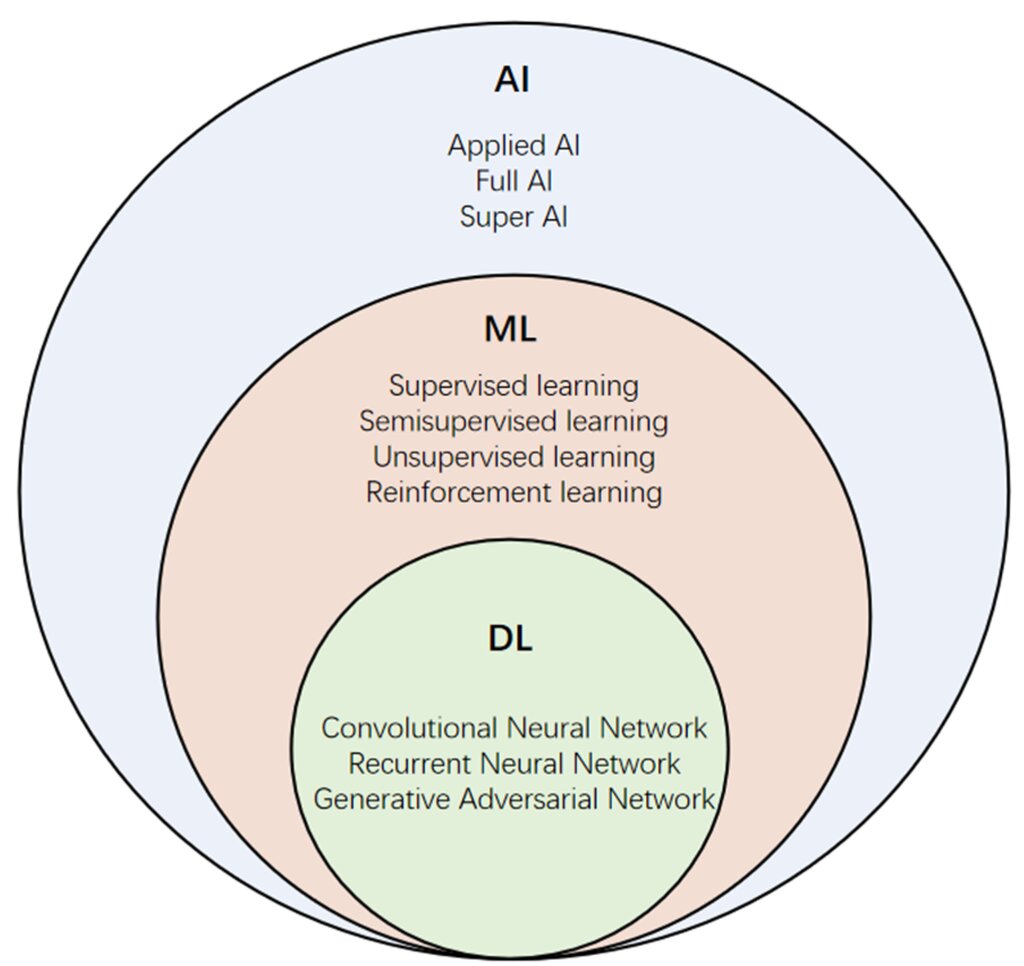
Think of AI as a broad field, like biology or mathematics. Within it are several key areas. The most important ones to know are Machine Learning and Deep Learning.
- Machine Learning (ML) is a subset of AI. It uses statistical methods to enable machines to improve at tasks with experience (i.e., data).
- Deep Learning (DL) is a subset of Machine Learning. It uses complex structures called neural networks to learn from vast amounts of data. This is the technology behind many recent AI breakthroughs.
This relationship is often shown as a set of nested circles, with AI being the largest, containing ML, which in turn contains DL.
A Brief History
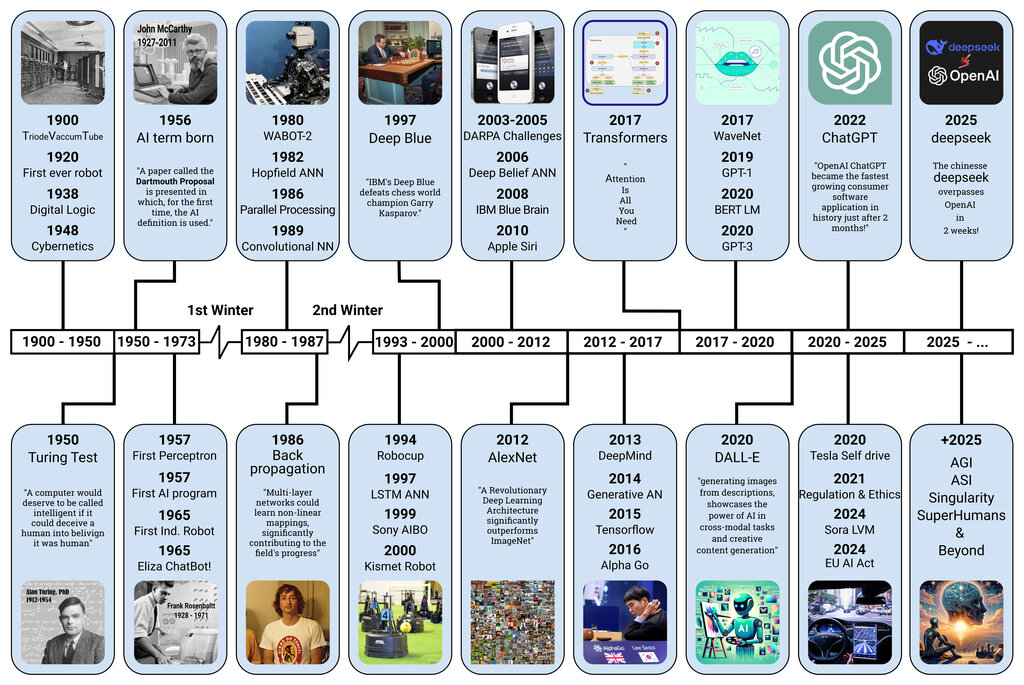
The idea of intelligent machines has been around for centuries, but the modern field of AI officially began in 1956 at a workshop at Dartmouth College. It was there that the term “artificial intelligence” was coined.
The history of AI has seen cycles of optimism followed by periods of reduced funding and interest, known as “AI winters.” Early excitement was often followed by the realization that creating true intelligence was incredibly difficult. However, recent advances in computing power and the availability of massive datasets have led to the current boom in AI development.
The Three Types of AI
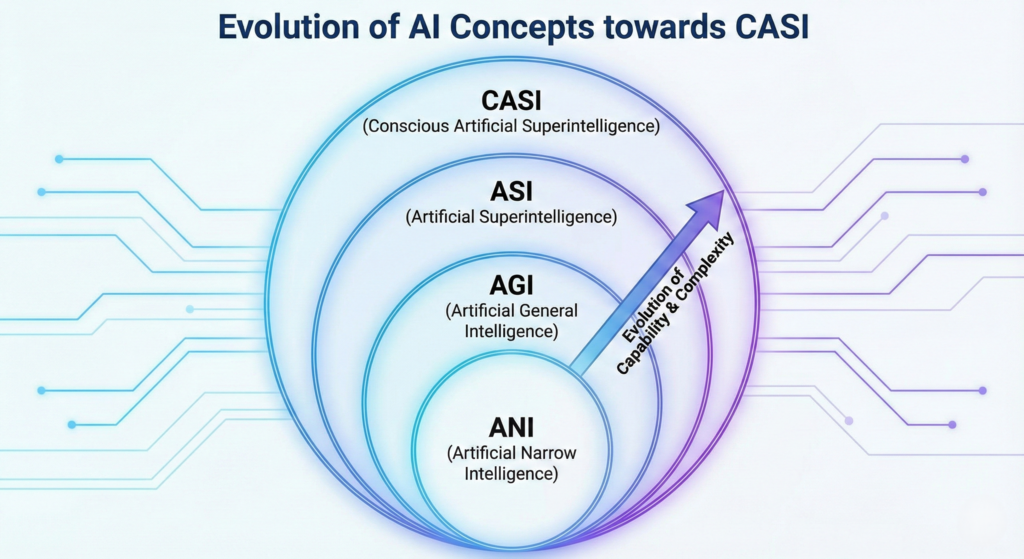
AI systems are often categorized by their level of capability. There are three main types.
Artificial Narrow Intelligence
noun
Also known as Weak AI, this is AI that is specialized for one particular task. It operates within a limited, pre-defined range of functions.
All the AI we use today is ANI. This includes everything from the recommendation engine that suggests what you should watch next to self-driving cars. While incredibly powerful at their specific jobs, these systems can't perform tasks outside of their single purpose.
A chess-playing AI can beat a world champion, but it can't tell you the weather or recognize a cat in a photo.
The next two types are theoretical and do not yet exist.
| Type | Description | Status |
|---|---|---|
| Artificial General Intelligence (AGI) | An AI with the ability to understand, learn, and apply knowledge in a wide range of tasks at a human level. | Hypothetical |
| Artificial Superintelligence (ASI) | An AI that surpasses human intelligence and ability across virtually all domains, from creativity to problem-solving. | Hypothetical |
How AI Learns
So, how does an AI system actually learn? The engine driving most modern AI is a concept inspired by the human brain: the neural network.
Neural Network
noun
A computing system made up of interconnected nodes, or neurons, that process information in a way similar to the human brain. These networks learn to perform tasks by analyzing examples, generally without being programmed with task-specific rules.
Deep Learning takes this concept further by using neural networks with many layers—hence the term "deep." Each layer learns to detect different features. For example, in an image recognition system, the initial layers might detect simple edges and colors. Subsequent layers combine these features to recognize more complex patterns like shapes, textures, and eventually, whole objects like a car or a person.
This layered approach allows deep learning models to handle incredibly complex patterns and make highly accurate predictions, which is why they are so significant in modern technology.
This foundational knowledge sets the stage for understanding how AI is being applied across countless fields, from healthcare to entertainment, reshaping our world in the process.