Introduction to Artificial Intelligence
Introduction to AI
The Idea of a Thinking Machine
Artificial Intelligence is about creating machines that can think, learn, and solve problems in ways that typically require human intelligence. It's a field of computer science dedicated to building smart systems that can perform tasks like understanding language, recognizing images, and making decisions.
Artificial Intelligence
noun
A field of computer science focused on creating systems that can perform tasks that normally require human intelligence.
The goal isn't necessarily to replicate the human mind perfectly. Instead, it’s about simulating intelligent behavior. Some AI systems learn from vast amounts of data to spot patterns, while others are programmed with a set of rules to follow. At its core, AI is the science of making things smart.
A Brief History of AI
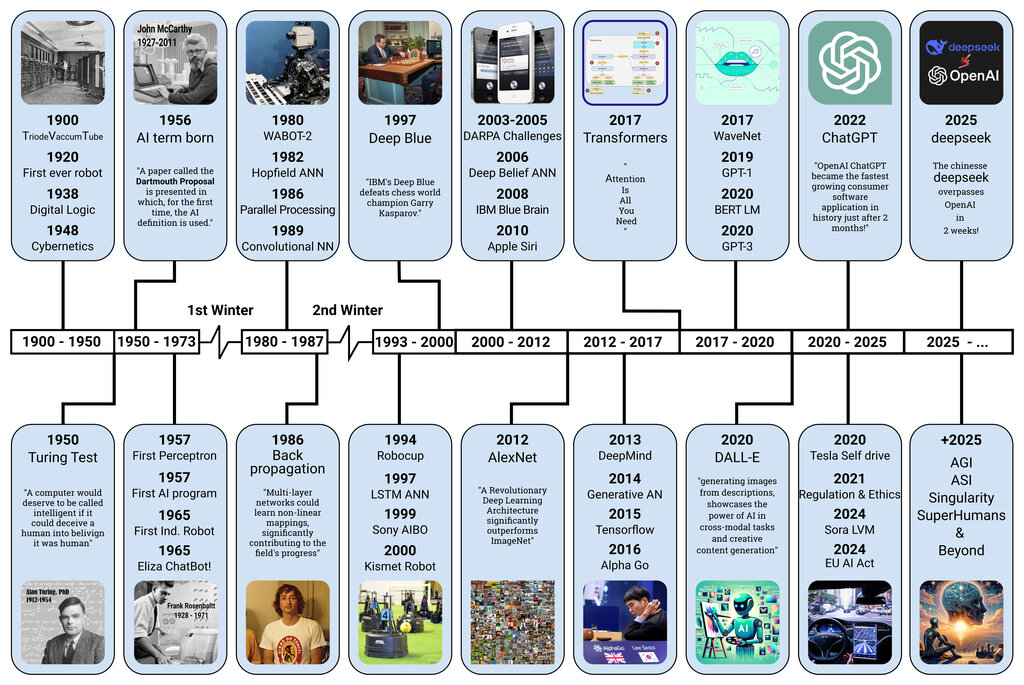
The concept of artificial beings with intelligence has been around for centuries, but the modern field of AI officially began in the summer of 1956. A group of researchers gathered at Dartmouth College for a workshop where they coined the term "Artificial Intelligence" and laid out the field's foundational goals.
The years that followed were a mix of incredible optimism and frustrating setbacks. Periods of rapid progress and funding were known as "AI summers," while times of disillusionment and reduced investment were called "AI winters." Early successes, like programs that could solve algebra problems, led to bold predictions. But the complexity of creating true intelligence proved to be far greater than imagined.
Understanding the history of artificial intelligence is crucial for grasping its current capabilities and future potential.
Key breakthroughs, like the development of machine learning algorithms and the explosion of computing power and data, have pushed the field forward. These milestones brought AI out of the lab and into our daily lives.
Two Kinds of AI
When people talk about AI, they are usually referring to one of two broad categories. It's important to distinguish between the AI we have today and the AI we see in movies.
First, there's Artificial Narrow Intelligence (ANI), sometimes called Weak AI. This is the only type of AI that currently exists. ANI is designed to perform a single, specific task very well. A chess program that can beat a grandmaster is a form of ANI. So are voice assistants, facial recognition systems, and recommendation algorithms that suggest what you should watch next.
All the AI we use today, from your phone's assistant to complex diagnostic tools, is a form of Narrow AI. Each is a specialist, not a generalist.
The other category is Artificial General Intelligence (AGI), or Strong AI. This is the more futuristic, sci-fi version of AI. AGI refers to a machine with the ability to understand, learn, and apply knowledge across a wide range of tasks at a human level. An AGI would be able to do anything a human can, from cooking a meal to writing a novel to reasoning about complex scientific problems. Currently, AGI remains a theoretical concept and a long-term goal for researchers.
Why AI Matters
Artificial Intelligence is more than just a fascinating area of research; it has become a powerful force in our society. Its significance lies in its ability to process and analyze data at a scale and speed that is beyond human capability. This opens up new possibilities for solving some of the world's most complex challenges.
From advancing medical research to making transportation safer and creating more efficient systems for energy and logistics, AI is a tool that can augment human abilities. It helps us find patterns we might miss, automate tedious tasks, and make more informed decisions.
Understanding the basics of AI is no longer just for scientists and engineers. It's becoming essential for everyone, as these technologies continue to shape our world in profound ways.
What is the primary goal of Artificial Intelligence?
The term 'Artificial Intelligence' was first coined at a workshop held in 1956 at which institution?