Introduction to Artificial Intelligence
Introduction to Artificial Intelligence
What Is Artificial Intelligence?
Artificial intelligence, or AI, is the science of making machines that can think, learn, and solve problems. The goal is to simulate human intelligence in a computer. This includes abilities like understanding language, recognizing faces in a crowd, making decisions, and even creating art.
Think of it this way: when we write a traditional computer program, we give it a precise set of rules to follow. To sort a list of numbers, we write step-by-step instructions. But with AI, we build systems that can figure out the rules for themselves by looking at examples. Instead of telling it how to identify a cat, we show it thousands of cat pictures and let it learn the patterns.
In essence, AI aims to create systems that can perform tasks that would otherwise require human intelligence.
The Dawn of an Idea
The dream of intelligent machines isn't new. Ancient myths have stories of artificial beings. But the modern journey began in the mid-20th century with pioneers who saw the potential of computers.
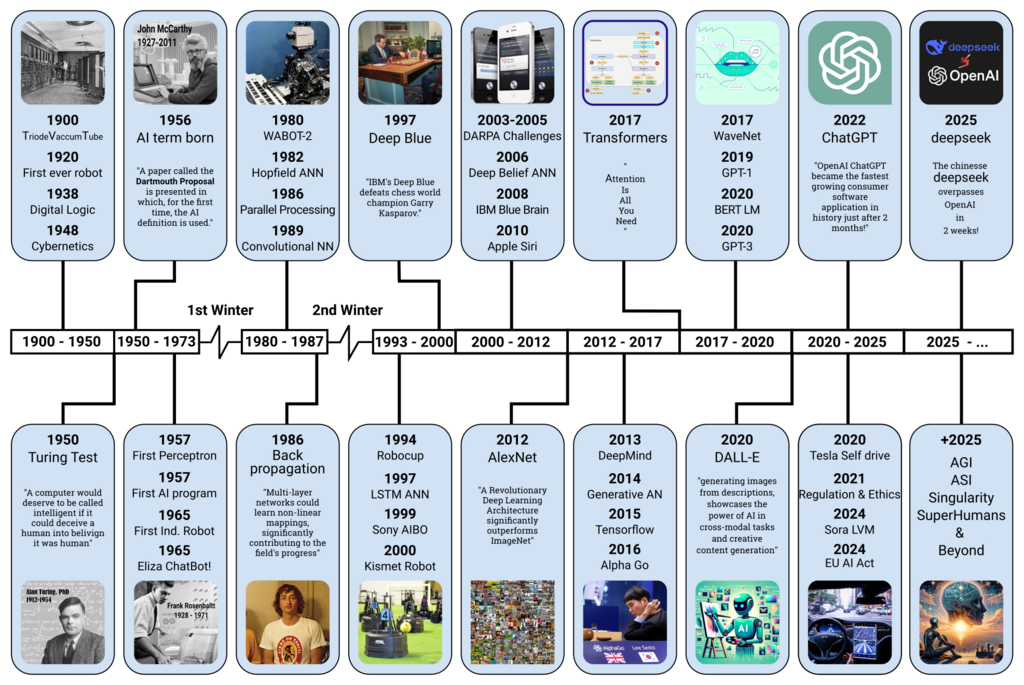
In 1950, British mathematician Alan Turing proposed a famous test. Could a machine's conversation be indistinguishable from a human's? The “Turing Test” became a foundational concept for AI, focusing on behavior rather than mechanics. It asked a simple question: If it acts intelligent, does it matter if it's not thinking like us?
This intellectual spark caught fire. The term “artificial intelligence” was officially coined in 1956 at a summer workshop at Dartmouth College. A small group of scientists gathered to explore the idea that “every aspect of learning or any other feature of intelligence can in principle be so precisely described that a machine can be made to simulate it.” They were optimistic, believing a machine with human-level intelligence was just a few decades away.
Milestones and Winters
The years after Dartmouth were full of excitement. Early AI programs could solve algebra problems and prove logical theorems. But progress was slower than expected. The complexity of human intelligence was far greater than the early researchers had imagined, and computers weren't powerful enough for the challenge.
This led to periods known as “AI winters.” Hype outpaced results, causing funding to dry up and public interest to fade. Researchers had promised thinking machines, but the reality was far more limited.
An AI winter is a period of reduced funding and interest in artificial intelligence research.
Yet, the field always bounced back. In the 1980s, “expert systems” became a success. These programs captured the knowledge of human experts in a specific domain, like diagnosing medical conditions, and could offer reasonable advice. A major public milestone came in 1997 when IBM's Deep Blue chess computer defeated world champion Garry Kasparov. It was a clear demonstration that a machine could master a complex, strategic task once thought to be the exclusive domain of human intellect.
These events, from early theories to groundbreaking achievements, map out the journey of AI.
The Fuel for Modern AI
So why is AI booming now? Three key factors came together to create the perfect storm for rapid progress.
First, we have big data. The internet, smartphones, and sensors have created an unimaginable amount of information. This data is the food for modern AI systems. The more examples an AI has to learn from, the smarter it gets.
Second is a massive increase in computing power. The same graphics processing units (GPUs) that make video games look so realistic are perfect for running AI models. They can perform many calculations at once, which is exactly what's needed to process huge datasets and train complex algorithms.
Finally, we developed smarter algorithms. Researchers have made huge leaps in machine learning techniques, particularly in an area called deep learning, which uses structures inspired by the human brain called neural networks. These improved methods are much better at finding subtle patterns in data.
This combination of vast data, powerful computers, and advanced algorithms has fueled the AI revolution we see today.