Introduction to Artificial Intelligence
Introduction to AI
What is Artificial Intelligence?
Artificial Intelligence is about making computers think or act like humans. The goal is to create systems that can perform tasks that normally require human intelligence, like understanding language, recognizing images, making decisions, and solving problems. It's a broad field with many different approaches.
Artificial Intelligence
noun
The theory and development of computer systems able to perform tasks that normally require human intelligence.
At its core, AI isn't just one thing. It's a collection of ideas and technologies that have changed over time. The main goal has always been the same: to build machines that are smart.
A Journey Through Time
The dream of intelligent machines is ancient, but the scientific journey began in the mid-20th century. In 1950, computer scientist Alan Turing proposed a key question: "Can machines think?" He devised the Turing Test, a way to gauge a machine's ability to exhibit intelligent behavior indistinguishable from that of a human.
The Turing Test is simple: if a human interrogator can't tell whether they're communicating with a person or a machine, the machine is said to have passed the test.
The term "Artificial Intelligence" was coined in 1956 at the Dartmouth Workshop. This event, organized by figures like John McCarthy and Marvin Minsky, brought together the field's founding fathers and officially launched AI as a research discipline. The early years were filled with optimism, leading to programs that could solve algebra problems and play checkers.
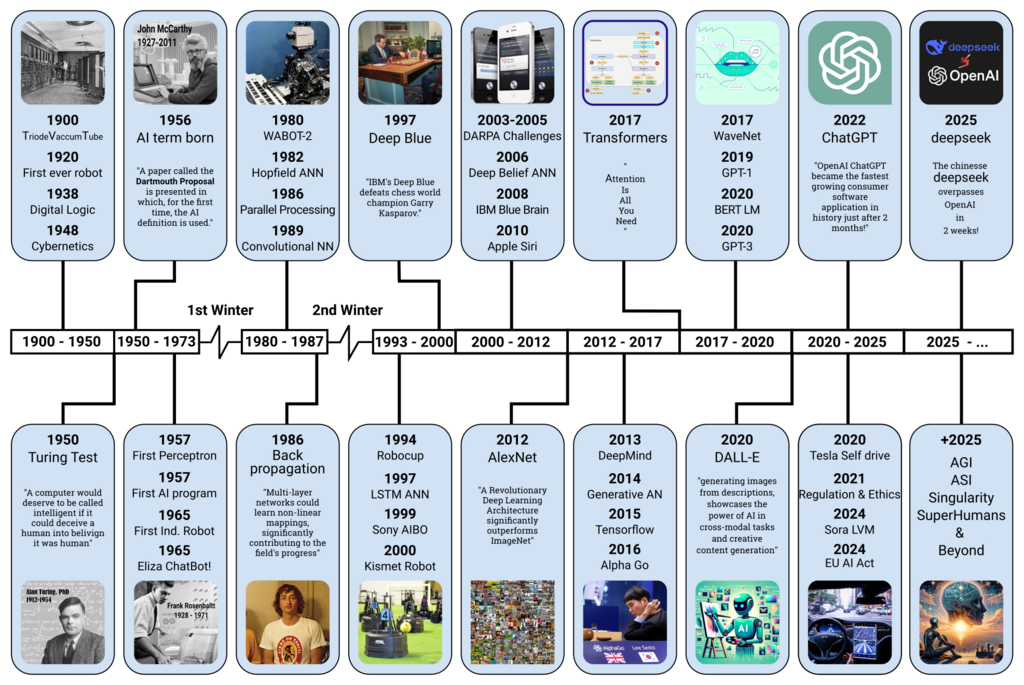
But the initial excitement hit a wall. The problems turned out to be much harder than expected. A lack of computing power and data led to a period in the 1970s and late 1980s known as the "AI winters," when funding and interest dried up. Despite this, progress continued quietly. In the 1990s, IBM's Deep Blue computer defeated world chess champion Garry Kasparov, a landmark achievement that brought AI back into the public eye.
Shifting Ideas
Early AI research followed a paradigm called Symbolic AI, or "Good Old-Fashioned AI." The idea was to program computers with explicit rules about the world. For example, to identify a cat, you would program rules like "if it has fur, whiskers, and pointy ears, it's a cat." This approach worked for well-defined, logical problems like chess but struggled with the messiness of the real world.
A different idea, called Connectionism, began to take hold. Inspired by the structure of the human brain, this approach uses networks of artificial neurons to learn patterns from data, rather than being explicitly programmed. This is the foundation of modern machine learning and deep learning.
The real breakthrough came in the 2010s with the rise of Deep Learning. This is a subfield of machine learning that uses very large neural networks with many layers. Thanks to massive amounts of data and powerful new hardware, deep learning models have achieved remarkable success in tasks like image recognition and natural language processing. Key figures like Geoffrey Hinton, Yann LeCun, and Yoshua Bengio, often called the "godfathers of AI," pioneered this work and received the Turing Award for their contributions.
This shift from rule-based systems to data-driven learning is the most important story in the history of AI. It's what has powered the recent explosion of AI capabilities that we see all around us.
Ready to test your knowledge?
What event is credited with coining the term 'Artificial Intelligence' and officially launching it as a research discipline?
Which AI paradigm is based on programming a computer with explicit, human-defined rules about the world?
Understanding AI's history gives us context for where the technology is today and where it might be headed. From logical rules to learning machines, the field has evolved dramatically, and it continues to change at a rapid pace.