Introduction to Artificial Intelligence
Introduction to Artificial Intelligence
What Is AI Anyway?
Artificial Intelligence is about creating machines that can think, learn, and solve problems like a human. Instead of being explicitly programmed for every single task, an AI system learns from data. It identifies patterns and makes decisions on its own.
Think of it this way: you don't teach a child to recognize a cat by describing its features. They learn by seeing many examples of cats. AI learns in a similar way, but on a massive scale.
Artificial Intelligence
noun
A field of computer science dedicated to creating systems that can perform tasks that typically require human intelligence, such as visual perception, speech recognition, decision-making, and translation between languages.
A Quick Trip Through Time
The idea of intelligent machines isn't new. It has roots in ancient myths about artificial beings. But the modern field of AI really began in the mid-20th century. In 1950, computer scientist Alan Turing proposed a test for machine intelligence, asking whether a machine could exhibit behavior indistinguishable from a human.
A few years later, the term "Artificial Intelligence" was officially coined. The field was born from a mix of optimism and big ideas.
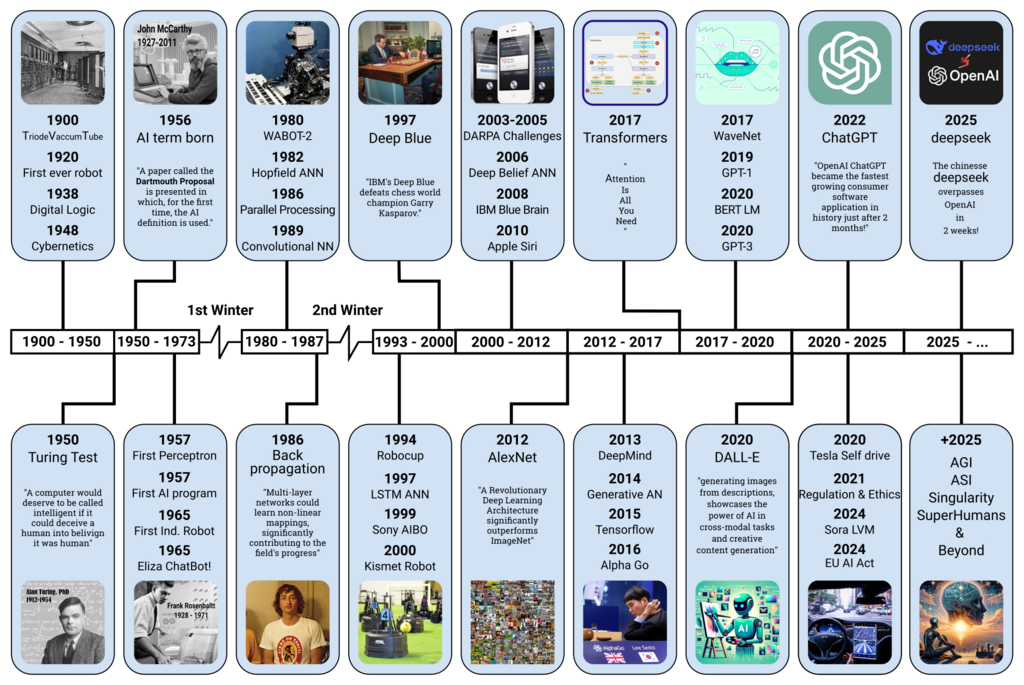
Progress wasn't a straight line. The early excitement led to high expectations that were difficult to meet with the technology of the time. This resulted in periods known as "AI winters," when funding and interest dried up because progress stalled.
But in recent decades, things have changed dramatically. Two key ingredients became widely available: massive amounts of data and powerful computers. These fueled the rise of machine learning and deep learning, leading to breakthroughs that have pushed AI into the mainstream.
AI Is Already Here
AI is no longer just a concept from science fiction. It's a practical tool that shapes our daily lives in countless ways, often working quietly in the background. From the moment you unlock your phone with your face to the shows recommended to you on a streaming service, AI is involved.
| Sector | Everyday Example |
|---|---|
| Entertainment | Recommending movies, songs, and products online. |
| Transportation | Optimizing routes in navigation apps. |
| Finance | Detecting fraudulent credit card transactions. |
| Communication | Translating languages in real time. |
| Healthcare | Helping doctors analyze medical images like X-rays. |
The significance of AI extends far beyond personal convenience. It is helping scientists tackle some of the world's most complex challenges, such as developing new medicines, creating more efficient energy systems, and understanding climate change.
As AI continues to evolve, it's changing industries and creating new possibilities. It's also raising important questions about ethics, bias, and the future of work. Understanding the basics is the first step to navigating this new landscape.
Ready to check your understanding?
What is the primary characteristic that distinguishes an AI system from a traditional computer program?
What were the 'AI winters'?
This foundational knowledge sets the stage for exploring the different types of AI and how they actually work.