Introduction to Artificial Intelligence
Introduction to AI
What Is Artificial Intelligence?
At its core, artificial intelligence is the science of making machines that can think or act like humans. The goal is to create systems that can perform tasks that typically require human intelligence, such as learning from experience, solving problems, understanding language, and recognizing objects and sounds.
Think of it as teaching a computer to see the world, reason about it, and then make decisions. This doesn't mean creating a conscious robot from a sci-fi movie. Most of the AI we interact with today is designed for specific tasks, like recommending a song, translating a sentence, or identifying a face in a photo.
AI isn't a single technology but a broad field of study. It includes many sub-fields, with machine learning and deep learning being two of the most important. Machine learning gives computers the ability to learn without being explicitly programmed, while deep learning is a more advanced technique that uses structures inspired by the human brain, called neural networks, to learn from vast amounts of data.
This layered approach allows AI systems to tackle increasingly complex problems, from simple data analysis to generating original text and images.
A Brief History of AI
The dream of creating intelligent machines is ancient, but the scientific field of AI is relatively new. It officially began in the summer of 1956 at a workshop at Dartmouth College. It was there that the term "artificial intelligence" was first used to describe this ambitious new field.
The early years were filled with excitement and bold predictions. Pioneers believed that a machine as intelligent as a human being was only a few decades away. Early programs could solve algebra problems and prove theorems in logic. But the initial hype soon ran into a wall. The real world turned out to be far more complex than the simple problems these early AIs could handle. By the mid-1970s, progress had stalled, leading to a period known as the "AI winter," when funding and interest dried up.
Things began to thaw in the 1990s and 2000s. Two key ingredients that were missing before became widely available: massive amounts of data and powerful computers. The rise of the internet created a flood of digital information for AIs to learn from, and faster processors allowed them to analyze that data at incredible speeds. This combination fueled the rise of machine learning and led to breakthroughs that were previously impossible.
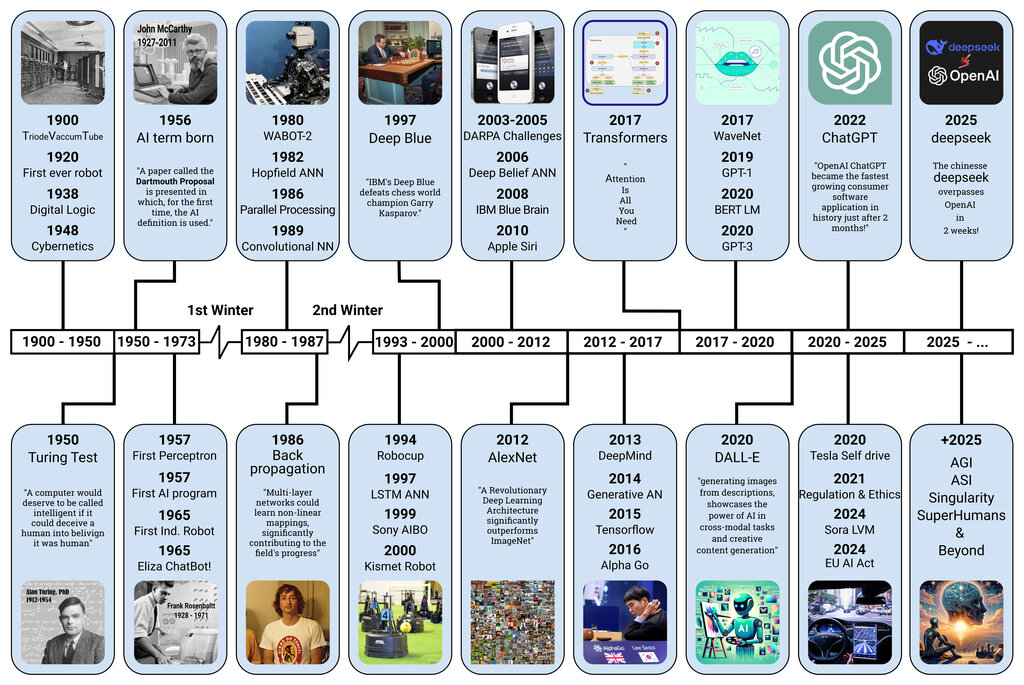
Understanding AI's historical development provides essential context for navigating its future.
Events like IBM's Deep Blue defeating chess champion Garry Kasparov in 1997 showed that machines could excel at complex, strategic tasks. This set the stage for the AI boom we are experiencing today.
Why AI Matters Now
AI has moved from the pages of science fiction into the fabric of our daily lives. It's the engine behind many of the technologies we use every day, from the search results we see to the spam filters that protect our inboxes. Its current significance comes down to its ability to find patterns and make predictions on a scale far beyond human capability.
Modern technology generates an unimaginable amount of data every second. AI provides the tools to make sense of all that information. It can analyze medical images to help doctors spot diseases earlier, manage complex financial systems to detect fraud, and even help scientists model climate change. It's a general-purpose technology, much like electricity, that can be applied to almost any field to improve efficiency, accuracy, and understanding.
AI is no longer just a concept in a lab; it's a tool that's actively shaping our daily digital experiences and solving some of the world's most complex problems.
As AI continues to evolve, it's not just making existing technologies better, it's enabling entirely new ones. The ability of machines to learn, adapt, and create is fundamentally changing how we interact with information and the world around us. This foundation is key to understanding the more advanced topics in AI.
Ready to check your understanding? Let's see what you've learned about the foundations of AI.
What is the core goal of artificial intelligence?
The period in the mid-1970s when progress stalled and funding for AI research dried up is known as the ______.
Understanding what AI is and where it came from provides a solid base for exploring how it works and what it can do.