Introduction to Artificial Intelligence
Introduction to AI
What is Artificial Intelligence?
Artificial intelligence is the field of science dedicated to building machines that can think and learn. The goal is to create systems that can perform tasks that normally require human intelligence, like recognizing speech, making decisions, and translating languages.
Artificial Intelligence
noun
The theory and development of computer systems able to perform tasks that normally require human intelligence, such as visual perception, speech recognition, decision-making, and translation between languages.
Think of it this way: instead of giving a computer a detailed set of instructions for every single possibility, we create a framework that allows it to figure things out on its own. It's the difference between giving someone a fish and teaching them how to fish.
The Age of Rules
The dream of intelligent machines is old, but the formal field of AI began in the summer of 1956 at a conference at Dartmouth College. It was there that the term "Artificial Intelligence" was officially coined. The pioneers at this event were optimistic, believing that a machine as intelligent as a human was just a few decades away.
Their approach, now called Symbolic AI or "Good Old-Fashioned AI" (GOFAI), was based on a simple idea: human thinking is based on manipulating symbols. If we could represent the world in a logical, symbolic language and give the computer a set of rules, it could reason its way to intelligent conclusions.
This worked well for clearly defined, logical problems. Early AI programs could solve complex algebra problems and play games like checkers at a respectable level. They operated like a logician, following rules perfectly. But they had a major weakness: they had no common sense and couldn't handle the messy, unpredictable nature of the real world. An AI could solve a difficult logic puzzle but wouldn't know that you can't be in two places at once.
Symbolic AI was about programming intelligence with explicit rules. If a situation wasn't covered by a rule, the system was stumped.
This over-optimism and the technical limitations of the time led to a period known as the "AI winter." Funding dried up, and progress slowed. The rule-based approach had hit a wall.
Learning from Experience
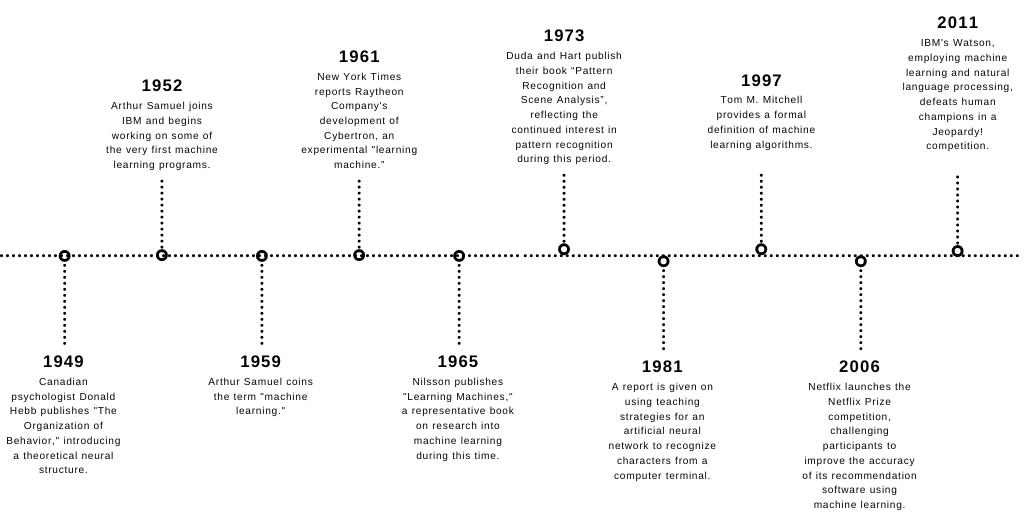
A new approach was needed. Instead of trying to hand-craft intelligence with rules, researchers thought, what if a machine could learn on its own? This shift in thinking marked the move from symbolic reasoning to machine learning.
The core idea of machine learning is to let computers learn from data. Instead of programming a computer with rules to identify a cat, you show it thousands of pictures of cats. The system analyzes these examples and learns the patterns on its own—pointy ears, whiskers, feline-shaped eyes. It builds its own internal rules for what constitutes a "cat".
Machine learning systems infer their own rules from patterns in data rather than being explicitly programmed.
As computing power grew and massive amounts of data became available, machine learning took off. This led to the next major leap: deep learning. Deep learning is a type of machine learning that uses structures inspired by the human brain, called neural networks. These networks have many layers, allowing them to learn incredibly complex patterns from vast amounts of data.
It's these deep learning models that power many of today's most impressive AI systems, from understanding human speech to generating realistic images. This evolution—from rigid rules to flexible learning—is the story of how AI grew from a philosophical curiosity into a transformative technology.
What is the fundamental goal of Artificial Intelligence?
The early approach to AI, known as Symbolic AI or GOFAI, was primarily based on what idea?
That's a brief look at the origins of AI and its evolution. Understanding this history helps explain why AI works the way it does today.