Introduction to Artificial Intelligence
Introduction to Artificial Intelligence
The Idea of Artificial Intelligence
At its core, Artificial Intelligence is about creating machines that can think, learn, and solve problems like humans do. The goal is to build systems that can perform tasks that normally require human intelligence, from understanding language to recognizing patterns.
Artificial Intelligence
noun
A field of computer science dedicated to creating systems capable of performing tasks that typically require human intelligence, such as visual perception, speech recognition, decision-making, and translation between languages.
This isn't just about programming a computer to follow a rigid set of rules. True AI involves the ability to adapt. It's about systems that can take in new information, learn from it, and adjust their behavior accordingly.
A Brief History
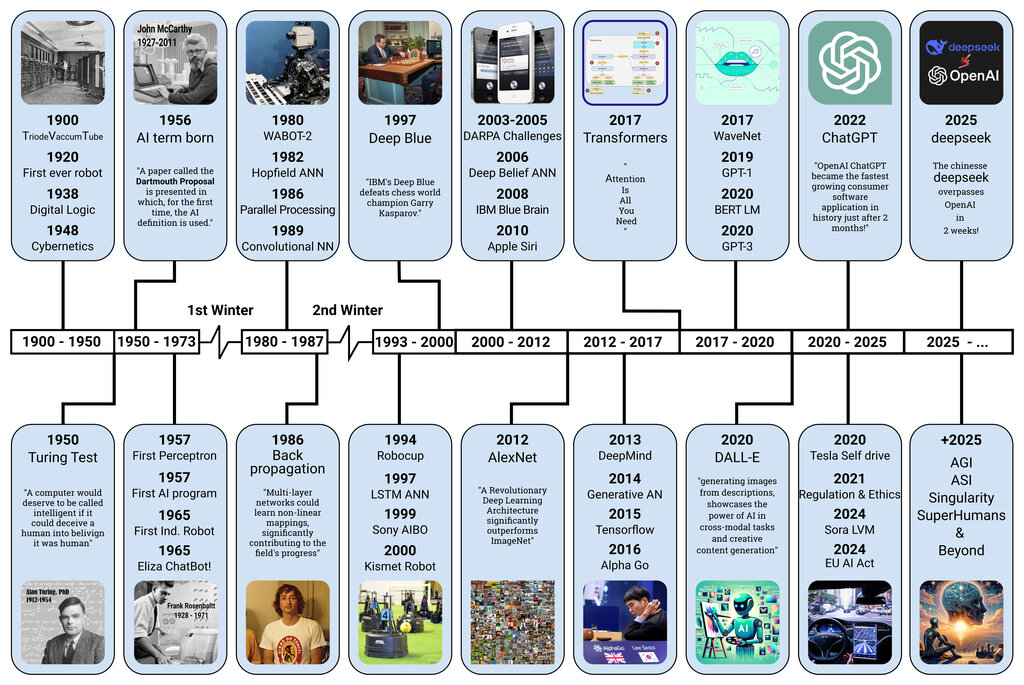
The dream of intelligent machines is ancient, found in myths and stories long before computers existed. But the scientific pursuit of AI began in the 1950s. A pivotal moment was a 1956 workshop at Dartmouth College, where the term "Artificial Intelligence" was first coined. Early researchers were optimistic, predicting that machines with human-like intelligence were just a few decades away.
Progress wasn't a straight line. The field experienced periods of intense excitement and funding, followed by "AI winters" when progress stalled and interest faded. Early systems were good at specific, logical tasks but struggled with the common sense and ambiguity of the real world.
A renaissance began in the late 1990s and accelerated dramatically in the 2010s. This boom was fueled by two key ingredients: massive amounts of data from the internet and the development of powerful, faster computers. These factors allowed new techniques, like machine learning and deep learning, to flourish, leading to the breakthroughs we see today.
Three Kinds of AI
Not all AI is created equal. The field is generally broken down into three stages or types, based on their capabilities.
The first type, Artificial Narrow Intelligence (ANI), is the only kind we have successfully built so far. ANI is designed to perform a single, specific task.
Think of a spam filter in your email, a language translation app, or the AI that recommends movies for you. These systems can be incredibly powerful and outperform humans at their specific jobs. A chess-playing AI can beat the world's best grandmaster, but it can't drive a car or even tell you if a picture shows a cat or a dog. It operates within a pre-defined, limited context. All the AI we interact with daily is a form of ANI.
The next stage is Artificial General Intelligence (AGI). This is AI with the ability to understand, learn, and apply its intelligence to solve any problem, much like a human being.
An AGI would be able to switch contexts and draw on knowledge from different domains. It could write a poem, then use that creative insight to help design a bridge, and then learn a new language from scratch. AGI doesn't just follow its programming for one task; it possesses the flexible, general cognitive abilities of a human. This is the type of AI often seen in science fiction, and it remains a theoretical goal for researchers.
The final, most advanced stage is Artificial Superintelligence (ASI). This form of intelligence would surpass human intellect in virtually every field.
An ASI would not only match human intelligence but would be vastly superior, capable of scientific creativity, social skills, and general wisdom far beyond our own. The creation of ASI is a distant prospect, but it represents the ultimate potential of artificial intelligence.
Understanding these definitions and distinctions is the first step. They provide a framework for thinking about what AI is today and where it might be headed in the future.
Ready to check your understanding of these core ideas?
What is the fundamental goal of Artificial Intelligence?
The AI that powers your email's spam filter is an example of which type of intelligence?
By grasping these fundamentals—what AI is, where it came from, and its different forms—you have the foundation needed to explore its impact on our world.