Introduction to Artificial Intelligence
Introduction to Artificial Intelligence
What Is AI Anyway?
Artificial Intelligence, or AI, is about making computers smart. It's the science of training machines to perform tasks that typically require human intelligence, like learning, reasoning, and problem-solving. Think of it less as creating a conscious robot and more as building software that can recognize patterns, make predictions, and adapt to new information.
At its core, AI gives a computer the ability to think and learn on its own.
AI is becoming a powerful tool in nearly every part of modern life. It helps us tackle complex problems that would be too difficult or time-consuming for humans to solve alone. From managing vast amounts of data to automating routine tasks, AI's ability to process information and learn from it drives innovation and efficiency. Its growing importance lies in its potential to augment human capabilities, opening up new possibilities for discovery and progress.
The Building Blocks of AI
AI isn't a single technology, but a broad field made up of many different methods and concepts. Three of the most fundamental ideas are machine learning, neural networks, and natural language processing. Understanding these concepts is the first step to grasping how AI works.
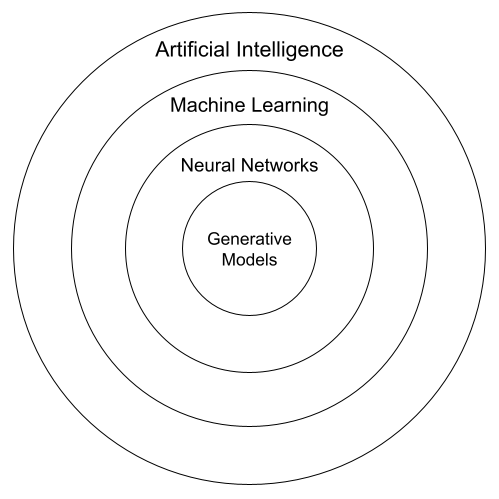
Let's break down each of these key areas.
machine learning
noun
A branch of AI where algorithms are trained on data to find patterns and make predictions without being explicitly programmed for the task.
Imagine teaching a child to recognize a cat. You don't give them a long list of rules about fur, whiskers, and pointy ears. Instead, you show them pictures of cats. Over time, the child learns to identify a cat on their own. Machine learning works in a similar way. An algorithm is fed huge amounts of data—like images, text, or numbers—and it learns to recognize patterns and make decisions based on that data.
neural network
noun
A computational model inspired by the structure and function of the human brain, consisting of interconnected nodes or 'neurons' that process information.
Neural networks are a key part of machine learning, especially a subfield called deep learning. They are designed to mimic the way human brains work. A neural network is made of layers of interconnected nodes. Each node receives inputs, processes them, and passes the result to the next layer. By working together, these layers can learn to identify very complex patterns, like recognizing a face in a photo or understanding the meaning of a sentence.
Finally, we have natural language processing.
natural language processing
noun
A field of AI that enables computers to understand, interpret, and generate human language, both text and speech.
Natural Language Processing, or NLP, is what allows you to talk to your phone or have a webpage translated instantly. It focuses on the interaction between computers and humans using natural language. The ultimate goal of NLP is to enable computers to understand language as well as we do. It’s a complex task because human language is full of ambiguity, nuance, and slang.
Now, let's check your understanding of these core concepts.
What is the primary goal of Artificial Intelligence?
How does machine learning primarily enable a computer to learn?
These three concepts are the foundation upon which the world of AI is built. By training machines to learn from data, recognize complex patterns, and understand human language, we can create intelligent systems that help solve some of our biggest challenges.