Introduction to Artificial Intelligence
What is Artificial Intelligence
What is AI?
Artificial Intelligence is the science and engineering of making intelligent machines. That’s the classic definition, but what does “intelligent” really mean? In this context, it refers to a system's ability to interpret its environment, learn from data, and use that knowledge to achieve specific goals through flexible adaptation. It’s about creating systems that can perceive, reason, and act.
Artificial Intelligence
noun
A field of computer science dedicated to creating systems that can perform tasks that typically require human intelligence. This includes capabilities like learning, reasoning, problem-solving, perception, and language understanding.
Unlike traditional software that follows explicit, hard-coded instructions, an AI system is designed to operate with a degree of autonomy. Think of a spell checker versus a language translation tool. The spell checker follows simple rules. The translation tool, powered by AI, understands context, grammar, and nuance to convert meaning between languages—a much more complex, goal-oriented task.
The Spectrum of Intelligence
Not all AI is created equal. The field is broadly divided into two aspirational categories: Weak AI and Strong AI. These aren't judgments on quality, but rather on scope and capability.
Weak AI, also known as Artificial Narrow Intelligence (ANI), is what we have today. It’s AI designed and trained for a particular task. Your smartphone's voice assistant, a chess-playing computer, or a spam filter are all examples of ANI. They can be incredibly powerful within their specific domain, but they can't operate outside of it. A chess AI can’t recommend a movie, and a spam filter can't drive a car.
Strong AI, or (AGI), is the hypothetical intelligence of a machine that can understand or learn any intellectual task that a human being can. An AGI would be able to reason, plan, solve problems, think abstractly, and learn from experience. It's the kind of AI you see in science fiction, and it remains a long-term goal for researchers, not a current reality.
Beyond AGI lies the theoretical concept of Artificial Superintelligence (ASI), an intellect that is much smarter than the best human brains in practically every field. This hierarchy—from the specialized tools of today to the hypothetical generalists of tomorrow—defines the ambition of the entire field.
Agents, Environments, and Goals
At the core of AI is the concept of an intelligent agent. An agent is anything that can be viewed as perceiving its environment through sensors and acting upon that environment through actuators. A human agent has eyes and ears (sensors) and hands and legs (actuators). A robotic agent has cameras and infrared sensors, and it acts using motors and wheels.
A simple thermostat is a basic agent. Its sensor is a thermometer, its environment is the room, and its actuator is the switch for the heating or cooling system. Its goal is to maintain a specific temperature. The key is this continuous loop of perception and action, all driven by a goal.
AI systems can be categorized by how they make decisions. Reactive systems are the simplest type. They perceive and react directly to the current state of the environment without any memory of past events. A fire alarm is a reactive agent. It senses smoke and triggers an alarm. It doesn't remember if there was a false alarm yesterday.
Deliberative systems, on the other hand, use a model of the world to plan their actions. They consider the consequences of their actions and choose the sequence that best achieves their goals. A GPS navigation system is a deliberative agent. It doesn't just react to your current location; it models the road network, considers traffic, and calculates the optimal path to your destination.
A Brief History of Ideas
The dream of creating artificial beings is ancient, but the scientific pursuit of AI began in the mid-20th century. The field was formally born at the in 1956, where a group of researchers convened to explore the idea that “every aspect of learning or any other feature of intelligence can in principle be so precisely described that a machine can be made to simulate it.”
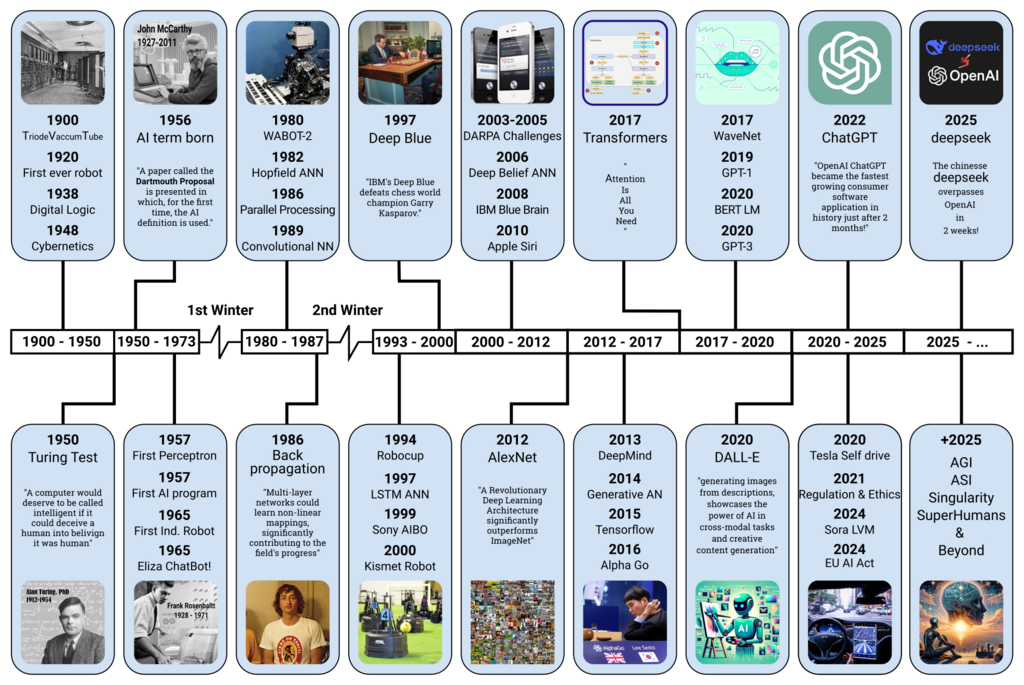
Early AI research focused heavily on symbolic AI, also known as “Good Old-Fashioned AI” (GOFAI). This approach is based on the idea that human intelligence can be replicated by manipulating symbols according to logical rules. It excelled at tasks that could be broken down into formal, logical steps, such as playing chess or solving mathematical problems. Knowledge was explicitly encoded into the system by programmers.
However, this approach struggled with the messy, uncertain nature of the real world. Things like recognizing a face in a photo or understanding spoken language proved incredibly difficult for purely logic-based systems. This led to periods known as “AI winters,” when funding and interest waned due to unfulfilled promises.
The modern AI boom was fueled by the rise of a different approach: machine learning. Instead of having programmers write the rules, machine learning systems learn the rules themselves by analyzing vast amounts of data. Combined with massive increases in computing power, this statistical approach has unlocked the capabilities we see in AI today.
What is the primary difference between Artificial Intelligence and traditional software?
Your email's spam filter, which is trained to identify junk mail, is an example of which type of AI?
Understanding these core concepts—the definition, the spectrum from narrow to superintelligence, and the agent-environment model—provides a solid framework for exploring the more specific branches of AI.