Introduction to Artificial Intelligence
Introduction to Artificial Intelligence
What is Artificial Intelligence?
Artificial intelligence is about creating computer systems that can do things that usually require human intelligence. This includes tasks like understanding language, recognizing patterns, solving problems, and learning from experience.
Think of it this way: we don't consider a simple calculator to be intelligent. It just follows pre-programmed rules. But when a machine can understand your spoken words, translate them into another language, and speak the translation back to you, that feels different. That system is demonstrating a form of intelligence.
Artificial Intelligence
noun
A field of computer science dedicated to creating systems capable of performing tasks that normally require human intelligence, such as visual perception, speech recognition, decision-making, and translation between languages.
At its core, AI isn't one single technology. It's a broad field that covers many different methods and approaches to building smart machines.
A Quick Trip Through Time
The idea of artificial beings has been around for centuries, but the scientific journey began more recently. The term "artificial intelligence" was first coined in 1956 at a workshop at Dartmouth College. A group of researchers gathered to explore the idea that every aspect of learning or intelligence could, in principle, be so precisely described that a machine could be made to simulate it.
Early AI research was filled with excitement. Scientists created programs that could solve algebra problems and prove theorems in logic. But the initial optimism soon hit a wall. The computers of the day weren't powerful enough, and the problems turned out to be much harder than expected. This led to periods known as "AI winters," when funding and interest dried up.
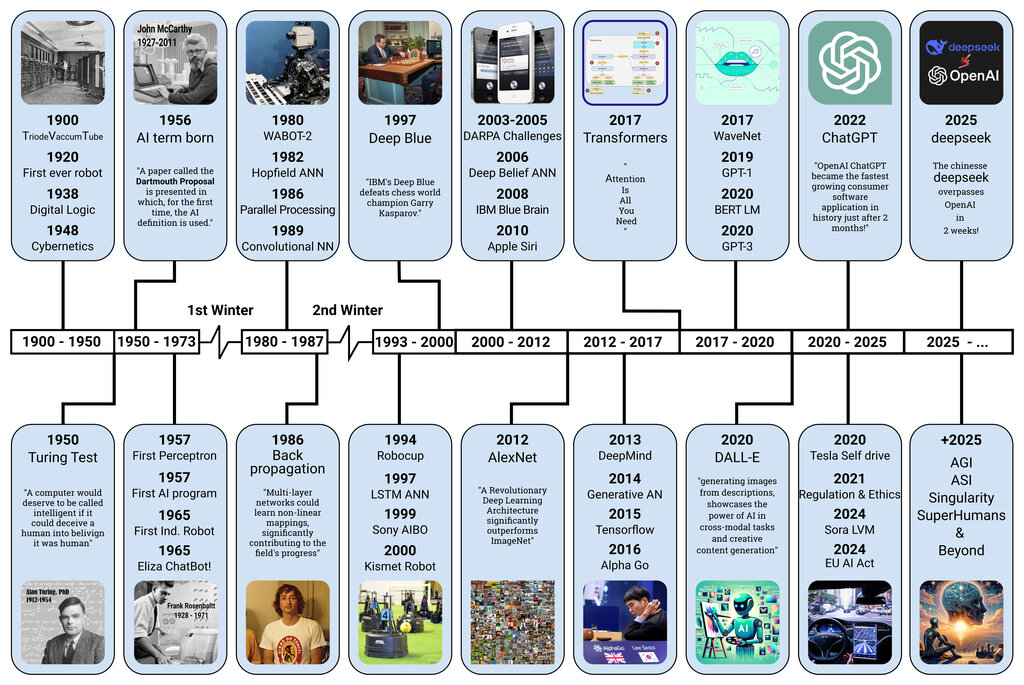
Things picked up again in the 1990s. In 1997, IBM's Deep Blue chess computer famously defeated world champion Garry Kasparov. This was a huge milestone, showing that a machine could master a complex, strategic game once thought to be the exclusive domain of human intellect.
In recent decades, the growth of the internet, the availability of massive amounts of data, and the development of much faster computers have fueled an AI boom. This has brought AI out of the research lab and into our daily lives.
The Three Types of AI
Not all AI is created equal. We can categorize AI based on its capabilities. Think of it as a spectrum from specialized to all-powerful.
Artificial Narrow Intelligence (ANI) This is the only type of AI we have successfully created so far. ANI, also known as Weak AI, is designed and trained for one specific task. It operates within a limited, pre-defined range and can't perform tasks beyond what it was built for.
While it might sound limited, ANI is incredibly powerful and is all around us.
Your email's spam filter, the recommendation engine on Netflix, and the voice assistant on your phone are all examples of Narrow AI. They are exceptionally good at their specific jobs, but they can't do anything else. You can't ask Siri to write a novel or your spam filter to diagnose a medical condition.
Artificial General Intelligence (AGI) This is the next step, and it's still the stuff of science fiction. AGI, or Strong AI, refers to a machine with the ability to understand, learn, and apply its intelligence to solve any problem, just like a human being. An AGI could switch between tasks as different as cooking a meal, composing music, and performing scientific research without needing to be retrained.
Creating AGI is a monumental challenge. It would require a machine to have consciousness, self-awareness, and a genuine understanding of the world. We are not there yet.
Artificial Superintelligence (ASI) This is the final, hypothetical stage. ASI would be an intellect that is much smarter than the best human brains in practically every field, including scientific creativity, general wisdom, and social skills.
The concept of superintelligence raises profound questions about humanity's future and our relationship with technology. For now, it remains a distant possibility, explored more in philosophy and fiction than in the lab.
| Type | Capability | Current Status |
|---|---|---|
| Narrow AI (ANI) | Performs a single task | Achieved and widespread |
| General AI (AGI) | Matches human intelligence | Theoretical / In development |
| Superintelligent AI (ASI) | Surpasses human intelligence | Hypothetical |
Understanding these categories helps us see where AI is today and where it might be headed. We currently live in a world powered by Narrow AI, which is transforming industries and our daily routines.
Time to check what you've learned.
What is the primary goal of artificial intelligence?
The type of AI that can perform a wide variety of tasks at a human level of intelligence, but does not yet exist, is known as...
This foundational knowledge sets the stage for understanding the specific techniques that bring AI to life.