Introduction to Artificial Intelligence
Introduction to Artificial Intelligence
What Is AI Anyway?
At its core, artificial intelligence is about creating machines that can think or act intelligently. Think of it as the science of making computers do things that, if done by a human, would require intelligence. This doesn't necessarily mean creating a walking, talking robot like in the movies. Often, it's about performing a specific task, like recognizing a face in a photo or understanding a spoken command.
The goal is to build systems that can interpret data, learn from it, and use those learnings to achieve specific goals through flexible adaptation.
Artificial Intelligence
noun
A field of computer science dedicated to creating systems capable of performing tasks that typically require human intelligence, such as visual perception, speech recognition, decision-making, and language translation.
This broad definition covers a lot of ground, from simple calculators to complex systems that can compose music. The idea of creating an artificial mind isn't new. It has deep roots in mythology and philosophy, but it only became a tangible scientific pursuit in the 20th century with the advent of computers.
From Theory to Reality
The journey of AI began with ideas. In 1950, the brilliant mathematician Alan Turing proposed a test, now called the Turing Test, to determine if a machine could exhibit intelligent behavior indistinguishable from that of a human. This thought experiment laid some of the philosophical groundwork for the field.
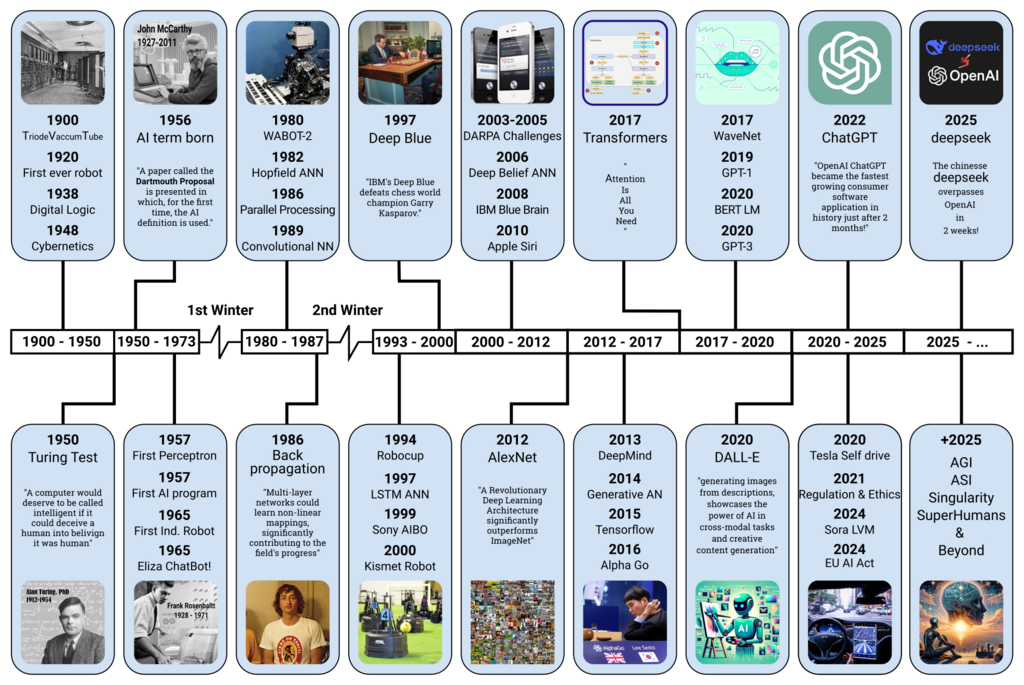
The term "artificial intelligence" itself was officially coined a few years later, in 1956. A group of researchers organized a summer workshop at Dartmouth College to explore the possibility of creating machines that could think. They were incredibly optimistic, believing that a significant advance could be made in just one summer.
Of course, building intelligent machines proved to be much harder than anticipated. The initial excitement was followed by periods known as "AI winters." During these times, public interest and funding dried up because progress stalled and promises went unfulfilled. Early computers were simply not powerful enough to handle the complex calculations needed for true intelligence.
However, the research never completely stopped. In the late 20th and early 21st centuries, two key factors led to an AI renaissance: the explosion of digital data and the development of much more powerful computers. Suddenly, the theoretical ideas from decades prior had the fuel and the engine they needed to become practical realities.
Why AI Matters Now
Today, AI is no longer just a theoretical concept in a research lab. It has become a foundational technology, quietly powering many of the services we use every day. It's woven into the fabric of the modern world, influencing everything from how we shop to how we discover new music.
AI's significance lies in its ability to process and understand vast amounts of information at a scale and speed far beyond human capability.
This ability to analyze data and identify patterns is transforming entire industries. In science, AI helps researchers analyze complex datasets to make new discoveries. In business, it helps companies understand customer behavior and optimize their operations. It’s a tool that enhances human abilities, allowing us to solve problems that were previously too complex or time-consuming to tackle.
What is the fundamental goal of artificial intelligence?
The term "artificial intelligence" was officially coined at which event?
Understanding these core concepts is the first step in appreciating the power and potential of artificial intelligence.