Introduction to Artificial Intelligence
Introduction to Artificial Intelligence
What Is Artificial Intelligence?
Artificial intelligence, or AI, is a field of computer science focused on creating systems that can perform tasks that normally require human intelligence. This includes things like recognizing speech, making decisions, translating languages, and identifying objects in an image.
The core goal of AI is not just to mimic human actions, but to understand and replicate the processes behind them. The ultimate aim is to build machines that can learn from experience, adapt to new situations, and solve problems on their own. Instead of following a rigid set of pre-programmed instructions, an AI system learns and reasons, much like a person does.
A Family of Ideas
The terms AI, machine learning, and deep learning are often used interchangeably, but they represent distinct concepts that build on one another. Think of them like Russian nesting dolls, with AI as the largest doll, machine learning sitting inside it, and deep learning as the smallest doll at the core.
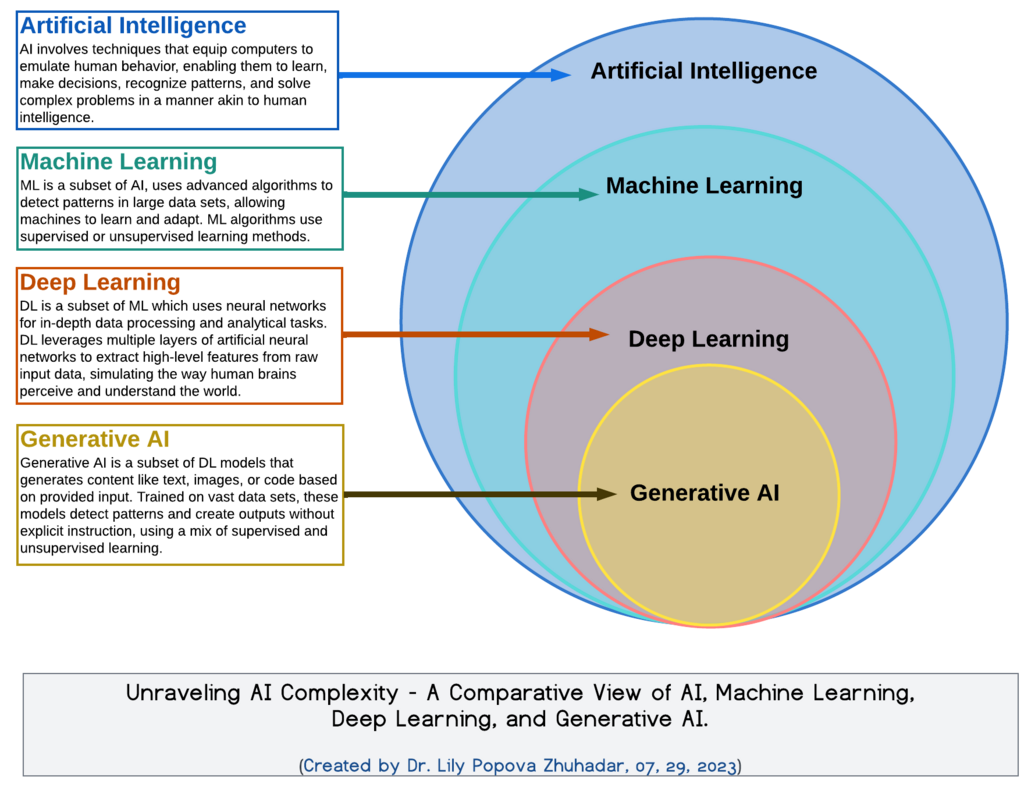
Here's a simple breakdown:
-
Artificial Intelligence (AI) is the broadest concept. It covers any technique that enables computers to mimic human intelligence. This includes everything from complex logic systems to the advanced models we see today.
-
Machine Learning (ML) is a subset of AI. Instead of being explicitly programmed for a task, ML algorithms are trained on large amounts of data. They learn to recognize patterns and make predictions based on that data. For example, a spam filter learns to identify junk mail by analyzing thousands of examples of spam and legitimate emails.
-
Deep Learning (DL) is a specialized subset of machine learning. It uses complex structures called artificial neural networks, which are loosely inspired by the human brain. Deep learning is particularly powerful for handling vast, unstructured data like images and sound. It's the technology behind self-driving cars recognizing pedestrians and voice assistants understanding your commands.
Two Kinds of AI
When people talk about AI, they're usually referring to one of two categories: Artificial Narrow Intelligence or Artificial General Intelligence.
Artificial Narrow Intelligence (ANI), sometimes called Weak AI, is what we have today. This type of AI is designed to perform a single, specific task very well. A chess-playing computer, a recommendation engine on a shopping site, or a facial recognition system are all examples of ANI. They can be incredibly powerful within their defined limits, but they can't operate outside of them. A chess AI can't help you write an email, and a spam filter can't drive a car.
The other category is still theoretical.
Artificial General Intelligence (AGI), or Strong AI, refers to a machine with the ability to understand, learn, and apply knowledge across a wide range of tasks at a human level. An AGI could learn to play chess, write an email, and drive a car with the same general cognitive abilities as a person. This type of AI does not yet exist and remains a long-term goal for researchers.
The Building Blocks of AI
Every AI system, regardless of its purpose, relies on three fundamental components working together.
First is data. Data is the raw material from which AI learns. For an AI to recognize cats in photos, it needs to be fed thousands of pictures of cats. The more high-quality, relevant data an AI has, the better it becomes at its task. Data is the fuel for any AI system.
Next are the algorithms. An algorithm is a set of rules or instructions that the computer follows to achieve a goal. In machine learning, algorithms are what allow the system to find patterns and relationships within the data. It's the recipe that tells the AI how to learn.
Finally, there is computational power. Processing massive datasets and running complex algorithms requires a huge amount of computing resources. Modern AI relies on powerful hardware, especially specialized processors like Graphics Processing Units (GPUs), to perform these calculations quickly and efficiently. This is the engine that drives the entire system.
These three components, data, algorithms, and computational power, are interdependent. Without vast amounts of data, even the best algorithm has nothing to learn from. Without a powerful algorithm, data is just a collection of information. And without sufficient computational power, neither can be processed in a useful timeframe.
What is the primary goal of Artificial Intelligence (AI)?
Which of the following analogies best describes the relationship between AI, Machine Learning (ML), and Deep Learning (DL)?