Introduction to Artificial Intelligence
Introduction to AI
What Is Artificial Intelligence?
At its core, artificial intelligence is the science of making machines that can think or act like humans. It's a broad field in computer science focused on creating systems that can perform tasks that typically require human intelligence. This includes things like learning from experience, solving problems, understanding language, and recognizing objects and sounds.
Artificial Intelligence
noun
A field of computer science dedicated to creating systems capable of performing tasks that normally require human intelligence.
Think of it less as creating a single, all-knowing robot and more as a collection of different technologies that allow a machine to sense its environment, reason about it, and make decisions. Some AI is designed for very specific tasks, like recommending a movie, while other research aims for a more general, human-like intelligence.
The Dawn of an Idea
The dream of intelligent machines is ancient, but the scientific pursuit of AI began in the mid-20th century. After World War II, a handful of scientists and mathematicians started exploring the idea that human thought could be broken down and simulated by machines. Early pioneers like Alan Turing proposed tests to determine if a machine was truly "thinking."
The field was formally born in the summer of 1956 at a workshop at Dartmouth College. It was here that computer scientist John McCarthy coined the term "artificial intelligence." The attendees were optimistic, believing that a machine as intelligent as a human being was only a generation away.
The Dartmouth workshop's proposal stated that "every aspect of learning or any other feature of intelligence can in principle be so precisely described that a machine can be made to simulate it."
A History of Boom and Bust
The decades following the Dartmouth workshop were a roller coaster of progress and setbacks. The initial period, from the late 1950s to the early 1970s, was a time of great excitement and discovery. Computers learned to solve algebra problems, prove theorems in geometry, and speak simple English. The funding flowed, and labs dedicated to AI popped up at universities around the world.
But the initial excitement soon ran into a wall. The early successes were on simple, well-defined problems. Tackling the complexities of real-world vision and language proved much harder than anticipated. By the mid-1970s, the promised breakthroughs hadn't materialized, and government funding dried up. This period became known as the first "AI winter."
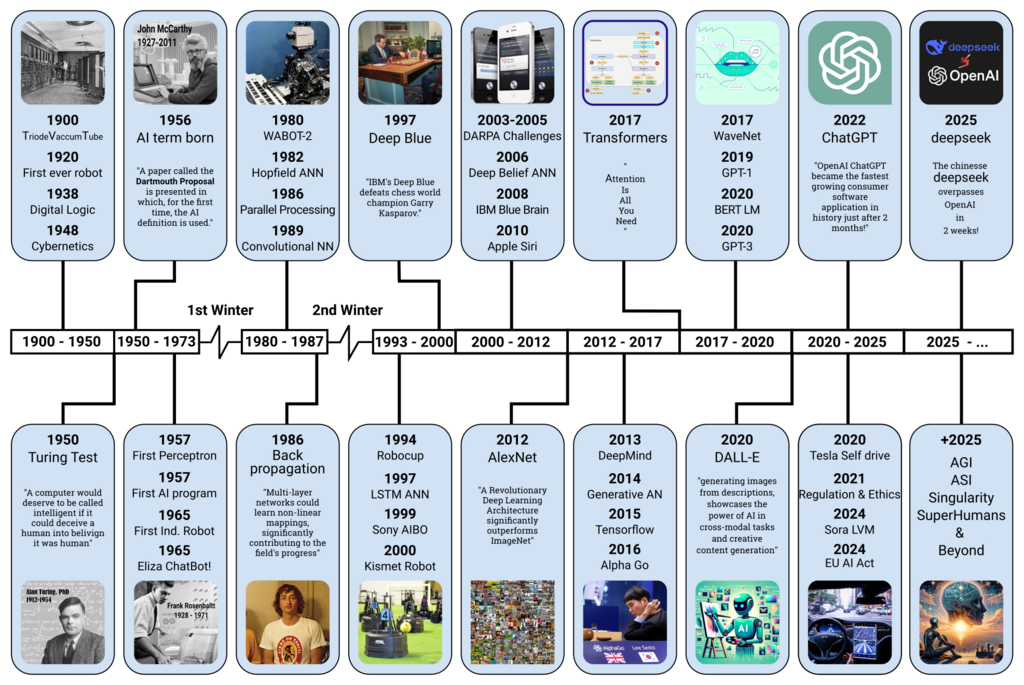
AI saw a resurgence in the 1980s with the rise of "expert systems." These programs captured the knowledge of human experts to make decisions in narrow fields, like medical diagnosis. But they were expensive to build and maintain, and when a second AI winter hit in the late '80s and early '90s, the field once again contracted.
Each cycle, however, left the field with new ideas and a better understanding of the challenges ahead. The slow, steady increase in computing power and the availability of vast amounts of data were setting the stage for the next boom.
Game-Changing Milestones
Several key moments jolted AI out of its winters and pushed the entire field forward, demonstrating new possibilities. These weren't just academic exercises; they were public displays that changed how people viewed machine intelligence.
| Year | Milestone | Significance |
|---|---|---|
| 1997 | Deep Blue Defeats Kasparov | IBM's chess computer defeated the reigning world champion, Garry Kasparov. It showed that AI could master complex, strategic tasks once thought to be the exclusive domain of human intellect. |
| 2011 | Watson Wins Jeopardy! | IBM's Watson competed on the quiz show Jeopardy!, beating two of its greatest champions. This demonstrated a machine's ability to understand natural language, including its nuances, puns, and subtleties. |
| 2012 | AlexNet Wins ImageNet | A neural network named AlexNet drastically outperformed all other competitors in the ImageNet image recognition challenge. This event kickstarted the deep learning revolution, leading to the rapid advances in AI we see today. |
These milestones represent a fundamental shift in the approach to AI. The success of Deep Blue was based on immense computational power and clever search algorithms—a very logic-driven approach. Watson and AlexNet, however, relied more on learning from massive amounts of data, a strategy that has come to define modern AI.
What is the core concept behind artificial intelligence?
The term "artificial intelligence" was first coined by John McCarthy at what event?
This journey of ambitious goals, hard limitations, and stunning breakthroughs has shaped the field of artificial intelligence. Understanding its past is the first step to understanding its present capabilities and future potential.