Introduction to Artificial Intelligence
Introduction to Artificial Intelligence
What Is Artificial Intelligence?
At its core, artificial intelligence is the science of making machines that can think like humans. It’s a broad field in computer science focused on building smart machines capable of performing tasks that typically require human intelligence, like learning, reasoning, and problem-solving.
Artificial Intelligence
noun
The theory and development of computer systems able to perform tasks that normally require human intelligence, such as visual perception, speech recognition, decision-making, and translation between languages.
Think of it this way: we teach a child by showing them examples. They see a few dogs and eventually learn to recognize any dog, no matter the breed. AI works in a similar way, but on a massive scale. A computer is fed vast amounts of data—images, text, or sounds—and learns to identify patterns within it.
The goal isn't just to make a machine follow instructions, but to enable it to learn and adapt on its own.
This ability allows AI to do more than just calculate numbers. It can understand spoken words, identify faces in a crowd, or even compose music. It’s not about creating a robot with human emotions, but about building tools that can augment our own abilities.
A Brief History of AI
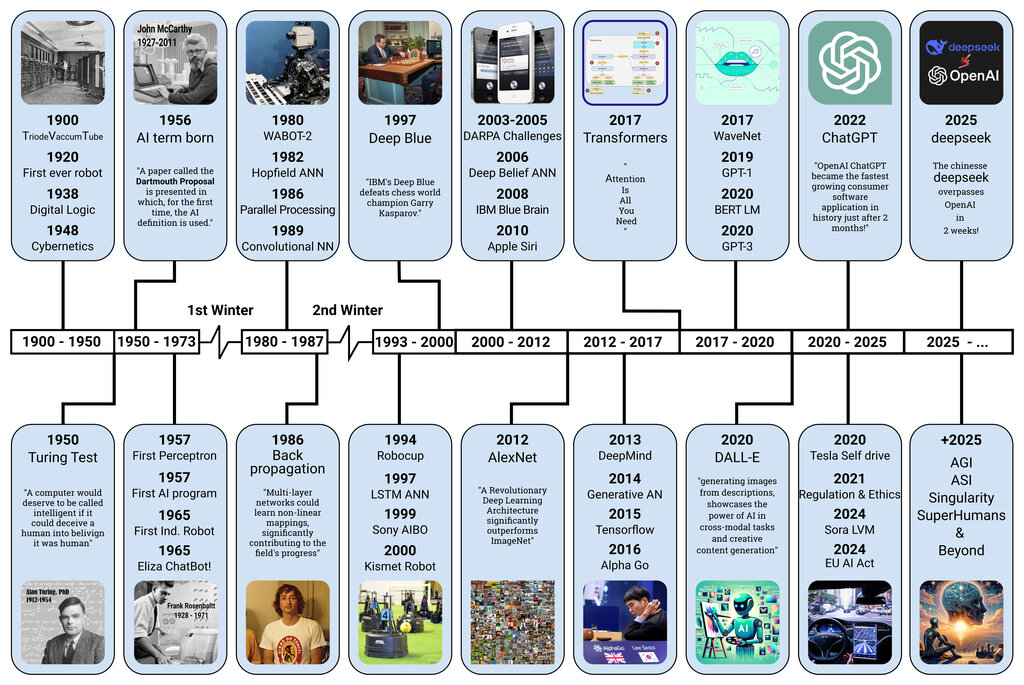
The idea of intelligent machines has been around for centuries, but the modern journey of AI began in the 1950s. A British mathematician named Alan Turing was one of the first to propose a test for machine intelligence, now known as the Turing Test. He asked a simple question: can a machine converse so well that a human can't tell they're talking to a computer?
The field got its name in 1956 at a workshop at Dartmouth College. A group of scientists gathered to explore the idea that "every aspect of learning or any other feature of intelligence can in principle be so precisely described that a machine can be made to simulate it." This event is widely considered the birth of AI as an official field of study.
It was at the 1956 Dartmouth Conference that the term "Artificial Intelligence" was first coined.
The early years were filled with excitement and bold predictions. Researchers developed programs that could solve algebra problems and prove theorems in logic. But progress was slower than expected. The complexity of creating true intelligence was far greater than anticipated, and the available computing power was limited.
This led to periods known as "AI winters," when funding dried up and public interest waned. The initial hype gave way to skepticism.
Things started to change in the 1990s and 2000s. Two key ingredients became available: immense computing power and massive amounts of data. The rise of the internet created a digital world overflowing with information, which was the perfect training ground for AI systems. This combination fueled a renaissance, leading to the powerful AI we see today.
Why AI Matters Now
Today, AI is more than just a futuristic concept; it’s a foundational technology that is reshaping our world. Much like electricity or the internet, AI is becoming a general-purpose tool that enhances countless other technologies and industries.
Its significance lies in its ability to make sense of the vast complexity of the modern world. Every day, we generate more data than we can possibly analyze. AI systems can sift through this data to find hidden patterns, make predictions, and automate tasks at a scale and speed humans can't match.
This isn't about replacing humans, but augmenting our intelligence. AI can help doctors spot diseases earlier, scientists analyze complex climate data, and artists create in entirely new ways. It handles the repetitive, data-heavy work, freeing us up to focus on creativity, strategy, and critical thinking.
AI's power comes from its ability to learn from data and improve over time, making it an incredibly versatile and dynamic tool.
Understanding the basics of AI is becoming essential for navigating modern life. It’s the engine behind many of the tools we use daily, from search engines to navigation apps. As it continues to evolve, its impact will only grow, making it one of the most important technological developments of our time.
What is the primary goal of artificial intelligence?
What event is widely considered the birth of AI as an official field of study?
That's a brief look at what AI is, where it came from, and why it's so important. As you continue, you'll explore the different types of AI and how they work in more detail.