Introduction to Artificial Intelligence
Introduction to Artificial Intelligence
What Is Artificial Intelligence?
At its core, Artificial Intelligence (AI) is about creating machines that can think, learn, and act in ways that we would consider intelligent. It’s a broad field in computer science focused on building systems that can perform tasks that typically require human intelligence. This includes everything from recognizing speech and images to making decisions and translating languages.
Artificial Intelligence
noun
The theory and development of computer systems able to perform tasks that normally require human intelligence, such as visual perception, speech recognition, decision-making, and translation between languages.
Think of it this way: AI systems perceive their environment, process that information, and then take action to achieve a specific goal. The methods they use to do this have changed dramatically over time, evolving from simple rule-based systems to complex models that can learn from vast amounts of data.
A Brief History of AI
The dream of intelligent machines has been around for centuries, but the formal field of AI research began in the summer of 1956. A group of scientists gathered for a workshop at Dartmouth College to explore the idea that “every aspect of learning or any other feature of intelligence can in principle be so precisely described that a machine can be made to simulate it.” It was here that the term “artificial intelligence” was officially coined.
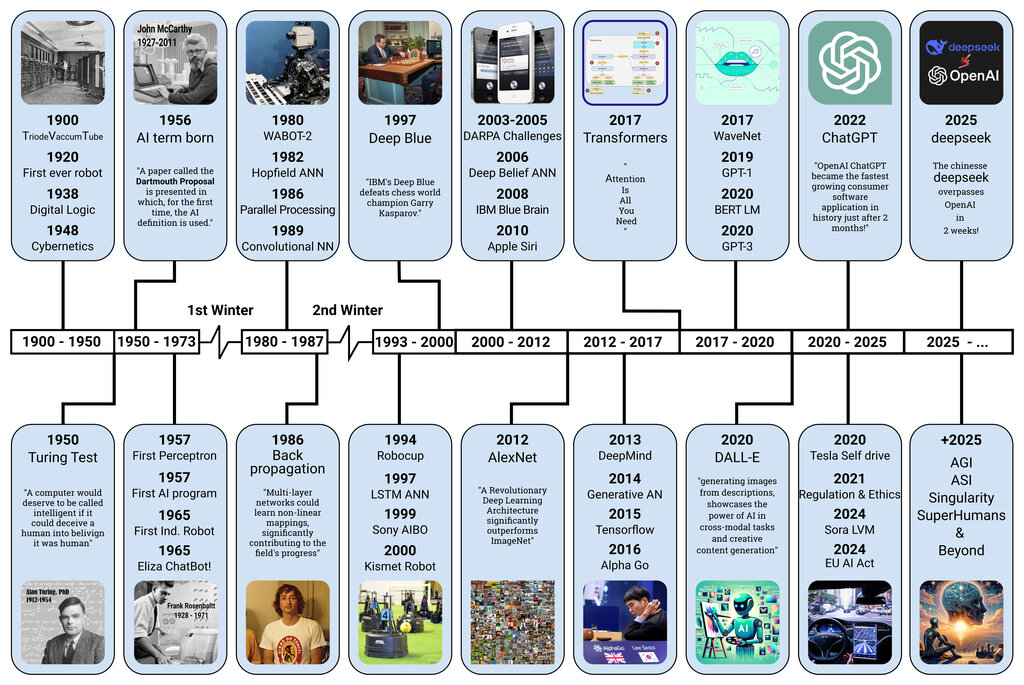
Early AI, known as “Symbolic AI” or “Good Old-Fashioned AI,” was all about rules. Researchers tried to program computers with the logical rules of human thought. For example, an early chess program would have rules for every piece and strategies for different board positions. This approach worked for well-defined problems but struggled with the messiness of the real world.
The initial excitement led to bold predictions, but progress was slower than expected. The technology wasn't powerful enough, and the rule-based approach was too rigid. This led to periods known as “AI winters,” when funding and interest dwindled.
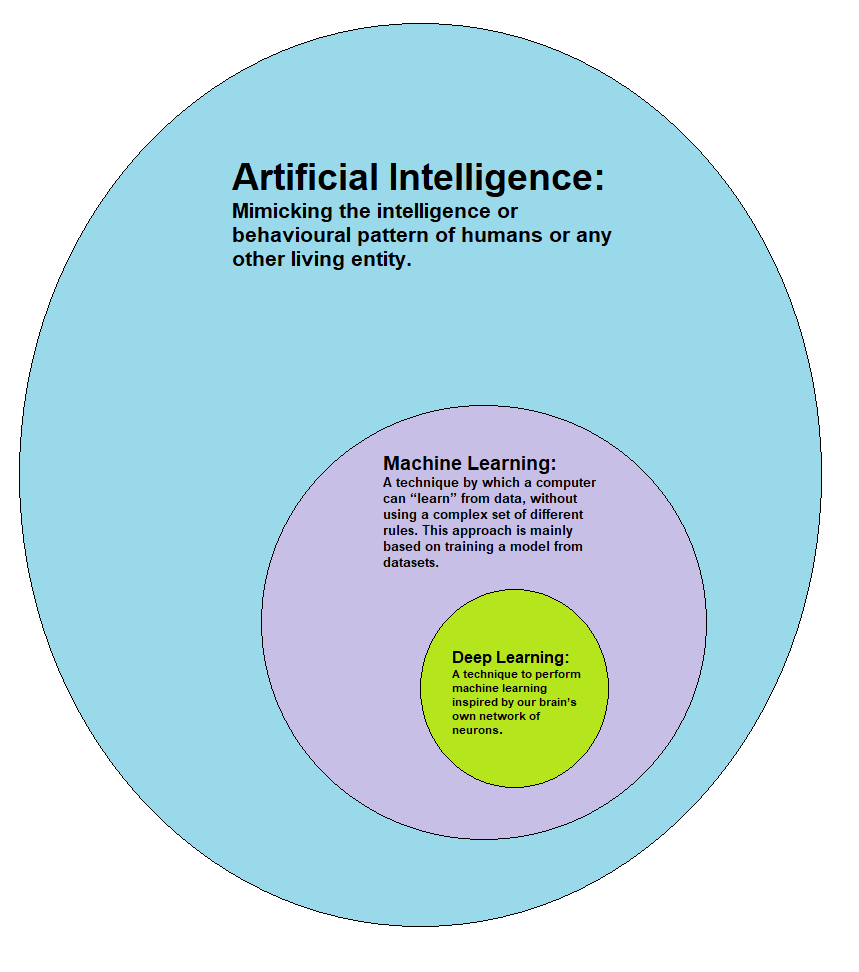
A major shift came with the rise of machine learning. Instead of feeding a computer explicit rules, developers began training it on data. The machine would learn to recognize patterns on its own. A machine learning model might be shown thousands of cat photos until it learns to identify a cat without being told what specific features to look for.
More recently, a powerful subset of machine learning called deep learning has driven huge advances. Deep learning uses structures called neural networks, which are loosely inspired by the human brain. These networks have many layers that allow them to learn very complex patterns from enormous datasets.
The Three Types of AI
When we talk about AI, it's helpful to categorize it by its capabilities. There are three main types, though only one is currently widespread.
Artificial Narrow Intelligence
noun
A type of AI that is programmed to perform a single, specific task, such as playing chess or recognizing faces.
1. Artificial Narrow Intelligence (ANI) Also known as Weak AI, this is the only type of AI we have successfully created so far. ANI is designed to handle one specific task. A chess program that can beat a grandmaster is an example of ANI. It’s brilliant at chess, but it can’t do anything else. It can’t check the weather, write a poem, or even tell you the rules of checkers. All the AI we use today, from spam filters to self-driving cars, is a form of ANI.
2. Artificial General Intelligence (AGI) Also called Strong AI, AGI is the kind of intelligence we see in science fiction. It refers to a machine with the ability to understand, learn, and apply knowledge across a wide range of tasks at a level comparable to a human being. An AGI could learn to play chess, then use its learning abilities to figure out how to compose music, and then apply that creativity to solve a complex scientific problem. AGI does not yet exist.
3. Artificial Superintelligence (ASI) This is a hypothetical type of AI that would surpass human intelligence in virtually every field, including scientific creativity, general wisdom, and social skills. An ASI would not just be faster than a human brain; it would be qualitatively different and far more capable. The development of ASI is a topic of intense debate, as its potential consequences are enormous and unknown.
Right now, every AI system in the world is a form of Narrow AI. The leap from Narrow AI to General AI is one of the biggest challenges in the field.
With this foundation, you can better understand where AI comes from and the different forms it can take. From simple rule-based systems to the learning machines of today, the journey of AI is a story of our own quest to understand intelligence itself.