Introduction to Artificial Intelligence
Introduction to AI Subfields
The Branches of AI
Artificial intelligence isn't one single technology. It's a broad field of computer science with several distinct branches, each tackling the problem of creating intelligence from a different angle. Some approaches teach machines to learn from vast amounts of data, while others try to encode human knowledge and logic directly into rules. Understanding these key subfields is essential for grasping how different AI systems work.
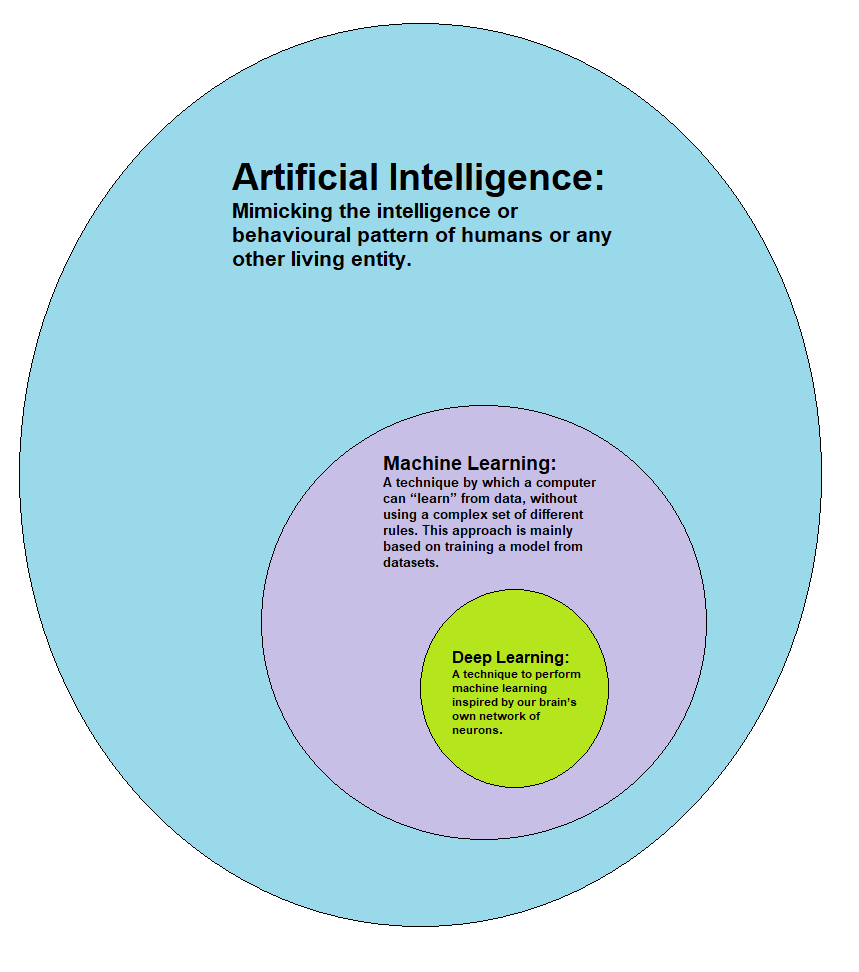
We'll look at three major areas: Machine Learning, Deep Learning, and Symbolic AI. Machine Learning and Deep Learning are closely related, with Deep Learning being a specialised subset of Machine Learning. Symbolic AI represents a fundamentally different, logic-based approach.
Machine Learning: Learning from Data
Machine Learning (ML) is the most common form of AI today. Its core idea is to build systems that can learn patterns directly from data, rather than being explicitly programmed with rules. An ML model is trained on a dataset, and it uses statistical techniques to identify relationships and make predictions or decisions.
Think about a spam filter in your email. You don't program it with a list of every possible spam phrase. Instead, you show it thousands of examples of spam and legitimate emails. The algorithm learns to identify the characteristics of spam on its own, such as certain keywords, sender information, or message structure. This ability to learn from examples is what makes ML so powerful.
Applications of Machine Learning are everywhere, from the recommendation engines on streaming services to fraud detection systems at banks and predictive maintenance for industrial equipment.
Deep Learning: Inspired by the Brain
Deep Learning is a powerful subfield of Machine Learning that uses structures called artificial neural networks. These networks are inspired by the human brain, with many layers of interconnected nodes, or 'neurons'. Each layer learns to detect increasingly complex features from the data.
For example, when analysing an image of a cat, the first layer of a deep neural network might learn to recognise simple edges and colours. The next layer might combine those edges to identify shapes like ears or whiskers. Subsequent layers combine those features until the network can recognise the entire cat. This hierarchical feature learning is what makes 'deep' learning deep.
This layered approach makes deep learning exceptionally good at handling unstructured data like images, audio, and text. It's the technology behind self-driving cars' vision systems, voice assistants like Siri and Alexa, and advanced language models like ChatGPT.
Symbolic AI: The Logic-Based Approach
Symbolic AI, also known as Good Old-Fashioned AI (GOFAI), takes a completely different path. Instead of learning from data, it operates on a set of explicitly programmed rules and symbols that represent real-world knowledge. The goal is to create a system that can reason about information logically, much like a human expert.
A classic example is an expert system designed for medical diagnosis. A programmer would work with doctors to codify their knowledge into a series of if-then rules. For instance: IF the patient has a fever AND a sore throat, THEN consider strep throat. The system uses these rules to process patient data and arrive at a logical conclusion.
/* A simplified rule for a medical expert system */
RULE 101:
IF patient.symptom == 'fever'
AND patient.symptom == 'sore throat'
AND test.strep == 'positive'
THEN diagnosis = 'Strep Throat'
Symbolic AI excels in problems with clear, established rules, like playing chess, solving logic puzzles, or managing complex scheduling. Its main drawback is brittleness. If it encounters a situation not covered by its rules, it fails. It also struggles with the ambiguity and uncertainty of the real world, which is where data-driven approaches like Machine Learning shine.
Each of these subfields offers a unique set of tools for building intelligent systems. Modern AI often blends these approaches, using ML to handle messy data and symbolic reasoning to manage the results.
Time to check your understanding of these concepts.
What is the primary principle behind Machine Learning (ML)?
An AI is designed to play chess by evaluating moves based on a vast, pre-programmed set of rules about piece values, board positions, and game strategies. Which branch of AI does this best represent?
By understanding the differences between these core branches, you can better appreciate the specific strengths and applications of various AI technologies.