Introduction to Artificial Intelligence
Introduction to AI
What Is AI?
Artificial intelligence is about making computers that can think or act in ways we'd consider intelligent. This doesn't mean creating a conscious robot like in the movies. It's more about building systems that can perform specific tasks that usually require human intelligence, like recognizing faces, understanding speech, or playing chess.
Artificial intelligence (AI) is a branch of computer science and engineering that focuses on building machines that are capable of learning, solving problems, making decisions, and all other functions that are performed traditionally by the human intellect.
Think of AI as a broad field with many different approaches and goals. At its core, it's about giving machines the ability to learn from data, identify patterns, and make decisions with minimal human intervention. This capability is powering everything from your phone's digital assistant to complex medical diagnostic tools.
Two Kinds of AI
AI isn't a single entity. It's helpful to split it into two main categories: Narrow AI and General AI.
| Type | Description | Example |
|---|---|---|
| Narrow AI | Designed for a single, specific task. | A spam filter for your email. |
| General AI | Can understand, learn, and apply knowledge across a wide range of tasks, like a human. | This is still theoretical and doesn't exist yet. |
All the AI we use today is Narrow AI, sometimes called "Weak AI." It's incredibly powerful but limited to its pre-defined function. A chess-playing AI can beat a grandmaster, but it can't tell you the weather or recommend a good book. It operates within a very narrow set of rules and contexts.
Artificial General Intelligence (AGI), or "Strong AI," is the stuff of science fiction for now. It represents the idea of a machine with the same cognitive abilities as a human, capable of learning and reasoning about anything.
How AI Learns
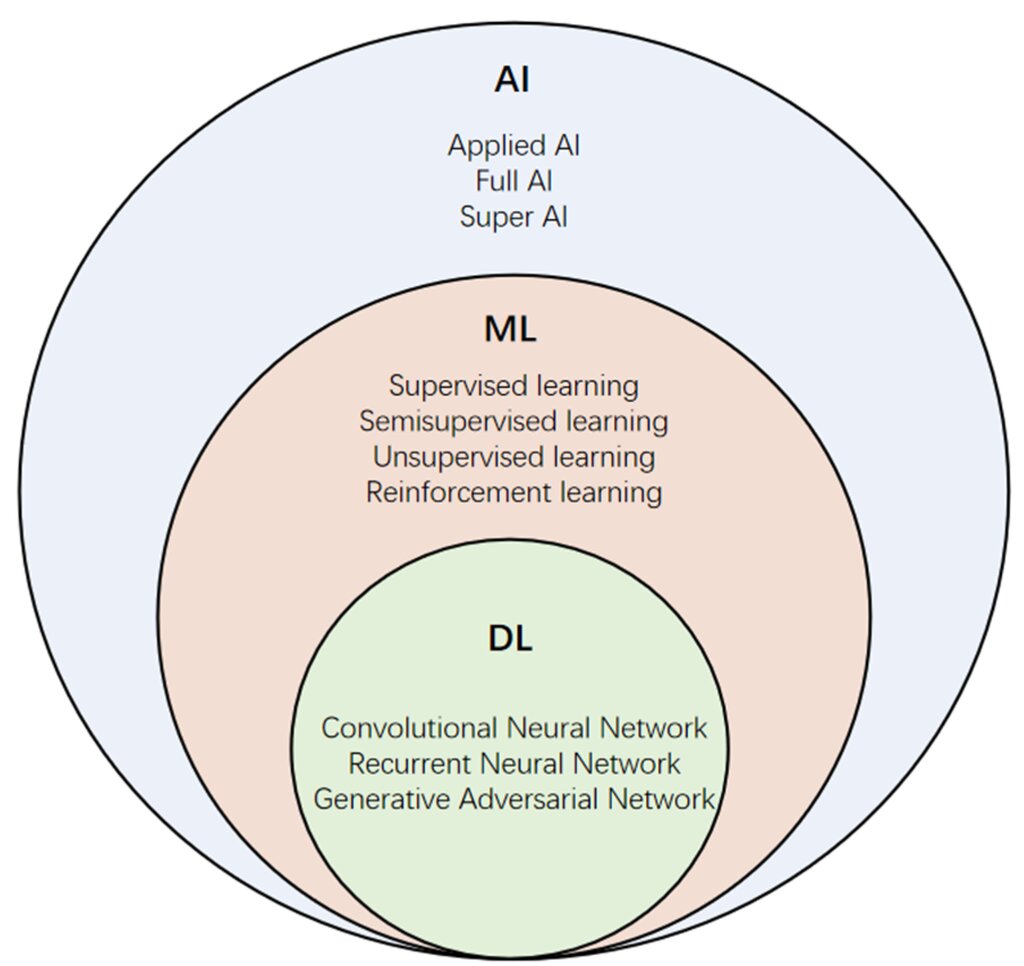
So how do we get a machine to perform an intelligent task? One of the most important approaches is called Machine Learning (ML). Instead of programming a computer with explicit, step-by-step instructions, we give it a large amount of data and let it learn the patterns for itself. It's like teaching a child to recognize a cat by showing them thousands of cat pictures, rather than trying to describe a cat with a list of rules.
algorithm
noun
A process or set of rules to be followed in calculations or other problem-solving operations, especially by a computer.
Within machine learning, there's a more advanced technique called Deep Learning. It uses structures inspired by the human brain, known as neural networks. These networks are made of many layers of interconnected nodes, or "neurons."
Each layer learns to detect different features. When you show a deep learning model a picture of a cat, the first layer might identify simple shapes and edges. The next layer might combine those to recognize paws and ears. A deeper layer might put it all together to identify a cat. This layered approach allows the system to learn very complex patterns from data.
Neural Networks are the engines that power deep learning. A basic neural network has an input layer, one or more "hidden" layers where the processing happens, and an output layer that delivers the final result. The network learns by adjusting the connections between its neurons based on the data it's shown. If it makes a wrong prediction, it tweaks these connections to do better next time. Over millions of examples, it becomes incredibly accurate.
These concepts—AI as the broad goal, machine learning as a method to achieve it, and deep learning with neural networks as a powerful technique within machine learning—are the building blocks of the modern AI revolution.
Time to check your understanding of these core ideas.
What is the relationship between Artificial Intelligence (AI), Machine Learning (ML), and Deep Learning (DL)?
The AI that can beat a grandmaster at chess but cannot recommend a movie is an example of what?