Introduction to Artificial Intelligence
Introduction to Artificial Intelligence
What Is Artificial Intelligence?
At its heart, artificial intelligence is about creating machines that can think or act like humans. It's a broad field in computer science focused on building smart systems capable of performing tasks that typically require human intelligence. This could be anything from understanding language to recognising patterns or making decisions.
AI is commonly defined as “a system’s ability to interpret external data correctly, to learn from such data, and to use those learnings to achieve specific goals and tasks through flexible adaptation.”
Think of it less as creating a conscious robot and more as giving a computer a specific skill. A chess program that can beat a grandmaster is a form of AI. So is the software that suggests what film you might want to watch next. These systems aren't 'intelligent' in the way we are, but they can process information and make calculated choices to achieve a goal.
The Journey Begins
The idea of artificial minds isn't new. Myths and stories from ancient times are filled with automatons and artificial beings. But the scientific journey of AI began in the mid-20th century, alongside the invention of the electronic computer.
Early pioneers like Alan Turing began to ask a fundamental question: Can machines think? In his 1950 paper, Turing proposed a test, now called the Turing Test, to determine if a machine could exhibit intelligent behaviour indistinguishable from that of a human.
The field got its name in 1956 at a summer workshop at Dartmouth College in the United States. A group of scientists gathered to explore the idea that “every aspect of learning or any other feature of intelligence can in principle be so precisely described that a machine can be made to simulate it.” This event marked the official birth of AI as a research discipline.
The Dartmouth workshop set the stage for decades of research, defining the problems and goals that would shape the future of artificial intelligence.
Milestones and Winters
The years following the Dartmouth workshop were filled with optimism. Researchers developed programs that could solve algebra problems, prove theorems in geometry, and speak basic English. There was a widespread belief that a fully intelligent machine was just a few years away.
However, progress was harder than expected. The complexity of creating true intelligence was immense, and the available computing power was limited. This led to periods known as "AI winters," when funding dried up and interest in the field waned.
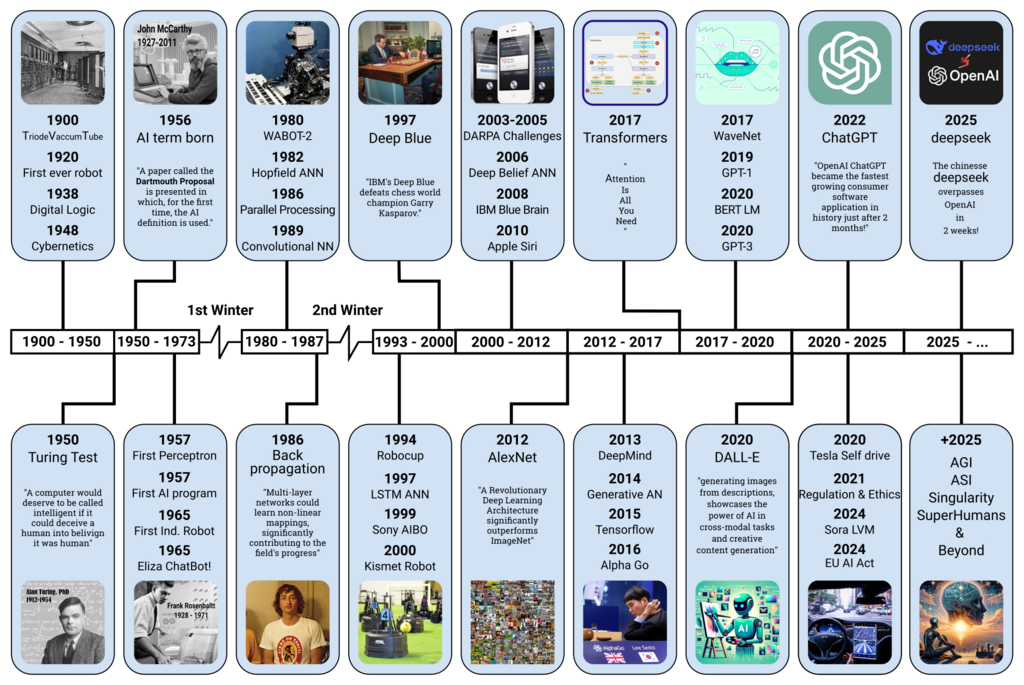
Despite these setbacks, breakthroughs continued to happen. In the 1980s, "expert systems" became popular. These were AI programs designed to mimic the decision-making ability of a human expert in a specific domain, like diagnosing diseases.
A major turning point came in 1997 when IBM's Deep Blue chess computer defeated the world champion, Garry Kasparov. This event showed the world that a machine could master a complex, strategic game once thought to be the exclusive domain of human intellect. This success, along with the rapid growth of the internet and vast increases in computing power, ushered in a new era for AI, dominated by machine learning and the analysis of enormous datasets.
According to the text, what is the fundamental goal of artificial intelligence?
Which event is widely regarded as marking the official birth of AI as a research discipline?
From philosophical questions to tangible technological achievements, the history of AI is a story of human ambition, curiosity, and persistence. Understanding this journey helps us appreciate where the field is today and where it might be headed.