Introduction to Artificial Intelligence
Introduction to Artificial Intelligence
What is Artificial Intelligence?
At its core, artificial intelligence is the science of making machines smart. It's about creating computer systems that can perform tasks that typically require human intelligence. This includes things like learning from experience, understanding language, recognizing objects in photos, making decisions, and solving problems.
Think of it this way: instead of programming a computer with a rigid set of instructions for every possible situation, AI allows a computer to figure things out on its own.
Artificial Intelligence
noun
The theory and development of computer systems able to perform tasks normally requiring human intelligence.
A Brief History of Ideas
The idea of intelligent machines isn't new. It has roots in ancient myths and centuries of philosophical thought. But the modern field of AI truly began in the mid-20th century, alongside the development of the first digital computers.
A key moment was the Dartmouth Workshop in 1956. A small group of researchers gathered to explore the idea that "every aspect of learning or any other feature of intelligence can in principle be so precisely described that a machine can be made to simulate it." This event coined the term "artificial intelligence" and kicked off decades of research.
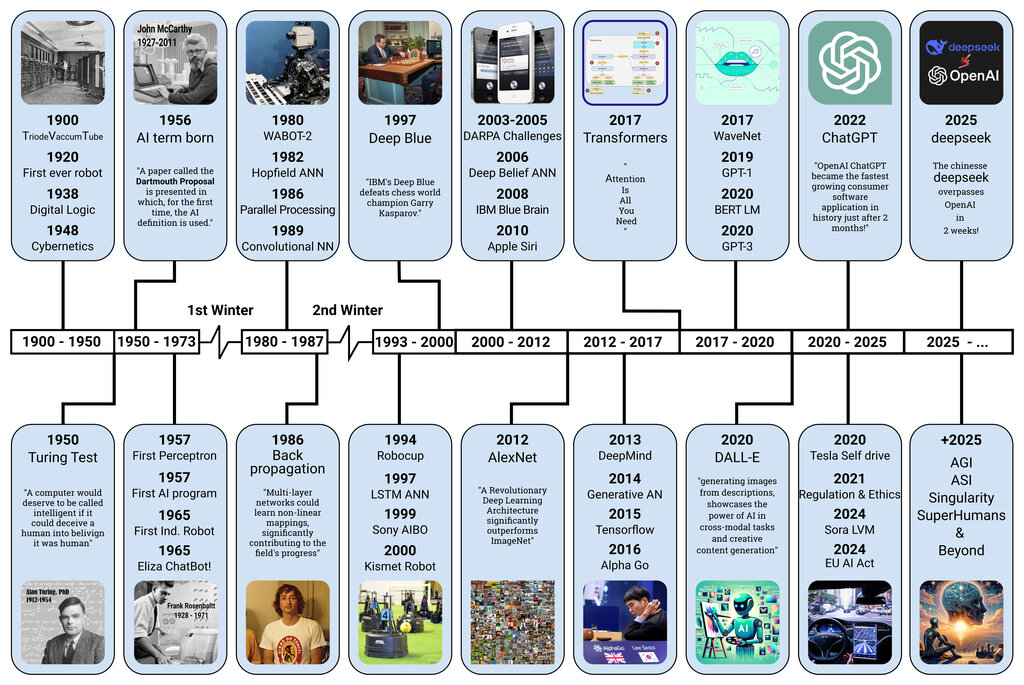
The journey wasn't a straight line. The field experienced "AI winters," periods when funding dried up because progress didn't meet the high expectations. But breakthroughs in computing power and the availability of vast amounts of data eventually led to a resurgence. Today, we are in an AI boom, with new advancements happening at a dizzying pace.
AI in Our Daily Lives
You probably interact with AI every day without even realizing it. When a streaming service recommends a movie you might like, that's AI. When your navigation app reroutes you around traffic, that's AI. It's the technology behind spam filters in your email, voice assistants on your phone, and the fraud detection systems that protect your bank account.
Beyond personal convenience, AI is transforming entire industries. In healthcare, it helps doctors diagnose diseases earlier and more accurately. In agriculture, it optimizes crop yields to help feed a growing population. And in transportation, it's the driving force behind the development of self-driving cars.
The significance of AI lies in its potential to solve some of the world's most complex problems. By processing information on a scale humans cannot, AI can accelerate scientific discovery, improve efficiency, and create new possibilities for how we live and work. It’s a tool that extends our own intelligence, allowing us to tackle challenges in new and powerful ways.
Understanding the basics of what AI is and where it came from provides a solid foundation for exploring this transformative technology further.