Introduction to Artificial Intelligence
Introduction to Artificial Intelligence
What Is Artificial Intelligence?
At its core, artificial intelligence is the science and engineering of creating intelligent machines. It’s about building computer systems that can perform tasks that typically require human intelligence. This doesn't just mean building walking, talking robots from science fiction. It’s about creating systems that can perceive their environment, understand what they perceive, and make smart decisions based on that information.
Artificial Intelligence
noun
A field of computer science dedicated to creating systems that can perform tasks that normally require human intelligence, such as visual perception, speech recognition, decision-making, and translation between languages.
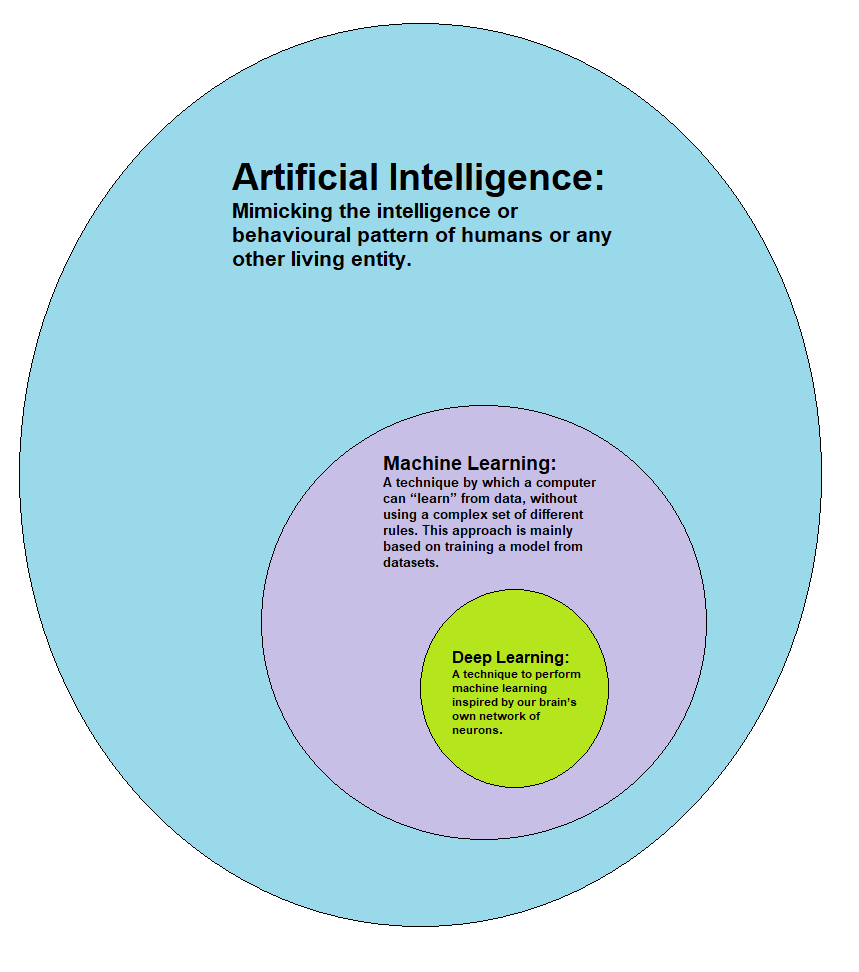
Think about how you recognize a friend's face in a crowd, understand the meaning of a sentence, or learn to play a new game. AI aims to replicate these abilities in machines. To do this, AI is often broken down into subfields. Two of the most important are Machine Learning and Deep Learning. Machine Learning gives computers the ability to learn from data without being explicitly programmed. Deep Learning is a specialized type of machine learning that uses complex structures called neural networks to learn from vast amounts of data, much like a human brain.
A Brief History of AI
The dream of creating artificial beings with intelligence is ancient, appearing in myths and legends for centuries. But the scientific pursuit of AI is much younger. The field was officially born in the summer of 1956 at a workshop at Dartmouth College, where the term “artificial intelligence” was first used.

The early years were filled with excitement and bold predictions. Researchers developed programs that could solve algebra problems, prove theorems in logic, and speak simple English. But the initial excitement outpaced the technology. The limited computing power and data of the time led to a period of reduced funding and interest known as the “AI winter” in the 1970s and 80s.
The field re-emerged in the 1990s and 2000s, thanks to faster computers, new algorithms, and, most importantly, the explosion of data from the internet. This combination allowed machine learning techniques to flourish, leading to breakthroughs like IBM's Deep Blue defeating chess champion Garry Kasparov in 1997. The modern era of AI, powered by deep learning, has given us everything from voice assistants to self-driving cars.
Core Principles and Goals
The ultimate goal of AI is to create technology that can solve complex problems in the world. This broad objective is supported by several core principles and capabilities that researchers are working to advance.
| Capability | Goal | Simple Example |
|---|---|---|
| Reasoning | To solve problems through logical deduction. | An AI solving a Sudoku puzzle. |
| Knowledge | To represent information about the world. | A system that understands the capital of France is Paris. |
| Planning | To set goals and achieve them. | A robot navigating a warehouse to retrieve an item. |
| Learning | To improve performance on a task with experience. | An email filter getting better at spotting spam over time. |
| Perception | To understand the world through sensory input. | A phone unlocking by recognizing your face. |
| NLP | To understand and generate human language. | A chatbot answering customer service questions. |
These capabilities often work together. For instance, a self-driving car uses perception to see a red light, knowledge to understand that a red light means "stop," and planning to apply the brakes. Its learning systems constantly gather data to improve its driving performance over time.
AI isn't a single technology, but a collection of capabilities that allow machines to sense, comprehend, act, and learn.
AI in the Real World
Artificial intelligence is no longer confined to research labs. It has become a part of our daily lives and is transforming nearly every industry.
These are just a few examples. AI is also used in agriculture to monitor crop health, in retail to manage inventory, and in scientific research to accelerate discoveries. As the technology continues to evolve, its impact will only grow, creating new opportunities and challenges for society.
What is the primary goal of artificial intelligence?
Which statement best describes the relationship between Machine Learning (ML) and Deep Learning (DL)?
This introduction provides a starting point. As you continue, you'll delve deeper into the specific methods and models that bring artificial intelligence to life.