Introduction to Artificial Intelligence
Introduction to AI
What Is Artificial Intelligence?
At its core, artificial intelligence is about creating machines that can think, learn, and solve problems like humans do. It’s a branch of computer science focused on building smart systems that can perform tasks that typically require human intelligence.
Artificial Intelligence
noun
A field of computer science dedicated to creating systems capable of performing tasks that normally require human intelligence, such as visual perception, speech recognition, decision-making, and translation between languages.
Think of it like teaching a computer. Instead of giving it a rigid set of instructions for every single possibility, you give it examples and let it figure out the patterns on its own. A programmer might tell a computer exactly how to identify a cat in a photo by coding rules for pointy ears, whiskers, and a tail. An AI, on the other hand, would be shown thousands of cat photos until it learns to recognize a cat on its own, without explicit instructions for each feature.
The main goal is to create systems that can operate intelligently and independently.
A Quick Trip Through Time
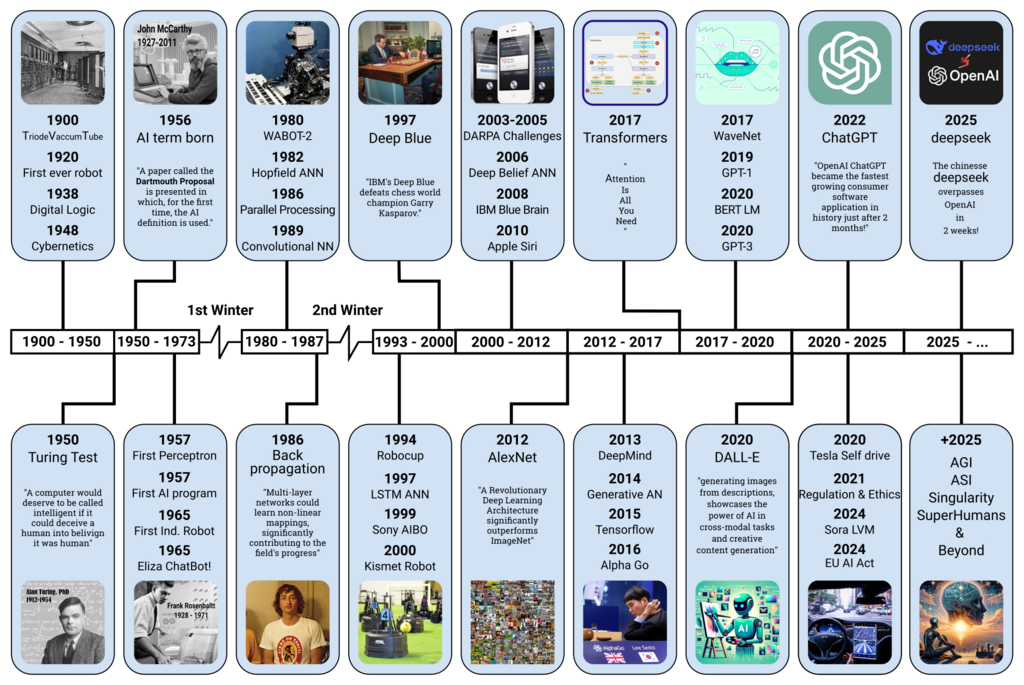
The idea of intelligent machines has been around for centuries, but the actual field of AI officially kicked off in the summer of 1956 at a workshop at Dartmouth College. It was there that the term "artificial intelligence" was coined.
The journey since then has been a series of booms and busts. There were periods of great excitement and funding, known as "AI summers," followed by "AI winters" when progress stalled and interest faded. In the last couple of decades, two key ingredients have sparked a major AI renaissance: massive amounts of data from the internet and the powerful computers needed to process it all.
The Two Main Kinds of AI
AI isn't a single, all-powerful thing. It exists on a spectrum. Today, we generally talk about two main types: Artificial Narrow Intelligence and Artificial General Intelligence.
Artificial Narrow Intelligence (ANI), sometimes called Weak AI, is what we have today. It's an AI that is trained to perform a specific task very well. Your favorite navigation app, the recommendation engine on a streaming service, and a smart voice assistant are all examples of ANI. They are masters of their domain but can't operate outside of it. You can't ask your navigation app for a movie recommendation.
Artificial General Intelligence (AGI), or Strong AI, is the kind of AI you see in movies. It possesses the ability to understand, learn, and apply its intelligence to solve any problem, much like a human being. AGI doesn't exist yet, and it remains a long-term goal for many researchers.
The Basic Recipe for AI
So how does an AI system actually work? While the details can get very complex, the basic structure is straightforward. It involves three main components: data, a model, and an output.
-
Data: AI systems need information to learn from. This can be anything from millions of images to years of sales figures or vast libraries of text. The quality and quantity of this data are crucial for building an effective AI.
-
Model: This is the core of the AI system. It's an algorithm, or a set of rules, that processes the data. During a process called "training," the model analyzes the data to find patterns or relationships. For example, it might learn the patterns that distinguish a picture of a dog from a picture of a cat.
-
Output: After training, the model can take new, unseen data and produce an output. This could be a prediction (e.g., forecasting the weather), a classification (e.g., identifying spam email), or a recommendation (e.g., suggesting a product you might like).
From banking and healthcare to entertainment and transportation, AI is already having a huge impact. It's helping doctors diagnose diseases earlier, enabling banks to detect fraud more effectively, and powering the self-driving cars of the future. This is just the beginning of how AI is reshaping our world.
What is the fundamental difference between an AI-based approach and a traditional programming approach to identifying a cat in a photo?
A navigation app that excels at finding the fastest route but cannot suggest a dinner recipe is an example of what?