Introduction to Artificial Intelligence
Introduction to Artificial Intelligence
What Is Artificial Intelligence?
Artificial Intelligence (AI) is the science of making machines that can think like humans. The goal is to create systems that can perform tasks that typically require human intelligence, such as learning, reasoning, problem-solving, and understanding language.
At its core, AI is about a system’s ability to interpret external data correctly, to learn from that data, and to use those learnings to achieve specific goals through flexible adaptation.
Think of it this way: instead of programming a computer with a rigid set of instructions for every possible scenario, AI allows the computer to figure things out on its own. It's the difference between giving someone a fish and teaching them how to fish.
A Brief History
The idea of intelligent machines has been around for centuries, but the modern field of AI officially began in the summer of 1956. A group of scientists gathered at Dartmouth College for a workshop where they coined the term "Artificial Intelligence" and laid out the field's foundational goals.
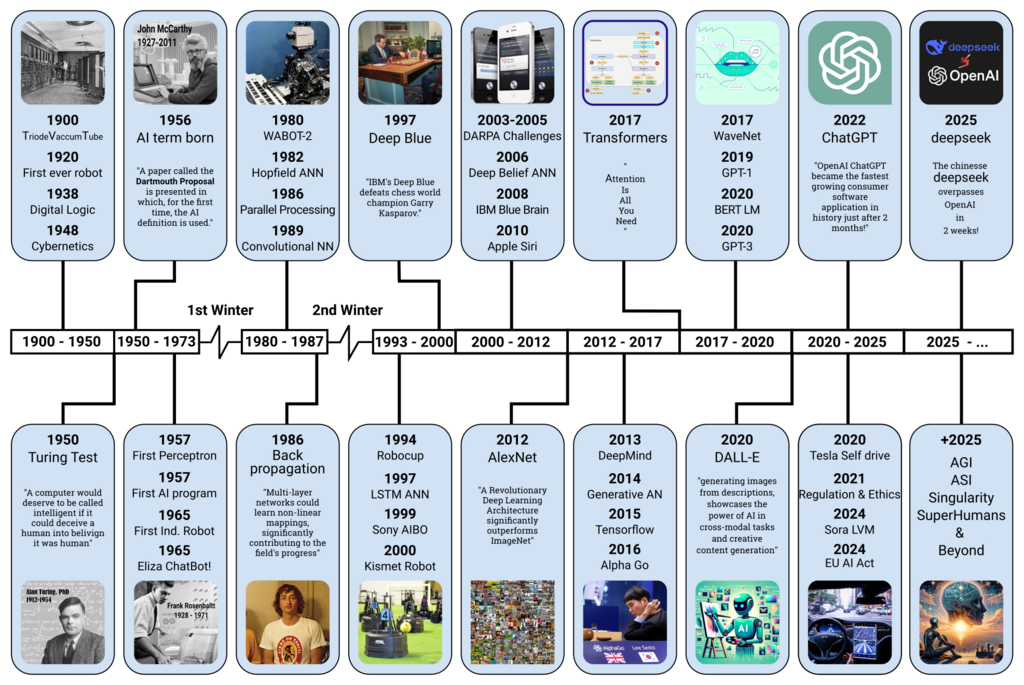
Early AI research was optimistic, focusing on solving complex problems and creating machines that could play chess. Over the decades, progress ebbed and flowed through periods known as "AI winters," where funding and interest dried up. However, breakthroughs in computing power and the availability of massive amounts of data in the 21st century have led to the AI boom we see today.
Types of AI
Not all AI is created equal. Today, we can categorize AI into two main types based on its capabilities: Narrow AI and General AI.
Artificial Narrow Intelligence (ANI)
noun
Also known as Weak AI, this is the only type of AI we have successfully created so far. It is designed and trained for one particular task. ANI is incredibly powerful at what it does, but it operates within a limited, pre-defined range.
Examples of Narrow AI are all around us. The spam filter in your email, the recommendation engine that suggests movies, and the software that recognizes your face to unlock your phone are all forms of ANI.
Artificial General Intelligence (AGI)
noun
Also known as Strong AI, this is the type of AI you often see in movies. AGI refers to a machine with the ability to understand, learn, and apply its intelligence to solve any problem that a human being can. It possesses consciousness and a human-like range of cognitive abilities.
It's important to remember that AGI is still purely theoretical. We have not yet created a machine with the self-aware, flexible intelligence of a human being. The gap between the most advanced Narrow AI and a true General AI remains vast.
| Feature | Narrow AI (ANI) | General AI (AGI) |
|---|---|---|
| Scope | Performs a single task or a narrow range of tasks. | Can understand and perform any intellectual task a human can. |
| Consciousness | No consciousness, self-awareness, or genuine understanding. | Possesses consciousness and self-awareness (hypothetically). |
| Learning | Learns from the data it's trained on for its specific task. | Learns from experience and can apply knowledge across domains. |
| Current Status | Widely deployed in many applications today. | Purely theoretical; does not exist yet. |
Core Components of AI
Every AI system, from the simplest to the most complex, is built on a foundation of three core components that work together.
-
Data: AI learns from data. Just as humans learn from experience, AI systems learn by analyzing vast quantities of information. This could be anything from images and text to numbers in a spreadsheet. The quality and quantity of the data are crucial for the AI's performance.
-
Algorithms: These are the sets of rules and statistical techniques that the AI system uses to learn from the data. The algorithm is like the brain of the AI, processing information and identifying patterns to make predictions or decisions.
-
Computing Power: Processing huge datasets and running complex algorithms requires a lot of computational muscle. Advances in specialized computer chips (like GPUs) have provided the power needed for modern AI to function effectively.
These three components are interdependent. Without data, the algorithm has nothing to learn from. Without the right algorithm, the data is just noise. And without sufficient computing power, the process would be too slow to be useful.
What is the primary goal of Artificial Intelligence?
The type of AI that can perform a wide variety of tasks at a human level of intelligence, and is currently only theoretical, is known as ______ AI.
This introduction provides a foundation for understanding what AI is and how it works. As we continue, we will delve deeper into the specific methods and applications that make AI such a transformative technology.