Introduction to Artificial Intelligence
Introduction to AI
What Is Artificial Intelligence?
At its heart, Artificial Intelligence (AI) is the science of making machines smart. The goal is to create computer systems that can perform tasks that normally require human intelligence. This includes things like learning from experience, solving problems, understanding language, and recognizing objects and sounds.
Think of it this way: we're trying to build machines that can not only follow instructions but can also think, reason, and adapt.
The main objectives of AI are to replicate or simulate human intelligence in machines. This breaks down into a few key areas:
- Learning: Acquiring knowledge and rules for using that knowledge.
- Reasoning: Using the rules to reach approximate or definite conclusions.
- Problem-solving: Figuring out the best course of action for a given goal.
- Perception: Understanding the world through sight, sound, touch, and more.
A Quick Trip Through Time
The idea of intelligent machines has been around for centuries, but the modern field of AI officially began in the summer of 1956 at a workshop at Dartmouth College. There, a group of scientists coined the term "artificial intelligence" and kicked off a new era of research.
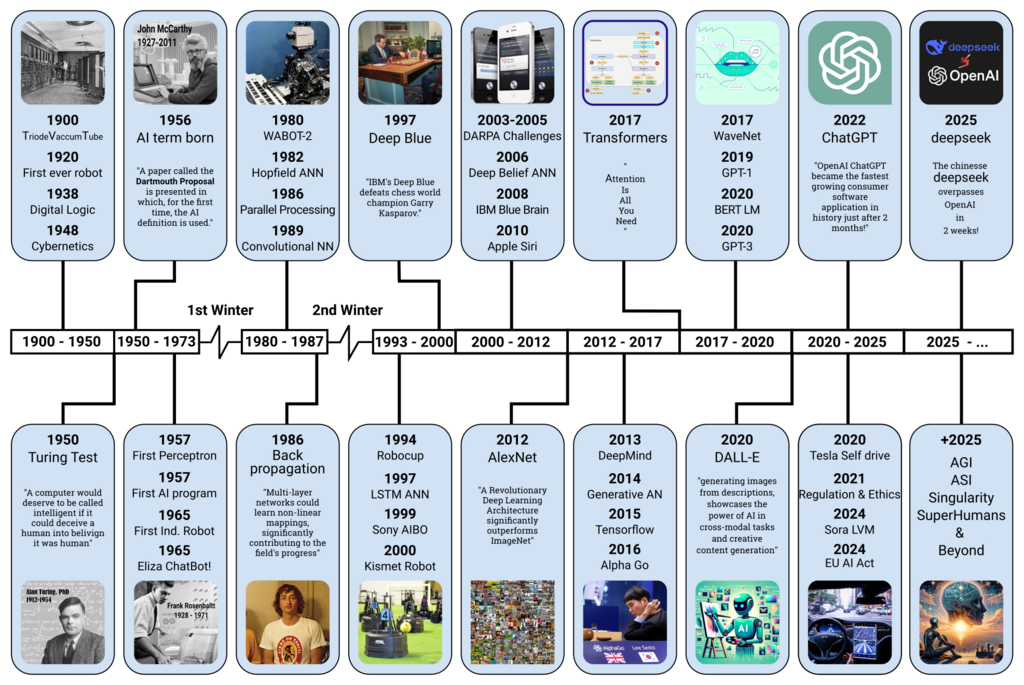
The journey wasn't a straight line. Early excitement led to big promises, but the limits of computer power and theory led to periods known as "AI winters," when funding and interest dried up. However, key breakthroughs kept the dream alive.
In the 1980s and 90s, a new approach called machine learning gained traction. Instead of trying to write rules for every possible situation, researchers created algorithms that allowed computers to learn from data. This was a game-changer.
A major public moment came in 1997 when IBM's Deep Blue chess computer defeated world champion Garry Kasparov. It showed that an AI could beat the best human mind at a complex, strategic game. More recently, the rise of "deep learning" and massive datasets has fueled the AI boom we see today, leading to everything from voice assistants to generative art.
The Different Kinds of AI
Not all AI systems are created equal. They are often categorized by their capabilities. The simplest forms are already all around us, while the more advanced types are still theoretical.
Reactive Machines
This is the most basic type of AI. Reactive machines can't form memories or use past experiences to inform current decisions. They simply perceive the world and react to it.
Deep Blue is a perfect example. It could analyze the pieces on a chessboard and calculate the best possible move from billions of options. But it had no memory of what happened in previous games. Its world was wiped clean after every match.
Limited Memory
This is where most of today's AI applications live. Limited memory AI can look into the past to make better decisions. Their memory isn't permanent, but it's enough to be useful for a specific task.
Self-driving cars use this type of AI. They monitor the speed and direction of other cars, which is information they store and update constantly. This memory of recent events helps them navigate traffic safely. Your phone's voice assistant also uses limited memory to understand the context of your conversation.
Theory of Mind
This is the next level of AI systems that we are still trying to build. "Theory of mind" is a psychology term that refers to the understanding that others have their own beliefs, desires, and intentions that affect their decisions. An AI with a theory of mind could understand human emotions and social cues.
Imagine a robot assistant that could tell you're frustrated and offer help without you having to ask. This kind of AI would be able to interact with humans in a much more natural and empathetic way. It's a major area of ongoing research.
These foundational ideas—from the basic definition to the different types of intelligence—are the building blocks for understanding the complex and fascinating world of AI.