Introduction to Artificial Intelligence
Introduction to AI
What Is AI?
At its core, artificial intelligence is about creating machines that can think or act like humans. This doesn't necessarily mean robots that look like us. More often, it refers to computer systems that can perform tasks that typically require human intelligence, like understanding language, recognizing patterns, or solving problems.
Artificial Intelligence
noun
A field of computer science dedicated to creating systems that can perform tasks that normally require human intelligence.
The idea isn't new. For centuries, myths and stories have featured artificial beings with human-like intelligence. But the scientific pursuit of AI is much more recent, beginning in the mid-20th century.
The Dawn of AI
The journey into modern AI began with pioneers who asked a fundamental question: Can machines think? British mathematician and computer scientist Alan Turing was one of the first to explore this seriously. In 1950, he proposed what is now known as the Turing Test.
The test involves a human judge who engages in a natural language conversation with two other parties, one a human and the other a machine. If the judge cannot reliably tell which is which, the machine is said to have passed the test. This simple idea provided a powerful framework for thinking about machine intelligence.
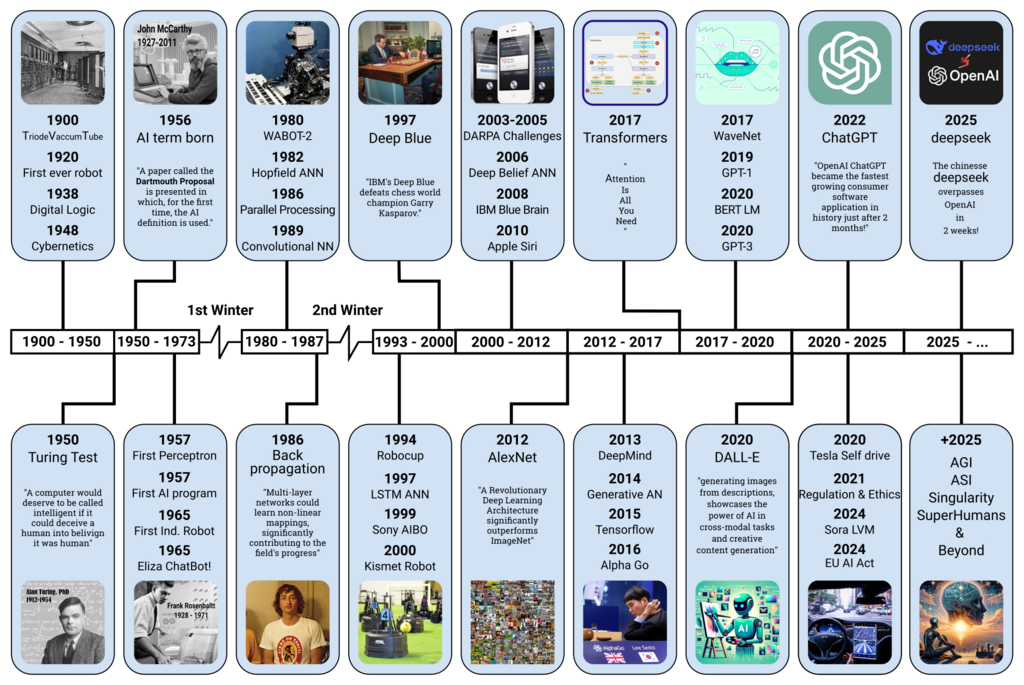
The field got its name in 1956 at a summer workshop at Dartmouth College. Organized by computer scientist John McCarthy, the event brought together a small group of researchers who believed that every aspect of learning or any other feature of intelligence could, in principle, be so precisely described that a machine could be made to simulate it. This workshop is widely considered the official birth of AI as an academic discipline.
Early Experiments
The years following the Dartmouth workshop were filled with excitement and optimism. Researchers developed programs that could solve algebra word problems, prove theorems in logic, and speak rudimentary English. These early successes fueled predictions of rapid progress.
One of the most famous early programs was ELIZA, created in the mid-1960s by Joseph Weizenbaum. ELIZA could carry on a conversation by recognizing keywords in a user's typed comments and reflecting them back in the form of a question. It mimicked a psychotherapist, and some users became surprisingly attached to it, revealing very personal thoughts.
ELIZA showed that a machine could appear to understand language without any real comprehension. It was a clever illusion based on pattern matching.
Another groundbreaking program was SHRDLU, developed in the late 1960s. It operated in a small virtual world of blocks and could understand and execute commands in natural language like "pick up a big red block" and answer questions about its actions. It was a significant step forward in natural language understanding and problem-solving.
Cycles of Progress
The initial burst of progress led to high expectations, but the complexity of creating true intelligence was far greater than anticipated. Limited computer power and data held back progress. This led to periods known as "AI winters," when funding dried up and interest waned.
However, the research never stopped. Each cycle of excitement and disappointment brought new insights and better tools. Breakthroughs in the 1980s and 90s, fueled by more powerful computers, brought AI back into the mainstream. A major milestone occurred in 1997 when IBM's Deep Blue chess computer defeated the world champion, Garry Kasparov. This event demonstrated that machines could solve highly complex problems once thought to be the exclusive domain of human intellect.
What is the primary goal of the Turing Test?
The academic discipline of Artificial Intelligence is widely considered to have been formally born and named at which event?
These historical steps, from philosophical questions to tangible programs, laid the foundation for the powerful AI systems we see today.