Introduction to Artificial Intelligence
Introduction to AI
What is AI?
Artificial intelligence is the science of making machines that can think and learn like humans. The goal is to create systems that can perform tasks that typically require human intelligence, such as understanding language, recognizing patterns, and making decisions.
Artificial Intelligence
noun
A field of computer science dedicated to creating systems that can perform tasks that normally require human intelligence.
At its core, AI isn't about creating a conscious robot from a sci-fi movie. It's about building tools that can process information and make predictions or classifications based on that information. Think of it as a way to simulate intelligent behavior, not replicate the human mind.
The fundamental goal of AI is to enable computers to learn from data and experience, rather than relying solely on instructions programmed by humans.
A Brief History of AI
The idea of intelligent machines has been around for centuries, but the formal field of AI research began in the mid-20th century. One of the earliest pioneers was Alan Turing, a British mathematician who proposed a test for machine intelligence in 1950. The "Turing Test" challenged a human to distinguish between another human and a machine based on their typed responses. If the machine could fool the human, it could be considered intelligent.
The term "artificial intelligence" itself was coined in 1956 at a workshop at Dartmouth College. This event brought together the founding fathers of AI and marked the official birth of the field. Early research was filled with optimism, with researchers predicting that machines with human-level intelligence were just a few decades away.
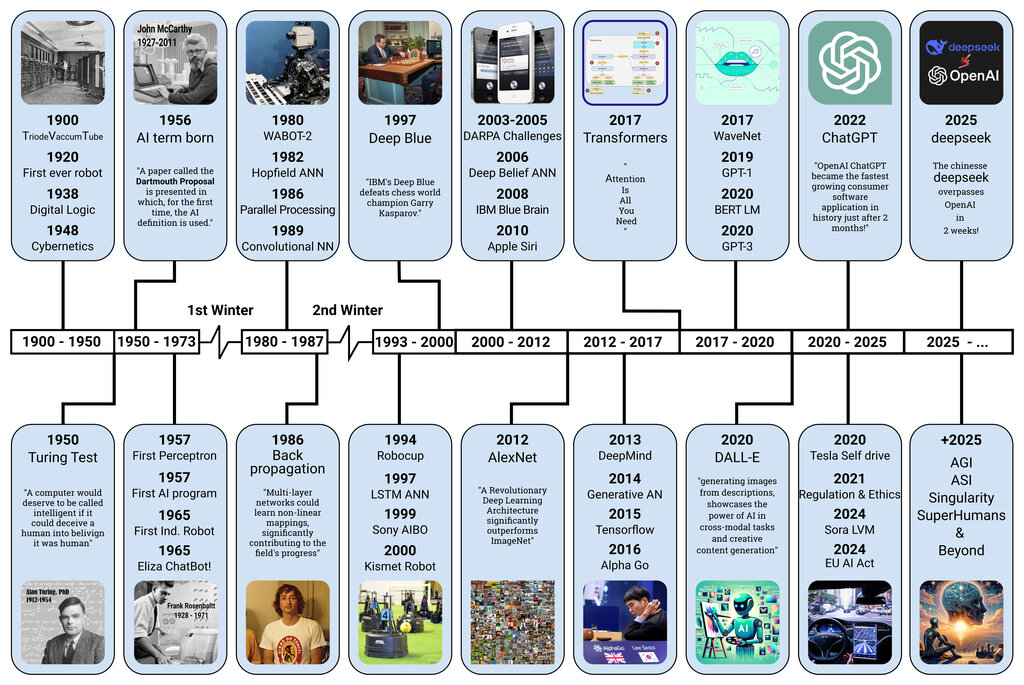
However, progress was slower than expected. The complexity of creating intelligence was far greater than anticipated, and limitations in computing power led to periods known as "AI winters." During these times, funding dried up, and public interest waned.
Everything changed with the rise of the internet, big data, and powerful processors. These advancements provided the fuel AI needed to flourish, leading to the breakthroughs we see today.
The Evolution of AI
AI technology hasn't followed a single path. It has evolved through several key phases. Early AI systems were primarily rule-based. Programmers would hand-write a set of if-then rules for the machine to follow. This worked for simple, well-defined tasks but was brittle and couldn't handle new situations.
The next major leap was Machine Learning (ML). Instead of being explicitly programmed, ML algorithms learn patterns directly from data. This allowed computers to make predictions or decisions without being told exactly how. For example, an ML model can learn to identify spam emails by analyzing thousands of examples of spam and non-spam messages.
Deep Learning is a subfield of machine learning that uses structures called neural networks, which are inspired by the human brain. These networks have many layers, allowing them to learn complex patterns from vast amounts of data. Deep learning is the engine behind many modern AI marvels, from voice assistants to self-driving cars.
Most recently, Generative AI has emerged as a powerful new frontier. These models, a type of deep learning, can create new content—like text, images, or music—that is often indistinguishable from human-made work.
Why AI Matters Today
AI is becoming a general-purpose technology, much like electricity or the internet. It's not just a tool for computer scientists; it's a force that is reshaping industries and daily life. The significance of AI lies in its ability to automate complex tasks, find insights in massive datasets that humans could never process, and solve problems in new and innovative ways.
Understanding how AI works is no longer just a technical skill. It's becoming a fundamental part of modern literacy. As these tools become more integrated into our world, knowing their history, capabilities, and limitations is essential for everyone.
Understanding AI's historical development provides essential context for navigating its future.
Now, let's test your knowledge on these foundational concepts.
What is the primary goal of artificial intelligence, as described in the text?
The term "artificial intelligence" was officially coined at a workshop held at which institution in 1956?
This introduction covers the basic ideas that form the foundation of artificial intelligence. By understanding its definition, history, and evolution, you're ready to explore its more advanced concepts and applications.