Introduction to Artificial Intelligence
Introduction to Artificial Intelligence
What is Artificial Intelligence?
Artificial intelligence, or AI, is the science of making machines that can think or act like humans. The goal is to create systems that can perform tasks that typically require human intelligence, such as learning, reasoning, problem-solving, and understanding language.
It isn't just one field of study. AI is an interdisciplinary blend of computer science, mathematics, psychology, and cognitive science. It borrows ideas from how our own brains work to build intelligent software and robots.
At its core, AI is about creating systems that can interpret data, learn from it, and use that knowledge to achieve specific goals through flexible adaptation.
A Brief History
The idea of intelligent machines has been around for centuries, but the modern field of AI officially began in the mid-1950s. Early researchers were optimistic, believing that a machine as intelligent as a human being could be built in just a few decades.
Progress wasn't always a straight line. The field went through periods of high excitement and funding, known as "AI summers," followed by periods of disappointment and budget cuts, called "AI winters." Despite these ups and downs, key breakthroughs continued to push the field forward. From programs that could play checkers to chess-playing computers that could defeat grandmasters, AI has steadily grown more capable over time.

Today, thanks to massive amounts of data and powerful computers, AI is more integrated into our lives than ever before.
Two Main Types of AI
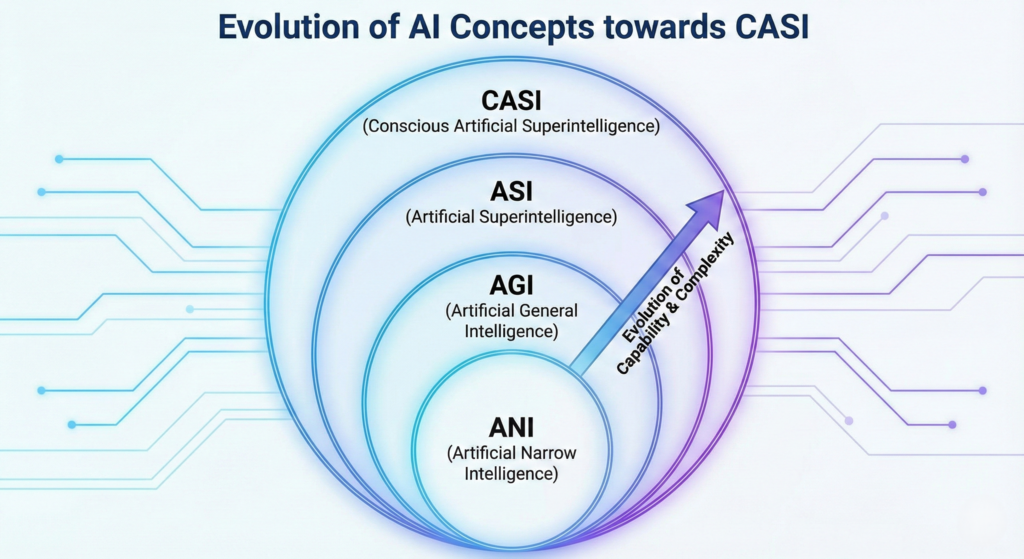
When people talk about AI, they are usually referring to one of two main types: Narrow AI and General AI.
Narrow AI
noun
Also known as Weak AI, this is a type of artificial intelligence that is trained to perform a specific task.
This is the only kind of AI that exists today. It excels in its designated area but has no intelligence outside of it. A spam filter is great at catching junk mail, but it can't order you a pizza. A facial recognition system can identify people in photos, but it can't write a poem. These systems are specialists.
Then there's the other type, which is still theoretical.
General AI
noun
Also known as Strong AI, this is a type of artificial intelligence that possesses the ability to understand, learn, and apply its intelligence to solve any problem, much like a human being.
Artificial General Intelligence (AGI) is the stuff of science fiction—a machine with the same broad, flexible intelligence as a person. It could learn any intellectual task that a human can. Building an AGI is the ultimate goal for many in the field, but it remains a distant prospect for now.
AI's Impact on Our World
AI is no longer just a laboratory experiment. It's a powerful tool that's reshaping industries and daily life.
In healthcare, AI helps doctors analyze medical images like X-rays and MRIs, often spotting signs of disease that might be missed by the human eye. This leads to earlier diagnoses and better treatment plans.
In finance, AI algorithms work around the clock to detect fraudulent credit card transactions, protecting consumers and banks from theft. They also analyze market trends to inform investment strategies.
In transportation, AI is the brain behind self-driving cars, processing information from sensors to navigate roads safely. It also powers navigation apps that find the fastest route by analyzing real-time traffic data.
These are just a few examples. From entertainment recommendations to smart assistants in our homes, AI is quietly working in the background, making many aspects of modern life more efficient and personalized.
Now, let's test your understanding of these foundational concepts.